 |
|
|
by Chaya Geles
Translated by Sara Mages
Seemingly, Gorzd was a town like all other towns in Lithuania. Wooden houses, mostly one-story and very low, hyssop grew the roofs and from a distance the roof looked like a flower garde. Nevertheless, there was something special and different in my town from other towns.
Its uniqueness was in its vibrant social life, in the pleasant relations between people, and perhaps also in the development of most of its residents as opposed to the population in nearby towns. This development was probably caused by its proximity to the German city of Memel and the surrounding area. The German border passed right at the edge of our town.
I loved my hometown and wonderful memories of its life are etched in me. I will never forget our small house. My father, Pesach Furman, was an honest and perfect Jew. The store was located inside the house. There he repaired and sewed shoes and boots for sale to the villagers who came to our house on Sunday on their way to church, and on Thursdays - market day.
In those days, our house was full of drunken gentiles, and I was very afraid of them.
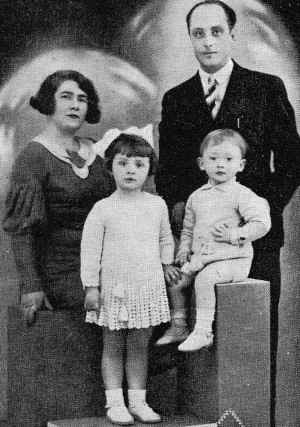
Our small house excelled in its cleanliness and the joy of life that reigned in it. My mother, Bat-Sheva, was very devoted to her family. She was lean and delicate with caressing eyes. She radiated her good personality on us, the children, and on everyone who came to our house. We were five children: Elchanan, Ozer, Chana, Zev, and me Chaya. Unfortunately, today I am the only one left. My three brothers immigrated to Eretz Yisrael and passed away in Tel Aviv. My sister, Chana, perished in the Holocaust with her husband and their two children. May HaShem avenge their blood, and may their memory be blessed!
I will never forget the Sabbath and holidays in our pleasant home. I remember the many preparations every Friday. My mother baked, cooked and cleaned the house with the help of the gentile woman who worked for us several days a week. On Friday afternoon the house was shiny, and the Sabbath foods gave their scent. The table was covered with a white tablecloth and on it were candlesticks and Shabbat candles. The children were washed and dressed festively in honor of the Shabbat. Happiness shone from our mother's eyes when she looked at us. I had a special role
[Page 154]
on Shabbat eve and the holidays: to bring poor families the Shabbat food that my mother sent them. My father and brothers went to synagogue, and we at home felt the Divine Presence near us. And on Shabbat morning, neighbors and relatives came to visit us after our father, mother and brothers returned from synagogue. I remember the group who sat there, among them were Elia Asher, Shlomo the tailor, my uncle Ben Zion, and others. My mother served them brandy and cake, chopped liver or stuffed fish. The box of snuff passed from hand to hand because they didn't smoke on the Shabbat. All members of the group talked and discussed world news and current affairs, all in peace
|
|
and quiet. On Shabbat evening, when my father returned from the Maariv [evening] prayer he conducted the Havdalah service before us. My mother removed the candlesticks and the white tablecloth from the table, and then I felt as if the Divine Presence left the house.
The atmosphere of the holidays and festivals in our house is well preserved in my memory. I see before me the eve of Tisha B'Av. Many women gathered at our home waiting for my mother to read the lamentations to them. They all sat on stools; their heads wrapped in headkerchiefs listening to the reciting of to the lamentations. They shook their heads and wept over the destruction of the Holy Temple. How sad I was that evening!
The High Holidays left a deep impression in my heart. The blowing of the shofar at the synagogue on Rosh Hashanah, the fast and “Kol Nidrei” prayer on Yom Kippur.
On Yom Kippur eve my father made sure to hold the kapparot ritual for each
[Page 155]
of us. He lifted a white rooster, and a white hen, and waved them over our heads. At the final meal before the fast, our mother asked us to eat a lot so that we wouldn't be hungry the next day.
How great was the holiday of Sukkot in all the town's homes. The sukkah was permanent structure which was used throughout the year to store various belongings. In preparation for Sukkot we
|
|
cleared out all the belongings and decorated it. The town's children competed among themselves to see who would have the most beautiful sukkah. Our father brought an etrog and lulav from the synagogue and blessed them with us at home. The holiday of Hanukkah is etched in my memory
[Page 156]
when it was bitterly cold and frosty outside, but warm and cozy inside. The Hanukkah candles in the window illuminated the whiteness of the snow. Relatives and friends sat around the table, played cards and tasted my mother's good food.
Many were the preparations for Passover - cleaning the entire house, whitewashing and endless polishing. The melting snow and the spring weather added to the joy. My mother was careful and made sure that we would not bring leavened food into the rooms that had been prepared for Passover. My father conducted the chametz test in every corner of the house and I accompanied him. I loved all the days of Passover in our house for the beautiful tableware and special foods.
A celebration in the town, such as a wedding or a circumcision, was everyone's joy. We, the children, brought cakes as gifts to the celebrants. A wedding ceremony was held near the synagogue and all the townspeople participated in the joy.
All of this was and is no more, the German Nazis and their helpers destroyed everything without leaving a trace. But they could not murder the beautiful memories. They remained engraved deep in my heart, because I loved my town.
[Page 155]
I Think of You
Translated by Theodore Steinberg
|
I think of you and see you with eyes that recall. The beginning of ripe summer days lies over the world, and like a blue, searching wing the dawn spreads, glows and grows on houses, on trees, on flowers as children would come together.
It's still early–on Yom Tov the town sleeps in.
Here a cleaned shirt, an ironed suit,
Today is Yom Tov. The shops and stores are closed.
The streets await, the woods, the river near the garden. |
[Page 156]
|
Has the town forgotten its holiday? Will children no longer play and no Jews go to shul and no doors open up?
Will children not come together |
[Page 159]
Memories
by Moshe Drori (Rupel)
Translated by Sara Mages
I was born in 1915 to my parents R' Liber and Chaya-Rachel Rupel. My midwife was Teme. When I grew up, the midwife told me that my parents paid her with a large loaf of bread.
I remember myself from the age of three and a half. The “Shtiebel-Rabbi,” an old man with a white beard, came to us and his from vest pocket peeked a smooth straight white bone – the teitel [pointer]. He held the teitel in his trembling right hand, pointed it at each letter, and taught me the alphabet with nikkud [vowel signs] and called out: kamatz-alef-ah[1]! And I repeated each and every letter after him accompanied by a melody. When I pleased my grandfather, R' Nechemia Leibe z”l, my mother's father, he threw a few kopecks over my head and said: “an angel is throwing the kopecks from heaven as a gift for studying well and for being a good boy.” Of course, I always tried to be a good student and a good boy.
I first saw my father, R' Liber, when I was five years old. One day my father, who was a medical officer in the First World war, returned and I was already studying at the cheder. The day my father came home my mother z”l said: “children, today we will have great joy at home.” When we asked what she meant, she replied: a bird knocked several times on the window, and when our father suddenly arrived without any prior notice, it was proof that the bird heralded his arrival.
We were four children then. Two girls: Sara-Feige z”l and Yentka may she live long, my brother Abeka z”l, and me Moshe, may I live long. After a while, my parents had three more daughters: Toibe Atne z”l, Heanke Rivka z”l, and Dabale, may she live long, who is in Russia.
Gorzd was a small and vibrant town. Carters and their passengers traveled from Riteve [Rietavas], Plungian [Plunge], Vizeic [Vėžaičiai] and other places whose names I have forgotten over the years. To Memel, a big city with big shops and beautiful streets. Merchants from surrounding towns purchased all kinds of goods there, but they all had to pass through Gorzd. The carters traveled in convoys because they were afraid to travel alone through the dense forests because of attacks by murderers and highwaymen. Even though
[Page 160]
the distance from Riteve to Gorzd was thirty-five kilometers, they traveled all night on difficult routs. Their first stop was in Gorzd to feed the horses and rest from the difficult and tiring road.
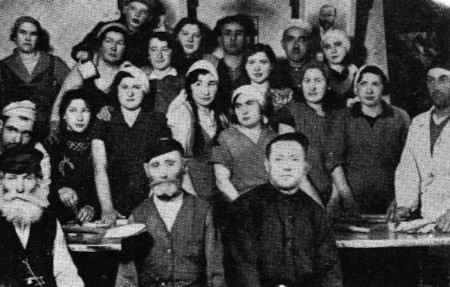
The carters filled every inn from which a little light shone. At Aronstein and at R' Biere Velvel Milner. Even though the latter was a baker it was possible to find a cup of hot tea at his place. A large part of Gorzd's Jews made their living from the city of Memel. Some had shops, and others made a living by marketing fruits and vegetables of all kinds to the residents of Memel. Another part made a living in Gorzd. There were grocery stores, bakeries, hardware stores, and a milliner. Watchmakers, one of whom I remember, David (der zeyger-makher). There were two blacksmiths, Are der Smyd and Itza der Smyd. And I think that on Tamoczne Street, next to Feive der Muler, was a Christian blacksmith. Feive built ovens and repaired them, and when his daughter got married, he taught the profession to his son-in-law. His laborer was Itzel'e Hage Mires, who mixed the material into mortar with his feet and his pants were rolled up to his knees.
In Gorzd were Talmud Torah (cheder), elementary school (di shule), synagogue (di shul), the old Beit Midrash and next to it the shtiebel. The teachers at Talmud Torah were R' Peite z”l, the teacher Danishbeski who moved to Gorzd from Plungian, and young teachers who changed from time to time. In the first lesson we prayed and then we learned the other subjects. At Talmud Torah we studied from seven in the morning until noon with a break for a meal break at home. At two-thirty in the afternoon we returned equipped with lanterns, which had a candle inside, to light the dark the road at night as we returned home.
There were a lot of scholars in Gorzd. R' Velvel der Rav, R' Leib der Rav, Velvel Stoch, R' Yosel Furet the slaughterer, R' Ali the slaughterer, David der zeygermakher, R' Yakov Boorstein, R' Gershe Feive, and many more whose names I don't remember. Three minyanim[2] prayed at Beit HaMidrash on weekdays. In the first minyan prayed those who hurried to set off on their journey. Many times it was possible to see a Gorzd's Jew sitting in a cart, wrapped in a tallit and tefillin, and praying as the horses made their way safely.
Young and adults, who had time at their disposal, prayed in the second minyan prayed.
Elderly Jews and scholars prayed in the third minyan. This minyan was called
[Page 161]
the rabbi's minyan. Beit HaMidrash was filled with people all day long and never closed during the day. The shamash (Yose Elie der Shamash) opened the Beit Midrash at four o'clock in the morning and locked it late at night. In the afternoon, and at dusk, members of the Shas[3] Society studied the Six Orders of Mishnah and Talmud under the guidance of R' Gershe Feive.
There were also - Mishnayot Society, Ein Yaakov Society and Tehillim Society.
On the Shabbat they only prayed in one minyan. The synagogue and Beit HaMidrash were filled to capacity. Young people, who were not religious and few communists, came to the prayer to honor their parents. On Shabbat evening, Beit HaMidrash was noisy and bustling. At a large table, on the right, they studied the Gemara. Opposite it they recited Tehillim, and next to the stoves stood tables and there they studied Mishnayot and Ein Yaakov. In Gorzd was a cantor named Barken. He was a slaughterer and a cantor. He had choir for the High Holidays and for a short time I was one of the singers.
The cantors were Velvel Stoch, Leibe Preides and my father z”l. In Gorzd was a society of “Tiferet Bachurim” [“The Beauty of Youth”] headed by Alter Magid. He lived here in Israel and here he passed away. There were yeshiva students who studied at various yeshivot: David Pil, Ze'ev Shavel, Yehudah Furet, Shlomo Milner who was killed in the War of Independence, and me. When I returned from the yeshiva for the Passover holiday or for Sukkot, my father took me to the city rabbi to test my knowledge, and when Rabbi Shabtil pinched my cheek, my father knew that I had not disappointed him. Then, he took me to a second tester, to R' Gershon Yenkes, who was a great scholar and probably lost his two legs in the First World War. R' Gershon Yenkes was a wealthy Jew, handsome and noble. He arranged a minyan for prayer on Shabbat eve and holiday and on many occasions my father z”l as a cantor for him. They were also friends. On the Shabbat and holidays two Jews carried R' Gershon Yenkes to Beit HaMidrash. One of the carriers was Hatzale Duchas and another whose name I don't remember.
In Gorzd was a big park called Der Garten. In the summer, on the Shabbat, it was possible to meet all the townspeople there, mothers with their babies in their arms, children, teenagers, adults and the elderly. When they felt that the time for the Mincha [afternoon] prayer was approaching, they hurried to run to the synagogue. If I was late, prayed alone and arrived home for the Seudah Shlishit[4], my father asked: where were you at Mincha, and when my answer was not clear to him, he asked: who was the cantor of the Mincha prayer?
In Gorzd there were warm-hearted and hospitable Jews. Beggars also
[Page 162]
loved to come to Gorzd for the Shabbat, because they were sure of receiving a good warm hospitality. The Jews of Gorzd were good Zionists in their heart and soul. The first immigration from Gorzd to Israel started in 1920. Gorzd Jews generously donated to Zionism, Keren Kayemeth LeIsrael [JNF] and Keren Hayesod [United Israel Appeal]. They donated a lot of money to yeshivot and various institutions. In every house in Gorzd it was possible to find various charity boxes. In our home there were no less than twelve charity boxes.
There was a fire brigade in Gorzd and the commander was Shcpitel, a handsome old bachelor. Sometimes, on Sundays, he held a demonstration and all the volunteers were called to the sound of the trumpet.
A huge fire broke out in Gorzd in the middle of the night. Half of Tamoczne Street, with all its houses, burned to the ground. The fire broke next to my grandfather's, R' Nechamya, house. His neighbor, Mende Flack, was a spirit smuggler and at night, when they were filling bottles next to burning candles, the fire broke out. Those were the rumors. My grandfather's two houses went up in flames. One on Tamoczne Street and a smaller house on the courtyard side. Why was the street named Tamoczne Street? The border passed at the end of the street towards Laugal [Laugalia] which was in Prussian territory, and there stood the border guards and customs inspectors. This was called Tamoczne.
There were three matzot bakeries in Gorzd:
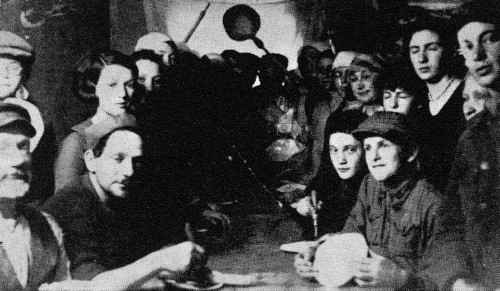
One bakery belonged to Shaprinze de Schvartze, one to Zalman and one to my parents. My parents provided matzot to the residents of Gorzd, and most of the matzos to Memel. Baking the matzo was a unique experience. Preparing the oven, bringing water from wells and transferring it to wooden barrels. The water was brought after sunrise, and it was only permitted to be used the next day. The water had to be mayim shelanu, meaning water that has slept overnight[5]. They worked in three shifts. The third shift, which started at midnight, was the most interesting. Women and teenage girls flattened the matzot. Also Christians.
“Whoever has not seen the joy of the Torah has never seen rejoicing in his life.” All the societies, Shas, Mishnayot, Ein Yaakov, Tehillim and Chevra Kadisha drank and ate until they were drunk. The main joy was at the rabbi's house where they heard biblical discourse and beautiful melodies. The melody of, “Offer up sacrifices of righteousness and trust in the Lord” [Psalms 4:6] still echoing in my ears.
The Rabbi of Gorzd was citizen number one. He was awarded the greatest honor. The
[Page 163]
|
|
rabbi blessed the bride and groom who arrived accompanied by an orchestra from their homes to the courtyard of Beit HaMidrash. Every Shabbat he was the third to make aliyah to the Torah, and when he walked from his place in the Mizrach [east] towards the bimah, the worshipers stood up. On Rosh Hashana the rabbi read the tekioth to Ba'al Tekiah [shofar-blower] R' Yosef Furet. When the rabbi passed away, all the townspeople, who were in different places at the time, came to participate in his funeral. The workshops were closed, and young and old attended the funeral of the rabbi zt”l.
There were two doctors in Gorzd: Dr. Oxman and Dr. Eglishtein. Miche der Blinder, who was blind in both eyes, also lived there. My role on Friday, to the age of fifteen, was to place the candlestick with the two candles in front of him. I lit the candles and he blessed them. I led him to Beit HaMidrash and brought him home after prayer. I had another role on Shabbat eve, to bring fish and challot to Beila de Toibe and her daughter, the old spinster, Ita.
Gorzd you were beautiful and nice.
You warmed your residents.
[Page 164]
Gorzd you were saturated in Torah,
In your crown they were bound and strengthened in valor.Gorzd, you remained naked,
And salvation wasn't obtained for you.Gorzd, we'll never see you again in your glory.
The city of Gorzd is gone – only its memory.I remember Gorzd, and I cried out when I saw gentile Gorzd built on its place,
And the religious Jewish city of Gorzd humiliated to the abyss of its grave.
Translator's footnotes:
[Page 165]
My Town Gorzd
by Dobka Duks (Blank), Canada
Translated by Theodore Steinberg
Gorzd, the town where I was born and raised. Gorzd, the town of my childhood and youth. Gorzd, which was and which remains now only in our memory.
I was born to very poor parents, but we never knew hunger. My father was a hardworking man. He labored on the Minija River and in the winter he worked at the train station, where he loaded and unloaded goods that came on the trains.
At times, when he had no work, he would go to the Gentiles in the villages to help them with their farm labors. He received no money from them, only farm products. He would come home for Shabbos with packs full of food, and with those he fed his family.
My mother, a good, devoted mother to her children, would satisfy us with good food, and we felt no needs at home.
Many times my father would bring a guest for Shabbos, someone who was staying in town for Shabbos or a yeshiva student who stopped there for Shabbos on his way to his yeshiva. My mother would greet the guest with a smile, give him a friendly welcome, and see that he was satisfied…
Our town was small, but quite nice. One could traverse the whole town in a quarter of an hour, from one end to the other. The walk began at Tamoszena and went to the market, and then…you were out of town.
The shtetl lived like a family. Everyone knew each other's joys and woes. One felt no difference
[Page 166]
Between poor and rich. And the town's Jews also lived in peace with the Gentiles.
|
|
In Gorzd there was a beautiful garden where the whole town would go walking. Especially on Friday evenings and on Shabbos was the garden full of strolling people, mostly young people.
During the summer, the town was covered with greenery. The air was redolent with the aroma of flowers, and everywhere the laughter of the strolling young people was heard. During the long winter months, we would get together at the Tamoszena. The whole town was covered with brilliant white snow that shimmered at night in the moonlight. It looked like the whole earth was covered by a silver cloth.
[Page 167]
We felt none of the antisemitism that existed in other towns. We knew nothing of pogroms. We lived our lives, without shocks, until the German Angel of Death erased from the surface of the earth our innocent town, killed its Jews so that only mass graves remain of our former Jewish Gorzd.
I, my sister, and my brother had a large share of the Gorzd Jews who were cut off: dear parents, our brother with his wife and children, our cousins with their families, and many other friends and acquaintances. I will never forget them as long as I live. The wound will bleed and drip for us for as long as we live.
Our beloved Gorzd is no more. Her dear, kind Jews are no more. Of the town, no memory remains–a large mass grave–but in our memories Gorzd lives as it was before.
[Page 168]
Dreams in Autumn
by Yudika
Translated by Theodore Steinberg
|
1.
Far away…far away…my town perished.
Never has day replaced night,
The first person in human form
Generations and ages, for thousands of years 2.
The sun moves as always over the earth |
[Page 169]
|
It wanders and visits each shining roof where the eternal game played out of mothers who bustle, clean, and cook conceiving, bearing, and raising children.
Of hammers banging in the shoemaker's shop,
It passes away with the day
and hears whether people speak in the stillness of night
If somewhere a couple wanders in its light
But all is still over the ruins and graves.
The moon turns her face away, |
[Page 170]
|
A song rises from the ruins– A dead mother sings for her dead child. 3.
Just as woman, spinning her wool,
Those rays illuminate.
A shul rises from the ruins,
The burnt forms of men and women
Rooms come alive with life, 4.
But suddenly from afar, on twisted roads, |
[Page 171]
|
the puffs like little white clouds speckled like devious eyes.
“Look,” I cry out, “atomic killers!
And the number of people increases, 5.
Fog covers near and far
Indistinct, his body covered by fog,
He raises his hands to block the smoke–
A blue-yellow light shines on his heart, |
[Page 172]
|
I stand amazed and cannot remember where I've seen that face before– a Jewish face, with Jewish sadness– was it a picture? A man?
And a voice is heard near and far
“Misfortunes will come to your ways!
“Shelter from storms will be set free
And then a bitter war will come __ __ ___ ___ __ __
Everything will float away…everything pass away. |
[Page 173]
Memories of my Home
by Aryeh Leib Dikson (Diksas)
Translated by Theodore Steinberg
Having long been away from my old dear home for many years, I see many things hazily, hard to recall. But I remember very well a difficult, poor, but excellent life at home with my parents.
I remember my father, a hard laborer, a hard worker, not a craftsman, who could hardly feed his family from his job. But despite the difficulties, my mother never complained about her fate when it was so hard when it was so hard for my parents to raise their children in such poverty.
When my grandmother died, my mother welcomed our grandfather into our home. He was badly paralyzed and could not move.
Our house, which consisted of a single room and a small kitchen, was too small for six people: my grandfather, my parents, and we four children [sic: there are seven of them], but we children never heard any discontent, never a bad word between my parents. My parents treated each other with great respect, always with love, and quietly and surely. And we children sensed and understood their good relationship, as we were raised in a good, warm atmosphere in our home.
I remember the Friday nights at home. We could feel Shabbos in every corner. A Shabbos spirit filled the house. As poor as we were, my mother worried that everything should be totally good for Shabbos.
After eating, we would sit around the Shabbos table and one of us would read a book aloud, a book we had taken from the town library. Usually it was stories by Shomer, which everyone liked because they were so out of the ordinary. This was our greatest pleasure.
[Page 174]
When I began to learn a trade, it made things easier at home. I began to earn a little and I could help my parents. I contributed to the household and our material conditions improved somewhat. But the time came when we had to be practical. The time came when it was impossible to remain at home. We had to tear ourselves away and venture into the wider world.
The first of us went to Canada with the help of our uncle, then my sister and then another sister. But in the early 30s, the situation in Canada was also not easy. It was difficult to get our lives in order. There was no work, and we were worn out.
We wanted to bring our parents to us, but in those conditions it was impossible, and we waited impatiently for things to improve so that we could be together with our parents.
Time passed, and our parents remained in Gorzd, and meanwhile the heavy, bitter destruction approached. Who could know and be prepared for the fact that we would never again see our dear parents, our brother and his wife, and all of our dear Jews in the town, our comrades and friends: Hilla Mann's family and the friends of my youth: Arka Rufel, Kadishka Tzin, Barka Shanka, Berele Veke's children, and everyone else.
All were killed at the hands of the Hitlerist executioners and their Lithuanian accomplices. Our whole family was cut off, along with all of Gorzd's Jews. No more Gorzd–our dear town of Gorzd. We will never forget them. May these lines be an eternal monument for our dear parents, our brother Ben-Tzion and his wife, and all of Gorzd's Jews.
Sacred be their memory.
[Page 175]
Experiences
by Rashel Oysher
Translated by Theodore Steinberg
“Gorzd, my town of Gorzd”--I often go over that well-known Yiddish song “Belz,” recalling with longing and pain my own town of Gorzd, where I was born and raised. There where my cradle stood and where I passed the best time of my childhood and youth.
Although the destroyed and rebuilt Gorzd is not at all like the former old Gorzd, in my thoughts and in my memory, our old, beloved town lives with its low houses and with the several hundred horribly murdered Jewish families, so innocent. They stand as if still living before my eyes and it seems that the brutal reality if only a dream and that when I will awaken from this nightmare I will again be in Gorzd with my unforgettable dear family, near ones, and beloved friends and comrades. To their memory and to the memory of our town of Gorzd will l dedicate these recollections.
Kleifeder Street 52.
In a low, close to the earth little dwelling of two small rooms we lived until the fire, a family of 9 people.
Our father Eliyahu (Elia), a shoemaker, would sit from early morning until dark working in his workshop. Our mother Sarah a sickly woman, would always be occupied in a dark corner of the dwelling that served as the kitchen.
My father's work was not enough to feed this large family, and we children were forced early to begin to work and earn money to help out the family.
[Page 176]
On Sunday morning, the older children would travel to Memel (Kleifede) to work, and only on Friday night would the whole family come together at the Shabbos table.
A Pesach seder lingers in my mind: joining my large family at the holiday table were my grandmother, Etta-Beila, my aunt Feiga-Guta, and my uncle Sholem with his family. Late into the evening we sang like a good chorus the Haggadah songs, and when the last song of the Haggadah, “Chad Gadya,” was completed, we suddenly heard from under the window loud applause. We children quickly ran to the window to see who was doing this, and we were amazed when I saw under our window a large group of people who were standing there, interested in hearing our singing…
Our family was industrious and we all got along. We always lived with the desire to make aliyah to Eretz Yisroel, but actually only my brother Tzvi fulfilled that desire. He made aliyah when he was 19. Tzvi devoted his whole life to the building of the state of Israel. He lives in Kibbutz “Amir” in the Upper Galilee together with his family and grandchildren.
Also my older sisters Tzvia and Tovah and their husbands went to a training area for alizyah, but they were prevented from going by the “White Book.” My parents, my brother Gavriel, as well as my older sister, along with their families, were killed as innocent victims at the murderous hands of the Hitlerist murderers and their Lithuanian accomplices, may their names and memories be effaced. My sister Simma was killed in a concentration camp in Germany.
Eternal memory to my family.
The sacred memory of my dear, cut off family will stay with me until my grave.
[Page 177]
On the Threshold of My House
by Yudika
Translated by Theodore Steinberg
|
On the threshold of my house lie roads in different directions– a little aslant, one from Memel, another toward Krettinger. Between those roads stands the house where I live– painted brown, a glassed-in porch, and flowers blooming by the house.
Houses that stand in rows,
Wagons laden with hay go by
Far from the Laugale field
On the threshold of my house |
[Page 178]
Gorzd, My Town (in Lithuania)
by Ella Zilberg
Translated by Theodore Steinberg
|
A town, my town, how dear your name to me. Who will think of you again, who will remember you?
When we are no more,
Your tiny streets |
|
|
JewishGen, Inc. makes no representations regarding the accuracy of
the translation. The reader may wish to refer to the original material
for verification.
JewishGen is not responsible for inaccuracies or omissions in the original work and cannot rewrite or edit the text to correct inaccuracies and/or omissions.
Our mission is to produce a translation of the original work and we cannot verify the accuracy of statements or alter facts cited.
 Gargzdai, Lithuania
 Yizkor Book Project
 JewishGen Home Page
Copyright © 1999-2026 by JewishGen, Inc.
Updated 15 Sep 2026 by JH