|
|
|
[Page 117]
by Arye Frak
Translated by Gloria Berkenstat Freund
A dynamic Jewish life pulsed in Gorzd, as in all other Jewish shtetlekh [towns], between both wars. This Jewish life was mirrored particularly in the framework of institutions, unions, organizations and a series of philanthropic groups, which bore the character of a kind of self help. However, the very distinct strength of the cultural center in the shtetl was unquestionably derived from the Zionist parties of all affiliations.
Their activities began in the second half of the 1920's until the capture of the Memel region by Hitler Germany on the 22nd of March, 1939.
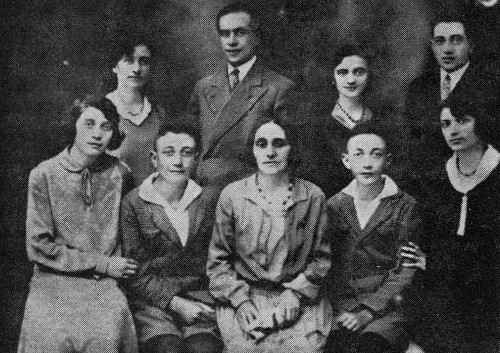
The first party that was founded in Gorzd was the Ts. S. Party (Zionist Socialist) that was more active and influential than any other in Gorzd. Later, a split in the party took place that divided itself into Ts. S. Welt Farbund [Zionist Socialist World Union] (which was called the Linke [left]) and the Histahadut Ts. S. [Union of Zionist Socialists] – (the royte [red]).
The leaders of the Ts. S. Welt Farbund were:
Chairman: the Hebrew teacher Dovid Kutlubski.To the leaders of Histahadut Ts. S. belonged:
Members of the Council: Ayzik Frydheim, the Vilna tailor (the son-in-law of Zisha the tailor), Mordekhai Leibovits, Shmeya Ilitovits and Shlomo Prak.
Mikhal Melamed, Sheinberg, his brother-in-law, Ayzik Wolfovits, Alter Ornshtein, the Gutmans' son Mikhal and others. Generally, both parts[Page 118]
|
|
lived together in peace and ran the large Jewish library together.
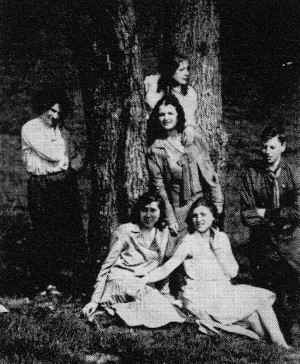
During those carefree years, many Gorzder emigrated to various countries such as America, South Africa and, mainly, to Eretz-Yisroel. This meant that as a result of the storm of emigration, the human potential of the parties was weakened. However, beginning in 1928 a certain revival of the party work with the influx of young strength was noticed. The religious party, Mizrakhi [religious Zionists], developed particularly animated work.
Halutzim [pioneers] from Mizrakhi, Agudas Yisroel [non-Zionist orthodox movement] and others worked in agriculture and other work. They went through hakhshore [training to prepare for emigration to Eretz-Yisroel] and prepared for a productive life in Eretz-Yisroel.
[Page 119]
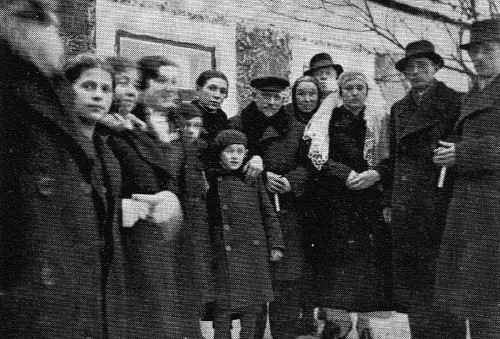
The Mizrakhi organized Oneg Shabbos [Joy of Shabbat], Minyon Shabbos [group of 10 men to prayer on Shabbat], Kebalah Shabbos [welcoming of the Shabbat]; religious and popular songs from Eretz-Yisroel were sung, songs on Biblical motifs and they also spent their free time in collective dance. But all of this was interrupted by the capture of the Memel region by the Nazis. Then the terror for the Gorzd Jews, who found themselves near the German border, began.
Returning to Gorzd from Memel, the Jews lost their source of existence and the young tried to organize in the large cities in Lithuania: Kovno, Shawl and others. I, personally, did not see any purpose for remaining in Lithuania and looked for a way to emigrate to Eretz-Yisroel. As is known, the gates to Eretz-Yisroel were closed and I made my way to Eretz-Yisroel through illegal emigration, thanks to the help of my good friend in Memel, Shlomo Zilberstein and his brothers, Moshe and Josef. After an exhausting three and a half month trip through various lands I arrived on the shores of the country, but I was interned in a camp for a month by the English.
During the above-mentioned period, major activities were carried out by the sports unions: Makhabi, Gigant and Tzeiri Hatakhia [Youth Reborn].
Makhabi had a large site at the sports area in the garden that during the war years, 1914-1918, belonged to Count Volmer. In this location, the Makhabi organized dance evenings, literary evening readings, discussions and so on.
Competitions would take place with the Memel sports union, Bar Kokhba, with the German sports union, with the Neustadt Makhabi, Skhod [Skuodas] and other shtetlekh.
The leaders of Makhabi were:
Zisl Markovits, the younger brother, Yudke Ornshtein, Aba Zusmanovits.
[Page 120]
|
|
Players: Leibl Luria, Ruwin-Leizer Beinigson, Feiwl Zusmanovits, Henakh Ban, Naftali Frak, who was an agile player and also a good sportsman with various sports equipment, Avraham Glojn, Josef Asherovits, Heshel Ornshtein and others.
In addition, the enlightened, educated youth founded a small sports union that was given the name Tzeiri Hatakhia. The leaders of Tzeiri Hatakhia were:
Zisl Shus (the son of Yankl Shus), Yitzhak Gutman, Avraham Ornshtein, Maks Wolfovitz and Asher Herc.
[Page 121]
Library
The organized youth also presented performances and the income from them would go in support of the Hebrew Library that was organized in Gorzd. Sam Saks took great interest in the library. The book fund was increased thanks to the large sums of money that he sent from America.
The librarians were: Malkala Ornshtein, Ruchl Zismanovits, Ester Furt, Ester Danishewski and Ida Erman. The library wandered from one room to another First it was in the public school; later with Hatsa Javshic. The third place was on the second floor with Mendl Luria near the Talmud Torah [school for poor boys] and at the end with the widow, Hena, across from Elihu Asher. (I do not know where the library was located after my departure from Gorzd.)
The philanthropic institutions, Linas haTzedekh [accommodations for the needy], Bikor Kholem [help for the sick], Sa'ad LaAniyim [aid for the poor] had one purpose: to help the needy and sick people and they bore a self-help character.
Two men were sent for a night shift as soon as it was learned about a sick person in a family, in order to free the family members from a sleepless night and in order to serve the sick one. Food, free remedies and free medical treatment were brought to the houses of poor, needy families.
With Bikor Kholem – that was a branch of Linas haTzedekh, and Maos Khitin [matzo for the needy at Passover] was actually administered by the kehile [organized Jewish community], gabbaim [rabbi's assistant] and the rabbi of the Beis haMedrash [House of Study and Prayer]. It was a custom from ancient times that matzo and everything that was needed for Passover was sent to the poor. The money used for this purpose was from offerings and secret donations. The income from the theater presentations also supported this purpose.
[Page 122]
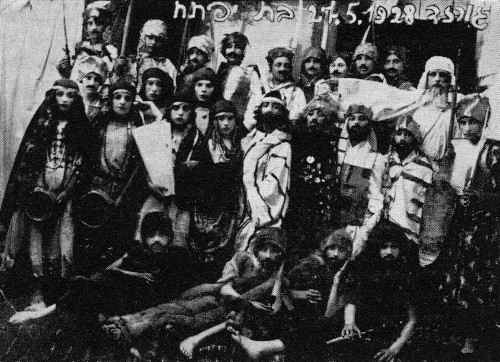
Dramatic Section
The founders of the dramatic section were Zalman-Leib Rubinstein and Josef Blech, both very bright talents for acting on the stage. Artists from Kovno, who appeared in interesting plays, would come to Gorzd many times.
The actors of the dramatic section were:
Shemya Ilitowitch, Rywka Man, Josef Osherowitch, Shmuel Ornstein and others. When Zalman Leib Rubenstein emigrated to America, Josef Blech replaced him as director. Sura Frak performed beautifully in various roles. Yehuda Leshem also excelled in various role and particularly as Avigil in the operetta, Shulamis [by Avraham Goldfaden]. Hantsa Glik played Shulamis, Avisholem was played by Chemes and the sorcerer was played by Ayzik Urias who was very successful with the audience. Other gifted artistic vigor was shown by Alter Ornshtein and Hantsa Akerman.The income from the presentations would go to support needy, poor people, impoverished men who would be supported in secret.
In as much as Gorzd was built mostly of wooden houses, fires broke out often in the shtetl and the firemen had their hands full of work. Kalman Zilber was the fire chief, the second was Shepsl Blis and also the Zismanovitses. The Firefighter Command consisted of volunteer, young, healthy men, Jews and Lithuanians. The practice by the poszsharnikes [firemen] brought vitality to the shtetl when they would go out on the then old machines with full barrels of water in shining brass helmets with their uniforms and the public watched with great interest how the agile firemen
[Page 123]
climbed ladders and extinguished objects, as if they were putting out “a real fire.”
Gorzd was a pious shtetl. The most sacred spot for Gorzd Jews was the Beis-haMedrash [house of study and prayer] with a large room full of casks of holy books, Talmud, Khumishim [plural of Khumish – Torah] bound with parchment, books of Psalms, Mishnayos [rabbinical commentaries] and other sacred books. There were also a large synagogue, a Talmud Torah [religious primary school, usually for poor boys] and a small synagogue. (After the First World War, the synagogue and Talmud Torah were rebuilt with bricks after the fire, but the area of the small synagogue remained empty.)
There were many learned men in Gorzd. The head of the yeshiva was Reb Yitzhak Katsin; later he and his family emigrated to Eretz-Yisroel. (His daughter, Dora is there.) Young and old went en masse three times a day to pray collectively in a minyon [10 men required for prayer]. On Shabbosim [Sabbaths] and the Days of Awe and other holidays the houses of prayer were overflowing with worshippers.
We related to Rabbi haGaon [the sage] Shabatai Shapira with great respect and reverence and not only the Jews, even the Lithuanians related to him with great respect and when they would encounter him strolling in the garden they would greet him with great respect. His sermons were very rich in content, sharp and full of passion…
In Gorzd there were many of the righteous pious. Reb Leibe der weiser [the white one] (Yehudis Leshem's grandfather), Reb Leibe, der shwartser [the dark one]; Reb Elihayu the shoykhet [ritual slaughterer]; the Rebbe Brener (he later lived in Memel) and Feiwl Brener, his son, who was an important employee in the Memel People's Bank; Reb Betzalel and his son, the child prodigy; Reb Zabulun; Reb Gershon-Feiwe Faktor; Reb Bere Welwe Milner and the Rabbi, Reb Yakov Burshtein; Reb Flatus; Reb Shmuel Ben-Tzion; Reb Feite the Shamas [assistant to rabbi] of the Beis-haMedrash and Reb Josef-Elihu the Shamas with
[Page 124]
his son the child prodigy; Reb Hirshe Itse Shralovits; the “shtibl [small, one room synagogue] rebbe” and great sage, Reb Heshl and many others.
This was the old generation in Gorzd that had a great influence on the Jews of the shtetl.
Particularly well liked were the Beli Tefillah [men who lead prayer- Baal Tefillah is the singular form] – messengers for the community. Their praying was full of heart and feeling. It is enough to enumerate several of them such as Reb Josef Furt, the shoykhet, Reb Yitzhak-Lieb Kac, a good Baal Tefillah with a beautiful voice (he was called Itse Leibele); Reb Yehoshua-Yakov Lurie (Shaya Yanke Lurie); Zalkind with his magnificent voice; Reb Moshe Osherovits – a good Baal Tefillah, Torah reader and later also the shoykhet and Reb Welwele Shtoch, who would pray with feeling and to this day I still cannot forget his Musef Yom Kippur praying. His liturgical poem from Aseret Harugei Malchut [Ten Martyrs] would evoke tears from the worshippers. I also remember the priestly blessing of the teacher, Dovid Lam and his son Yasha. (Here the kohanim [descendants of Aaron, the priestly class] sang solo and the community of worshippers repeated after them.) Yasha was among the enlightened young men. Later he studied at a Lithuanian gymnazie [secondary school] in Kovno and he gave a fiery speech in Lithuanian on the 16th of February, the day of the Lithuanian national holiday, and even the Lithuanians admired him. It is worth mentioning the khazan [cantor], Reb Yakov Bar Kohan on whose stamp was printed “ûber-kantor.” He actually was a good khazan with a magnificent voice and on the Days of Awe he prepared a good choir with superb voices and among them, Zivik, who had a strong bass voice, Shmuel Ornshtein, Mendl Man and others.
A kind of holiness reigned in the Beis-haMedrash when the khazan prayed with his choir and the crying and pleading from the women's section added to the holy atmosphere.
[Page 125]
There were various religious societies in Gorzd as in other shtetlekh in Lithuania, Khevre Gemara [society to study Talmudic commentaries], Khevre Mishnaius [society to study the compiled oral Torah], Khevre Tehilim [society to recite Psalms] and the Khevre Kadishe [burial society]. The Jews in these societies studied in the Bote-Medrashim [houses of study and prayer] and studied with authorities such as Reb Gershon Feiwe, sometimes also the Rabbi, Reb Shabatai, Reb Josef Puret, the shoykhet [ritual slaughterer], the head of the yeshiva, Reb Yitzhak Katsin and the Rabbi, Reb Yakov Burshtein. Jews reveled in his Talmud lessons; pearls truly poured from his mouth.
Those listening to the lessons were: Reb Eliezer-Moshe Wolwovits, a respected businessman, and his son, Ayzyk; Reb Hirshe-Itse Shrolovits; Reb Leibe-Hirsh – a respected Jew; Reb Mende-Falkes Frak, a Jew, a sage and a clever man and a giver of good advice; Reb Zisie Zusmanovits – a respected and very esteemed businessman. Dovid the lightmaker, Leizer Itsik's son, Reb Moshe Kurbman, a Jew, a God-fearing man; he would shout out his Shema Yisroel [Hear O, Israel – the central prayer of Judaism] with a strong voice so that the walls shook. He would give secret gifts to former Jewish businessmen, who later became impoverished. Only a few chosen ones knew of his support. Here in the land [Eretz-Yisroel], he was also a distinct Jew who was involved in the religious circles of the city.
Jews who studied a page of Gemara and Mishnaius privately could also be seen in various corners of the large Beis-haMedrash. Everyone was in his usual corner. Josef Hilel Shulman – a Jew, an owner of a building materials business; who in Gorzd did not know this good Jew? Yakov Gamzu – a Jew, a sagacious scholar of Talmud and a follower of the Enlightenment; Eliezer Shuster, a Jew, an artisan, but he was versed in the Gemara. Once I went into his house; I found him sitting at work and on the workstand lay an open Talmud treatise, Brokhus. Thus, he also learned while working. Elihu Ahser – a Jew, a sage and a scholar and a giver of good advice. Reb Yitzhak bar [son of] Welwe, Welwe's son Bere, Dovid Feil, Zev Shavel.
[Page 126]
Eliezer Akerman – Shakhne Akerman's son – was a Jew, a maskil [follower of the Enlightenment] and read many secular books. He was the chief bookkeeper for the People's Bank in Gorzd and a member of the Kehile [organized Jewish community], and a member of the Kehile council with the previous teacher, Dovid Kutlubski, Josef Furt and, I think, also Epharim Markovits.
Khevre Kadishe [Burial Society]
The gabbai [assistant to the rabbi] was Bere Wolf and also Ephraim Markovits. Reb Josef Ornshtein (the father of Avraham Ornshtein), Hirshe Ornshtein, the old Dovid Frak with his white beard had the duty to bring his purification tools from the poor house; he liked to perform the mitzvah [commandment]. During the summer he was an orchard keeper for his entire life and during the winter he dealt with hides. He died at the very old age of 90.
The Khevre Kadishe was greatly respected in the shtetl. The Jews of the Khevre Kadishe did their work with a great spirit of sacrifice and dedication in order to give respect to a Jewish burial.
Celebrations
The Jews arranged a large, kingly celebration every seven years after the Siem Shas [celebration of the completion of the study of the Talmud]. Klezmorim [musicians] played without stopping. The tables were full of all kinds of good foods like roasted goose, fish, herring, challahs and cakes and fruits of all kinds. Jews rejoiced and heard sermons from the gabbai and from the Rabbi, Reb Shabtai. The celebration of the Siem Shas was remembered for a long time
All of Gorzd came to the Bote-Medrashim on Simkhas Torah [fall holiday commemorating the completion of the yearly Torah readings]. Jews sang and the hakofus [circular procession with the Torah scrolls] in Gorzd had a good reputation. The Gorzd Jews were transported en masse by the joyful atmosphere in the shtetl; they permitted themselves to drink wine and whisky until they became drunk. They ate and drank as much as their hearts
[Page 127]
desired. The prayers and singing were heard far into the streets and alleys of the shtetl. It seemed that the entire shtetl was filled with Simkhas Torah…
There was also a Tiferes Bokhurim [Splendid Young Men] in Gorzd who consisted of young businessmen. They had a separate minyon and studied a page of gemara together and did various work in the religious communal area.
[Page 128]
Memories of My Town Gorzd
by Ita Arman (Kamil)
Translated by Sara Mages
I dreamt a dream: I am standing in a vast stubble field after the harvest. The sun is blazing and from a distance three figures are getting closer and calling toward me: wait for us! don't move away! who knows if we will meet again!… I woke up. I saw my hometown before me, the green fields around, the figures.
In my imagination I see my hometown, Gorzd, where I spent my childhood and youth. I see the main street that runs from the market square to the small train station in Laugaliai. Here stretched the border between Lithuania and Germany until after First World War. From here sprawled another world: white, well-kept houses with red tiled roofs, clean roads leading to the city of Memel [Klaipeda].
Early in the morning, after the Shacharit prayer, Gorzd's carters loaded their carts with vegetables, fruits, and meat, and transported their goods for sale in the big city. In the evening, they returned in carts loaded with the city's best as ordered by the town's shopkeepers: a barrel of salted fish and sacks of flour to one, or thick rolls of cloth for Tova-Leibe's manufaktura shop.
The overseas mail arrived at the post office in Laugaliai, and for us, the girls, it was like a holiday to go and ask about the mail, a walk of several kilometers. Along the sides of the road were canals, and in the puddles of rainwater grew purple forget-me-not flowers with yellow hearts. We loved the flowers. We tore them into clumps to place them in a dish of water with a stone in the center and enjoyed watching how the flowers “stood up” in their growth. Across the canal, the May lilac trees bloomed in purple and white, filling the air with a wonderful fragrance.
The little train left the village Laugaliai to the city of Memel. It crawled slowly and few were its wealthy passengers. The “common people” joined the carters for free transportation… I remember that near the train, a tall, bony German woman was wandering, and her blonde hairdo was pulled high in the
[Page 129]
|
|
old-fashioned way. It was said about her that she was a bit “crazy,” and called her Frau Chola [sick]. Her name was used as a derogatory name in fights between the girls.
The distance between Memel and Laugaliai was 17 kilometers. When we arrived in the city through the “Stone Gate, cement pillars on both sides of the road, we entered a bustling world, a new world for us. A port city on the shores of the Baltic Sea. From there, fresh and salted fish of various kinds were imported for the Jews of the surrounding towns to diversify their menus.
For the holidays, we received new clothes that our parents purchased in the fancy stores owned by German Jews, who had been rooted in the town for generations. Later, Jews from surrounding cities settled in Memel and young men and women flocked to it to find employment.
On a side street in the Jewish Quarter was Beit HeHalutz [Pioneer House]. The center of the halutzim [pioneers] from the hakhshara[1] who trained themselves in the many German estates in the district
[Page 130]
towards making aliyah to Israel. Beit HeHalutz was filled with Zionist youth dressed in ragged clothes, half-starved but happy.
Up the long main street, on the right side stood our school. a clean white wooden building with long windows, inside a garden of fruit trees. We started our first year of school at a German school, a compulsory school. I remember the first textbook with colorful pictures from Grimm's fairy tales: the witch with Hansel and Gretel, etc. This book greatly fascinated us, and was engraved in our memory together with the rest pleasant and unpleasant memories…
In 1920, the Germans withdrew and the city of Memel, and part of the district called Osproisen, passed under Lithuanian control. Then, a Hebrew elementary school was founded with a kindergarten teacher in the first grade. We had three teachers, the oldest among them was the teacher, Lem, who came from outside. He was tall and sturdy, had a shiny bald head, and he frightened us. During the lesson there was complete silence in the room. He punished us for every noise and movement, and woe to those who had difficulty learning. The main punishment was standing in the corner by the white stove, a punishment that was a burning insult… He also cursed in Russian and Polish and oppressed us. When I saw him on the street approaching from afar, I moved to the second sidewalk. He also cursed his daughter Rachel'ke and called her Karoba (cow). She was a beautiful, tall girl with big brown eyes. He oppressed us mostly when we were little. With the passage of time, as we grew older, our relationship with him improved. I befriended Rachel'ke and even visited her home. The teacher Lem was a good mathematician and also taught us geography and general history. He earned a recognition in the last days of his life. It has been told about him that he was among the handful of men who rose up against the German invaders in the last week of the month of June 1941, the day of the destruction of the community of Gorzd.
The Hebrew and Bible teacher was Horowitz, dark-skinned, thin, small, and sprightly, and behind his back we called him “the Turkish Hen.” Twice a week we learned the Lithuanian language from the man, Pablovsky, who was tall, thin and a little stooped. It has been told about him that he had a lung disease. We didn't take the Lithuanian language seriously.
On harsh winter days, when cold winds and snowflakes whipped my face and made it hard to breathe, I walked with my head tilted to the side until I reached school. When we finished elementary school, we continued to study with
[Page 131]
private teachers, mostly the German language. Next to our house stood the house of Chaya Hinda's - a small, quiet, modest woman with a white headkerchief on her head. She had an only daughter, Hinda, who was called Hinda Chaya's. Her husband spent most of his years in South Africa, suddenly he appeared, stayed at home for a while, and returned to where he came from. Hinda the teacher was taller than her mother, blonde and pale. When we came for a lesson, her mother, Chaya, served her gogll-mogl in a glass of milk, after all, it was an effort to teach a lesson to two girls…
|
|
Malka, my best friend, was an only daughter and had three brothers. Her parents owned a large grocery store, which was in the front of the house, and the residential apartment was behind it. Wooden stairs led from the kitchen to the second floor, to the two bedrooms. There we often spent our time talking, reading, and exchanging intimate secrets.
[Page 132]
She was too rich to leave her family. Her father took care of her future. She was promised a respectable dowry, but the groom was late in coming because he had to be exceptional… Her loving parents gave her a pleasant and comfortable life, and the murderers' machine gun killed them after tortures of hunger and hardship. Malka, the glamorous, playful, carefree blonde.
In the spring, when the snow melted, the stream near our house and the Mann's family overflowed its banks. The square in front of the houses, which was lower than the road, was flooded and resembled a vast river. The windows of Chaya Hinda's house were at a height of meter above the ground and the water penetrated into the apartment. We took off our shoes and socks and peeked through the window to see the special sight of the floating stools in the middle of the room.
The school was located on “Temozhna” Street, which means border in Russian. Next to it stood a small hut painted in red, white and black stripes, and inside it they inspected the returnees from Memel to collect customs duties. I don't understand how a Russian and a German guard lived together in the customs hut. My grandmother Frida, who was called Frida Reuven's after her father's name, told us that during the First World War Russian soldiers took up residence in her spacious living room. She made barter deals with them in bread, vodka and alcohol. Later, German soldiers invaded and expelled the Russians… in this manner the armies changed from time to time.
Up the street lived my two aunts, two sisters who married two brothers from the Ackerman family. My aunt Chana-Rucha and uncle Muta, aunt Ita-Chaya and uncle Bara lived in two low wooden houses next to each other. The entrance to aunt Ita-Chaya was through a long, dark corridor that led to a backyard, but the corridor was divided as an entrance to two families, the family of Bara's brother, Baruch and his wife Sarah Gitta. Each apartment had a living room and a bedroom where the families raised their many children. I must say that Sarah-Gita' small kitchen of, about two square meters, shone with its cleanliness. In the corridor, next to the kitchens, stood large wooden barrels filled with water that Itza, the water drawer in the town, supplied the residents.
In the bedroom stood two beds arranged with pillows and blankets to the height. She had four daughters and three sons. Two sons and the eldest daughter emigrated to America.
[Page 133]
Baruch died at a young age and the family subsisted on support from America. In the hallway stood a ladder that led to the attic and the chickens, which roamed the yard all day, climbed there to lay their eggs. One of the daughters, Bilka, was a prankster. She discovered that the chickens call out our aunts' names when they lay their eggs. Once they called Kuh-ka-ka-ka aunt Rocha and once, Kuh-ka-ka-ka aunt Chaya. This is how our aunts knew who the eggs belonged to.
One of the Ackerman's daughters was my friend Malka. She had blue eyes, big and innocent, and was delicate and fragile. She married at a very young age to a neighbor's son, who was older than her, after a seven-year courtship. She settled in the town in a house across the street, until the German murderers came and took her out of there with her many children. Also my aunt, Ita-Chaya, the tall and slender who knew hard work and fatigue and raised a tall, beautiful daughter Yehudit, and three sons with round faces and smiling eyes, mischievous and happy, were executed on a fine summer day. None of them came back. The gentle daughter, Ita, with the big blue eyes and wondering gaze, daughter of Hanna- Rocha, and three more children. The youngest daughter, Brach'le with innocent big brown eyes, of the sickly weak aunt whose husband, Muta, had always been in love with her, just like that… even if she was no longer able to properly supervise her household… How did they accept the terrible sentence? What was in their hearts when they were driven from their warm nest into the fields, to the forests, to the swamps, to hunger, to illness and grief? Who can write about this?…
Uncle Bara, strong man, the smiling, who was content with what he had and didn't ask for more, left every morning in his cart to the city to bring livelihood for his family. How they, he and his three young sons, were uprooted from life. They were murdered on the very first day, there on the hill by the lilac trees near the main road leading to Memel, the road he traveled in his cart for many years.
Our house stood down in the street. On one side flowed a narrow stream with clear water and yellow sand at its bottom. Before Passover we washed the holiday utensils in it, and also afterwards to store them for next year. The large wooden barrel full of water stood in a shed at the entrance to the kitchen, and Itza, the water drawer, filled it up. He was fat and short, always dressed in a light brown coat and a rope tied around his waist, his image never changed… When we were children, we teased him with songs that we wrote about him, and as children we called him by the derogatory name Itza der Bul (Itza the Bull).
[Page 134]
He called all the boys by the name “Peipka,” and the girls “Tzipea.” He brough to our kitchen a sack full of stale bread to toast it in the big oven. My grandmother served him a bowl of soup. But where did he sleep? Probably in our cowshed attic and in the winter in the synagogue. Has he ever bathed? Maybe for Passover or Rosh Hashanah at the public bathhouse. He never got sick, but he had a hump from the pole he carried on his back. He was probably a native of the town, a poor orphan, an only son…
In front of our house stood the fire department hut and in it the fire engine, and when a fire broke out young people volunteered to put it out. I remember that a fire broke out one summer night in the priest's estate in the market square next to the church. My father immediately bundled the bedding and placed it in the middle of the living room. All other belongings were packed to save them in case the fire spread. The fire didn't scare me because there was a kind of magic to it. On a summer night, tongues of fire rose into the sky, and all the townspeople, old and young, gathered to watch it. It was an unusual, even a fascinating sight… and in the same fire department hut, Charlie Chaplin's silent films were shown for the first time.
In my imagination I see my grandmother, Frida, returning from a visit to her daughters. She is walking down “Temozhna” Street, approaching slowly, and her eyes wandering around as she walks here and there. She passes by the houses of her sisters and sisters-in-law, and I watch her from afar. She raised us with devotion and endless love. On winter nights, she warmed our blankets in the stove and placed a hot brick in bed to warm cold feet. On Friday she got up early in the morning to bake the rolls to provide us with them when we went to school, fresh and warm, spread with melted butter. She knitted socks for us with her back leaning against the warm stove on winter nights. She dozed off while knitting out of fatigue as her head was resting on her chest. I don't remember if she complained about her difficult life being a widow. She didn't resent her fate for having to raise two families, me and Yanke'le, who was three months old when we were orphaned by our mother .She kept him in her bed to warm him and raise him. Our grandmother gave us a warm home. She loved life, a beautiful world, a world full of light, but she always said, there is no escape from the dark pit that awaits us.
On the Shabbat, she sat by the window Tz'enah Ur'enah[2] in Yiddish in her hand and read parables and legends about kings and
[Page 135]
princesses. I also loved reading them in my childhood. On the High Holidays, Rosh Hashana and Yom Kippur, she was very proud of me because I read the prayers before her in the Holy Language at the women's section in the synagogue. And we, the children, called her to come home from synagogue on Yom Kippur to give us a meal, and I was amazed at her willpower not to taste anything and fast to the end of the holy day.
In front of our house, across the road, stretched a deep-water lake. On its other side stood Aaron Hirscha, the tall and sturdy blacksmith, and his sleeves were rolled up. He worked in the smithy and sparks of fire flew when he touched his hammer to the hot iron. The farmers from the surrounding area brought him, especially on market day, carts to repair, horses to shoe, and sleds to repair in the winter. In the winter the lake froze, we skated on the ice, our cheeks burned from the cold and there was great joy.
After the snow melted my friend Malka and I went to the fields behind the smithy to collect screws, nails and colorful pieces of broken porcelain. I brought them home and hid them under the bed. After we sorted the nails and screws, we sold the to the two blacksmiths and bought sweets with the money we received. It was a closely guarded secret because if the families had known, we would have been punished. We were used to playing outside because we didn't know what toys were. My aunt sewed a doll for me, but the doll was made of black fabric, and it frightened me.
There was a belief in the evil eye - when a baby was born, amulets and notes with mysterious verses written on them were hung above the mother's bed. This was the work of the “expert” in the evil eye, for erysipelas on the skin and all kinds of ailments. He was trusted more than the only doctor, Dr. Egelstein, who also extracted teeth. As a souvenir of him, I was left with hollow places in my mouth from the extraction of two molars when I was still a little girl. I resisted having my teeth extracted, but I agreed after the doctor gave me several large strawberries. There was no dentist in all the towns in Lithuania, so instead of treating the teeth they were extracted and the children looked like old people.
My grandmother gave me a handkerchief and sent me to R' Gersha Feibe the “specialist for illness,” the brave warrior against demons and spirits. He blessed the handkerchief and placed it on the sick child to remove the “evil eye” that caused fever, constant yawning or external inflammation. R' Gersha Feibe was
[Page 136]
tall and skinny, wore a black kapota [silk coat], black visor cap and his beard was a long and grey. We climbed the wooden stairs to his house, and as we stood in the doorway, we were wrapped by the suffocating smell of old books. He sat hunched over and read the Holy Scriptures and hardly lifted his head. He had two grown daughters who never left their home. One, with disheveled hair that feathers were scattered in them, peeked through a crack in the bedroom door. In the town she was called by the derogatory name: Sheina Pro'a (uncombed).
The preparations for the Shabbat began on Thursday. At first, they kneaded the dough for the challot, prepared carrots for tzimmes, etc. The children were washed for the Shabbat, the house was clean, and they welcomed Shabbat. How did the mothers manage to do all this hard work under the conditions that prevailed at the time, is a riddle. The Jew, who laboriously and wearily pursued his livelihood all week long, straighten his stature on the Shabbat and on the holidays. He forgot his many hardships and felt like a king among his family sitting around the table. He was not rich in money, but he brought a guest from the synagogue who dined at his table on the Shabbat and holidays. The Jews' livelihood was accompanied by insults from the gentiles, by traveling in carts on difficult routes all days of the week. They slept in villages without cooked food, because a Jew would not eat a meal cooked by gentiles, and when Shabbat came, the Jew felt like a king among his family members.
We drew water from the barrel that stood in the hallway next to the kitchen. Eight people slept in one room and an old grandmother sat in the corner. It was the living room that also served as a guest room, a dining room, and at night it became a bedroom. Half of kitchen was used as a workshop and half for cooking and baking. This is how the Mann family lived, our neighbors Itza-Yanke and his wife Risha. He was short, with a pointed beard and intelligent eyes, a man who inspired respect for himself despite being a tinsmith. He read the newspaper every day and was interested in what was happening in the world. Risha was a tall woman with beautiful, intelligent brown eyes, and her entire image expressed nobility. The kitchen always smelled of the tin he used for his work. The windows of their house faced our courtyard, and we never heard any sounds of fighting except the mother reprimanding her children. There was a window in his work corner and another window opposite the oven. Once I saw Risha cooking dark soap for the needs of her home, she was a capable woman. The two grown daughters, Rivka and Tovka, were as wise and brave as their mother. Each of them helped
[Page 137]
|
|
to support the family. Rivka was a seamstress and Tovka studied photography. The two grown-up sons helped their father and the youngest daughter, Chana'le, was the joy of the family.
Opposite us stood the Ment family home. A new wooden house. They were called, “The Children.” My grandmother sent me to their store to buy a pound of flour or sugar, and said, “go buy at “The Children.” My grandmother told us that their parents died in the same week from pneumonia. Their father was a cobbler, and they lived in one room with four daughters, two sons and twins. The twins were babies when the parents died and the two eldest daughters raised them. My grandmother remembered that the parents lived with such affection that it was possible to say about them,” the beloved and pleasant in their lifetime, and in their death, they were not separated” [2 Samuel 1:23]. The two older sons supported the family, and when they had the means, they added a large room at the front. In the corner, by the window, the eldest daughter installed shelves on the wall and began selling groceries. After she got married her sister engaged in selling groceries.
The third daughter was a seamstress in the city of Memel. The eldest son, Yakov, was
[Page 138]
a tall dark-haired, and handsome young man. He arrived in Israel with several friends during the days of unemployment and hunger in the country. He was immediately disappointed and returned to the peaceful and beautiful town until, he too, was also swallowed by the Nazi beast. Only one of the twin brothers, Nahum Ment, lived for over forty years in Israel, He volunteered to the Jewish Brigade, contracted lung disease and was in poor health all his life. In spite of it, he established a family and had two children. He passed away a year ago.
Itka Gootman, the sixth in the family, was my best friend. After finishing elementary school , we continued to study the history of our people with the help of her brother Yitzhak, who had a sharp mind. Hannah, the eldest daughter, and Itka had cheeks as rosy as roses, clear delicate skin and silky brown eyes. They were fatherless, they only had a mother, Riva, who was a quiet, healthy and smiling woman. She always stood in the kitchen doing her work, no one felt her or heard her voice. She adored her beautiful and gifted children and served them with love and kindness. Her children respected her and she didn't demand much of herself. Their house shone with its cleanliness considering the conditions of those times. They didn't have their own apartment, they lived in a rented house, sometimes here and sometimes there. The two eldest sons supported the family. Later, the eldest daughter, Hanna, studied nursing at a hospital in the city of Memel. Miriam was a bank clerk. The three daughters emigrated to America. Itka survived the Holocaust and after the war joined her sisters. The youngest beautiful Leibka, with the laughing brown eyes and fair hair, perished in Latvia.
Down the stood shabby peasant houses and below them flowed the waters of the Minija River. From there on, stretched out the forests and rough roads that only horse-drawn carts could pass through them. Another world unfolded there. On one side - the Lithuanian peasant villages and on the other the tidy German landscape. The Lithuanian rural landscape, with its small houses made of clay and straw, enchanted us. The green fields, the forests that no human hand has planted, and the slopes where we walked on the Sabbath. On the way to the forests there was a ditch about four or five meters long, and only planks, six to seven meters long, allowed us to cross from one side to the other. We children crossed the “bridge” with a thrill in our hearts, and when we reached the other side, we felt great satisfaction. This operation was one of the joys of the trip. When the snow melted, we went to the forest to pick snowdrop flowers. The flowers were white, like small bells, and had an intoxicating scent. As the air warmed, violet flowers appeared, giving off a scent like
[Page 139]
perfume. On the way home we crossed the bridge over the Minija River and the road up the mountain. At the entrance to the town, on the left, stood the Catholic Church, a tall building with two elongated windows. In one window stood the colorful statue of Jesus and in the other the image of Mary with the baby. Behind the church, on a slope among rocks and tall grass, there was a hidden spring where we washed our hands and drank its pure water. This spring was one of the favorite places of our youth.
Another matter was the passage in front of the church on the Shabbat. The handkerchief was usually tied to the hand due to the lack of eruv[3] Shabbat around the town. If the handkerchief slipped and fell from the hand in front of the church, we were not allowed to bend over before the icon. That's what my grandmother warned me about. We looked to make sure there were no gentiles around, then we turned around and picked it up. In most cases, we did it intentionally to provoke the foreign religion…
The road that ascended from the right of the river to the town led to the city garden. At the wide entrance to the garden was a spacious field used for football games for the town's youth, and on Sunday evenings for folk dancing for the Lithuanian youth. They were called khorovods [choral dances] in the Lithuanian language. We, the boys and girls, didn't miss these events, the garden was large and shaded by tall trees. There were also plum trees in the garden that someone had leased and sold, but there was no fence and we picked the fruit. On the slopes leading from the garden to the Minija River grew small sweet wild strawberries. In May, the lilac blossomed, and we plucked branches from the lilac trees in purple-white colors to decorate our house.
On summer days, we enjoyed lying on the fresh grass, reading a book or listening to the birds chirping, basking in the sun and watching the blue sky as peace and quiet surrounded us. When we were children, we participated in every event, even on Catholic holidays. When the bishop came to the town we gathered near the church and waited for the ceremony of taking out their “sacred vessels”: images of the crucified and the Holy Virgin in a variety of colors, flags, ribbons and glittering decorations. The procession set off with monotonous singing and we, the children, followed the procession until the “Kepes” (Catholic Cemetery). Interestingly, this cemetery didn't scare us, and it didn't have the depression of the Jewish cemetery.
There were few gardens in front of the houses, but behind them stretched fields and the town was enveloped in greenery from the side streets. Behind the bathhouse,
[Page 140]
and several Jewish houses in back alleys, was the “Pleks” (puddle) Street. Unlike the main street and market street, which were paved with stones, the side streets remained as they were at the time of the creation of the world. When rain fell, puddles formed in the rich black soil, there stood the huts of the gentile Lithuanian farmers. Around their houses stood orchards and flowers. On Fridays, we exchanged a challah for flowers at the farmers, usually daisies of various colors. The peasants didn't bake bread from white flour, and those who could afford it bought yeast cakes filled with raisins from Jewish bakeries on Sundays.
On hot summer days when “Pleks” Street dried up it served as a shortcut in place of the main street. Here the air was also saturated with scents of ornamental gardens. On the way back we chose the smell of the Catholic Cemetery which also had gardens and jasmine bushes by the fences. From there we passed the synagogue courtyard and tasted the raspberries, which wound on the fence by the house of Yosi Elia the shamash[4] near the public toilets.
Behind the smithy stretched distant fields, the adults told us the once the German border passed there and on dark nights the Jews smuggled cigarettes and other goods through it. Today, the territory belongs to Lithuania, and Jews also rented parts of the field and sowed various vegetables for sale in the city of Memel.
On moonlit summer nights, we sat on the bench in front of our house and listened to the croaking of frogs in the lake, imagining that the future begins beyond the fields, and from there begins the big world. The sound of a piano, which were heard from the Flack house, broke the silence of the evening. It was one of the most beautiful houses in the town, it was surrounded by an enclosed white porch and an ornamental garden. Inside the house, sat the eldest daughter, Sarah-Nacha, playing a mournful tune on the piano… We stood by the fence and listened, never tired of listening to this melody that was etched in my memory. It has been told, that Sarah-Nacha had been waiting for years for her fiancé who had promised to return from America and marry her… In time, a phonograph also arrived in the town. The head of the Meyerowitz family, who was disabled in his old age and sat in a wheelchair, received a phonograph and records of cantorial music which was sung in Yiddish by famous cantors. These melodies filled many summer evenings in our childhood and the beginning of our youth. We learned them by heart and remembered them for many years.
The Haretz family, owners of the smithy, was a family with many adult sons.
[Page 141]
In their childhood they were orphaned by their mother and the older daughters raised their little brother, a boy named Asher, a gentle-faced, smiling young man who trained as a dental technician in Memel.
One warm summer evening, we heard his older sisters' screams because they found Asher dead in the stable attic. He drank poison and he was seventeen years old. I was fifteen at the time. I saw him as if he was sleeping with a smile on his lips. We never learned the real reason for his action. This event deeply touched our hearts because shortly before that he had participated with us in a theater performance. He was an excellent actor, and we liked him very much. He had a soft smile and was very refined. As we strolled through the city park, we saw the cemetery where our young friend, Asher, was buried and mourned him for years.
For years I had one and only dream:
I returned to Gorzd and I want to visit my aunts' house and my grandmother, and a delightful feeling fills my heart. Soon I will see my loved ones… Soon I will be with them. So much time has passed! Here I am going up the street, I see their houses, I'm getting closer, but the dream has been cut off. Disappointment fills my heart, after all I am in Gorzd, why couldn't I see them? I woke up and my heart aches with longing… I disappointed them… I was in Gorzd and didn't see my grandmother… Oh!
Translator's footnotes:
[Page 142]
by Sheva bas [daughter of] Meir Aronovits
Translated by Gloria Berkenstat Freund
Until the outbreak of the Second World War, our shtetl [town], Gorzd (Gargzdai in Lithuanian), which was located at that time right at the German border, was considered a shtetl with a Jewish culture. In addition to the religious institutions, there were also various youth organizations, committees for social help, two libraries, a dramatic circle that would from time to time present performances carried out by amateurs and the income from these performances would be used for various social or cultural purposes. Performances by school children would also take place, organized thanks to the initiative and active direction of the teachers.
Gorzd remains in our memories as it was with its one-story wooden houses and neat streets and alleys. We remember the Friday nights on the long Klaipeda Street, where the largest number of Jews in the shtetl lived. When after eating they would go out and take a stroll, the Shabbos [Sabbath] candles in the sparkling candlesticks on the tables covered in white would shine through the windows of the houses on both sides of the street.
On Shabbas [Sabbath] afternoons during the summer the strollers were in the shtetl park. Entire families would go there and spend the time until the evening among the aromatic trees. They were busy for the entire week, but they would be here on Shabbos. The ringing voices and laughter of the children who would play together on the lap of nature was heard in the air. Young people would often stroll through the park and go down the hill to the river (the Minija) that flowed through the green, spacious, full fields through all of Gorzd.
*
[Page 143]
Yes, the Minija still flows today as before. Klaipeda Street still exists, but instead of the earlier wooden houses, today many-storied modern brick buildings stand on both sides of the street. For the most part, people live there who came to Gorzd from other towns and in general did not know of such a place as Gorzd.
Only the headstones on the mass graves give evidence that Jews once lived here: the Jewish men's grave that is located in Gorzd itself and the mass graves of the women and children, which is located not far from Gorzd in the village of Anieliškė.
When Germany began the war against Russia, I was with my sister in Kovno. The German army advanced very quickly and occupied Kovno on the second day. The Germans immediately announced by radio that the Jews were forbidden to use all means of transportation and were forbidden to have dealings with the post office. Therefore we immediately lost all connections with Gorzd.
During the first weeks after the Germans took Kovno, the bloodthirsty Lithuanian murderers carried out pogroms against the Jews. Wild bands of Lithuanians who broke into Jewish houses beat and stole everything they could find. They grabbed Jews on the streets, dragged them away to the forts (fortresses) around Kovno and killed them there. There were very many victims then. There actually was a fear of going out into the street.
Later an order was issued that Jews had to put on a yellow patch (a yellow shield [star] of David) and it was forbidden to walk on the sidewalks, only in the middle of the road. Later, the period was set during which the Kovno Jews had to leave the city and move to the suburbs of Kovno Slobodka (Williampole) into a closed ghetto.
At that time, there were still Gorzders in Kovno who we met. We spoke together about finding
[Page 144]
a Lithuanian who would agree to travel to Gorzd and learn about the fate of our families. And it was so: We sent a Lithuanian to Gorzd with a nice payment and several days later he returned and brought a letter with sad news. Several families had written the letter on one piece of paper. All informed us with almost the same words that the men had been taken and the women and children were located in a barn in the village of Aneliski.
This was our last connection and the last message from the Gorzd Jews. Later we learned that the men were annihilated on the third day of the war and the women and children were held in a barn until the end of September 1941 and then they were killed.
We will never forget. We will never forgive their murderers.
[Page 145]
And You Ask
by Ella Zilberg
Translated by Theodore Steinberg
|
And you ask Why I mourn? Why I write despairing poems! Because in my heart I bear I bear the grave of millions of sisters, brothers |
Even in the cemetery no trace remains. And the earth there is drowning in rivers of victims' blood. |
|
|
Because my shtetl there in Lithuania where my cradle stood is destroyed down to its roots by the Nazi tyrants. |
Because all alone I remain of six sisters, like flowers, who were killed with their children and husbands. |
|
|
When I think of that great destruction, my blood curdles. With the six million martyrs my joy withers away. |
||
[Page 146]
Gorzd, My Town
by Khayim Man (Florida)
Translated by Theodore Steinberg
Gorzd, my town, beloved, beautiful. Who can forget your little streets, your roads, and the people of my beloved, beautiful home! The unity that ruled the Jews above all party disputes. The center and meeting-place of Gorzd was the hall, the beis-medresh, the shul. After davening, people left slowly, quietly, walking each other home; and as they went, they discussed all of the problems of the shtetl, of the country, of the world. Those discussions would sometimes get louder and attract more and more talkers and listeners. There were many newspapers in Gorzd–and readers from all parties were numerous, because each newspaper had its own adherents. People would exchange newspapers and then share their knowledge. I remember
|
|
[Page 147]
no radio in Gorzd, but the Jews of Gorzd knew what was happening in the world.
Our doors were always open to rich and poor, always with open-handed generosity. People warmly took in a poor person with alms and a meal–during the week as well as on Shabbos and holidays. People gave charity regardless of who asked or for whom it was intended. People celebrated each other's joys, took part in each other's celebrations, and felt each other's sorrows in times of misfortune.
Far from luxury, each person sought to make a good, honest living. And Jews in Gorzd did all kinds of work. Young people, too, worked and were happy. Unity ruled, and respect and honoring one's parents often took the highest place among all the mitzvahs.
And thus appeared the Jews of Gorzd. And all of it went up in flames. Our neighbors, the Lithuanians, caught us like birds in a nest. Suddenly, unexpectedly, like a storm on a sunny day, they fell on us, and with a wild joy, like bloodthirsty beasts, they led Gorzd's Jews to the slaughter, as one leads sheep. Those Jews who were brave enough to oppose the murderers were the first to be shot. It took no more than a few days and our home was erased from the earth, and only a few remnants remained.
We will always carry in our hearts the sacred memory of our parents, our sisters, and our brothers who were so tragically killed for the sanctification of God.
[Page 148]
I Once Had a Home
by Avraham Orenshtayn
Translated by Theodore Steinberg
I once had a home. A warm, precious home that I will never forget as long as I live. Ah, how loving and dear, and how pleasant it was when after a week of work and absence from home I would return to our nearest and dearest. The whole family waited for me and embraced me with such love and sincerity.
How pleasant it was on Friday night to sit together with everyone at the Shabbos table and tell each other how the week had gone, everything that had happened…
After dinner we would wait for friends, and how pleasant it was to see everyone and to hear what had happened in town during the week, to hear news about the town's Jews. Was this a small thing?--The whole town was like a family…
And who can forget Friday nights in the town during the summer?
All the young people would go through the streets and avenues chattering happily until it was almost dawn Only then did we begin to head home, with the hope that we would meet again on Shabbos morning after eating…
People called my father Yasha-Ara Hertzes. He was a skillful, accomplished businessman, a devoted father to his children, a devoted husband to his wife. His only wish in life was to raise his children well, to help them arrange their lives and go their independent ways.
Unfortunately, he could not see his wish fulfilled.
[Page 148]
A misfortune occurred and all his plans were ruined. Here is how it happened:
After the First World War, while the Germans were still in Gorzd and the Lithuanian government was starting up, one day a skirmish broke out between the Germans and the Lithuanians. That very evening, my father set out to return from a visit to his brother Hirsch, who lived not far from us. The Germans were, by their nature, great sadists, and without asking who was there, without warning, shot my father and wounded him in the leg. Wounded, he lay on the ground, all bloody and in great pain, receiving no medical help. He lay there for a long time, writing in pain. Some passerby brought us the bad news.
The Germans saw that they had made a horrible mistake, and in order to make amends for their error, in the morning they took him to the hospital in Konigsberg. My mother went with him.
I was a young child then, when this mishap happened to my father, and I did not understand. I did not know what a difficult situation my father was in, as well as the whole family. We were only told that my father had accidentally slipped and fallen and that his leg was hurt. I remember how I blamed the slipperiness…From Konigsberg they sent my father to a hospital in Berlin, where he remained for six months. I remember when he came home with his leg in a cast and using crutches. His appearance made a terrible impression on me. I was scared for him and I hid in another room…
A certain amount of time passed until I got used to
[Page 150]
him.
His every step on crutches pained me, and I felt sorry that he was suffering so horribly with every step. Thus my father remained an invalid on one foot, but even with the limited mobility of an invalid, he did not curtail his business activities. More than ever before, he participated in so many community organizations in Gorzd. He was active in various roles in the community: on the board of the charity fund, in “Linas ha-Tzedek,” and he was also a member of the Jewish People's Bank in Gorzd.
My mother was called Mishla Freims. She was a typical Jewish mother with a warm Jewish heart, very
|
|
devoted to her family and also to other people. She was a quiet, virtuous woman who always had a good word for everyone and always greeted everyone with a smile. After my father's misfortune,
[Page 151]
my mother took over the education of her children. She always wanted what was best for them, how best to lead them on an independent course, to help her children order their lives in the best way and to help each of us as best she could. She taught us children that “whenever someone comes seeking a donation, we should not allow that poor person to leave our home emptyhanded.” I remember how she used to sing the song “When a poor person enters your home–don't let him leave emptyhanded…” Her voice still rings in my ears. Sadly, to our great misfortune, a terrible illness took her from us in her prime. Only after her death did we learn how many good things she had done for people that we did not know about earlier. After her death, people came to pay off loans and charity that they had received from our mother. She was “a true daughter of Sarah” for us and for everyone.
Our family consisted of three brothers and one sister. My older brother was named Shmuel, but people called him Alter. He married Sarah Helling and had two precious little girls: Sheinele and Mirele, whom I loved with my whole being. My sister Batsheva married Dr. Kalman Sokolsky from Kyhartai, and they lived in Kovno. My second brother, Yehuda, lived in Gorzd together with my father and with the rest of the family.
Our family all got along. We were all devoted and true to each other, bound by strong family ties. Our was a home that was always full of people…I remember that at the Shabbos table, there was always a guest, and often more than one, whom my father brought home from shul.
[Page 152]
All of this was obliterated in the destruction caused by the murderous hands of the Germans and their Lithuanian accomplices. My dear ones, I will never forget you. Your are always with me wherever I am, and you will be close to my heart until I take my last breath!
Let these words take the place of a wreath of flowers on your graves for your snuffed out lives, and cursed be the murderous hands that spilled your innocent blood and that of all those who were killed as martyrs to God. Cursed be all those who destroyed our dear homes and effaced from the face of the earth our dear Gorzd kehilah.
|
|
JewishGen, Inc. makes no representations regarding the accuracy of
the translation. The reader may wish to refer to the original material
for verification.
JewishGen is not responsible for inaccuracies or omissions in the original work and cannot rewrite or edit the text to correct inaccuracies and/or omissions.
Our mission is to produce a translation of the original work and we cannot verify the accuracy of statements or alter facts cited.
 Gargzdai, Lithuania
 Yizkor Book Project
 JewishGen Home Page
Copyright © 1999-2026 by JewishGen, Inc.
Updated 14 Aug 2026 by JH