
Translation of
Published by the JewishGen Press
Available from
for $42.00
Original Yizkor Book Edited By: G. Aronson, J. Lestschinsky, A. Kihn
Project Coordinator: Theodore Steinberg
Cover Design: Nina Schwartz
Layout, formatting and indexing: Jonathan Wind
Hardcover 8.5x11, 400 pages with photographs
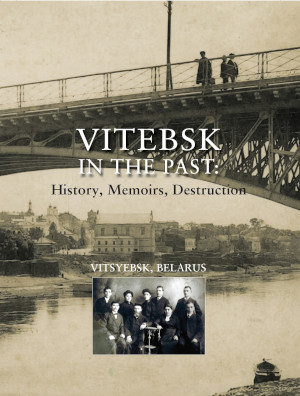 |
Details:
Jewish traders first came to Vitebsk in the mid-1500s, when the area was part of the Polish-Lithuanian Commonwealth. In the 18th century, the city became a major center of Jewish learning and spirituality, both Chasidic and traditional. Later, as part of the Russian Empire, Vitebsk became a bustling industrial hub and capital of the far-flung Vitebsk guberniya. By 1897, out of 65,871 total residents, 34,440 were Jewish. The community hosted dozens of synagogues, a Talmud Torah, a Jewish hospital, and several schools. Jews dominated local trades, particularly as mechanics, craftsmen in machine shops, and in the flax, timber, and grain industries. Vitebsk, the birthplace of Marc Chagall, appears in many of his paintings, often with the depiction of a fiddler on the roof of a house, but Vitebsk was hardly the shtetl of Fiddler on the Roof. It was, instead, a large city with a large and vibrant Jewish population. As Vitebsk Amol, the Vitebsk yizkor book, illustrates, it was a city with a diverse population–diverse religiously, economically, artistically, and politically. As the essays in Vitebsk Amol demonstrate, that diverse population participated in the major events of their time. There are chapters that deal with the development of Chasidism and the conflicts between the Chasidim and the Mitnagdim, with the development and influence of the Haskalah, and with the shattering revolutions of 1905 and 1917 and the rule of the Bolsheviks. There are also chapters that examine some of the leading figures in Vitebsk, including S. An-ski, R` Schneour Zalman of Liady, members of the Schneeurson family, Chaim Zhitlovsky, and Leon Kobrin, among many others. Vitebsk Amol provides a panoramic view of a city that typified the development of modern Jewish life and the forces that shaped that life. In these pages, the writers give a multi-sided picture of the Jewish community of Vitebsk, from its early history to its destruction in 1941. Vitsyebsk, Belarus is located at 55°12' N 30°12' E 139 miles NE of Minsk. Alternate names of the Town: Vitsyebsk [Bel], Vitebsk [Rus, Yid], Witebsk [Pol], Wizebsk [Ger], Vicebska [Latv], Vitebskas [Lith], Vitsebsk, Vicebsk, Viciebsk Nearby Jewish Communities:
Ostrovno 13 miles WSW |
 JewishGen Press
 JewishGen Home Page
Copyright © 1999-2026 by JewishGen, Inc.
Updated 8 Aug 2026 by LA