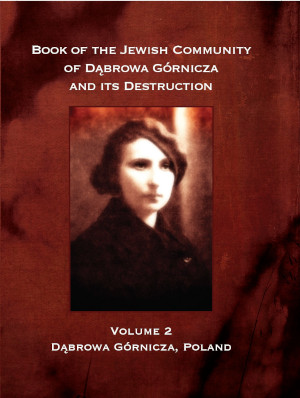
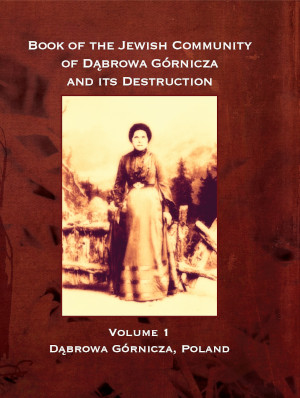
(Dąbrowa Górnicza, Poland)
Translation of
Sefer Kehilat Yehudei Dabrowa Gornicza ve-hurbana
Published by the JewishGen Press
Original Yizkor Book Edited By: Staff members with the participation of Mr.
N. Gelbart
Volume I: 8.5”x11”, 372 pages, hardcover with original photos
Volume I: Available from
for $41.00
Volume II: Available from
for $45.00
If purchased together, both volumes are available from
for $75.00
Project Coordinator: Lance Ackerfeld
Cover Design: Rachel Kolokoff Hopper
Layout and formatting: Jonathan Wind
Indexing: Stefanie Holzman
Book Description: Bruce Drake
Volume II: 8.5”x11”, 536 pages, hardcover with original photos
|
Details:
Dabrowa Górnicza in southern Poland was shaped by the coal mining that fueled industrial growth in the region. Coal permeates many of the book's chapters starting with one titled “The Eternally Gloomy Town.” Residents would say that the sky was always covered in a layer of smoke, flames that rose from the smelting plants were reflected in the sky, and it was difficult to differentiate between night and day. Everything was sooty -- the walls, the houses, and the footpaths. That was the environment in which the town’s Jews lived but they were largely not engaged in working in the mines or the heavy industries. Instead, most made their living as shopkeepers, craftsmen and traders providing the commercial infrastructure of the town. The rhythms of Dabrowa are captured in a section of the book called “Ways of Life and Memories.” The Jewish community in Dabrowa developed relatively late, in part due to legal restrictions on where Jews could live and work. It also had been a kind of satellite of nearby Bedzin where the established synagogues, cemeteries, and rabbinical courts were located. It did not gain the critical mass to form its own Kehilla until the early 20th century. In 1921, there were 4,304 Jews out of a total population of 39,860. Just before World War II, there were about 30,000 inhabitants total, with some 5,600 Jews. Among the sections of the book are “The Rabbis of Dąbrowa Górnicza” which includes several vignettes about student life in the town’s cheders, “Social and Political Life” which charts the Zionist movement and its various players, “Personalities” section with about 140 short profiles of notable people. “Destruction” details the hardships faced by Jews during the German occupation that began in September 1939 and culminated with the liquidation of the town’s ghetto in June 1943. After those in the ghetto had been sent elsewhere – many of them to die -- there were no more Jews in Dąbrowa Górnicza. The book concludes with a list of victims. Alternate names for the town: Dąbrowa Górnicza [Pol], Dombrova [Yid], Dombrowa [Ger], Dabrova Gornicha, Dambrova Gurnicha, Dombrava Gornitsha, Dombrowa Gornicza, Dombrove Gur Dąbrowa Górnicza (Poland) is located at 50°20' N 19°12' E 154 miles SSW of Warszawa Nearby Jewish Communities:
Będzin 2 miles W Zagórze 2 miles SSW Sosnowiec 3 miles SSW Strzemieszyce Wielkie 4 miles ESE Niemce 4 miles SSE Grodziec 5 miles WNW Czeladź 5 miles WSW Dańdówka 5 miles S Ząbkowice 5 miles NE Niwka 6 miles SSW Modrzejów 6 miles SSW Mysłowice 7 miles SSW Siemianowice Śląskie 8 miles WSW Szczakowa 8 miles SSE Dębowa Góra 8 miles ESE Jaworzno 9 miles SSE Sławków 9 miles ESE Katowice 9 miles WSW Siewierz 9 miles N Bytom 10 miles W Chorzów 11 miles WSW Łazy 12 miles NE Świętochłowice 13 miles WSW Bobrek 15 miles W |
 JewishGen Press
 JewishGen Home Page
Copyright © 1999-2026 by JewishGen, Inc.
Updated 16 Apr 2026 by LA