 |
|
|
[Page 208]
Translated by Jerrold Landau
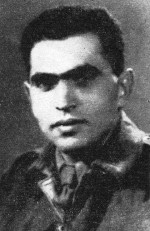
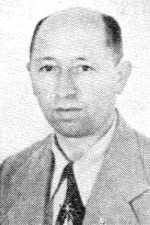
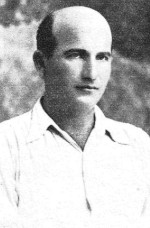
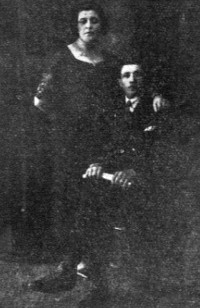
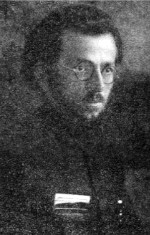
He was born in 1903. He died in a traffic accident on the Carmel on 16 Av, 5692 [Aug 16, 1932]. He is buried on the banks of the Jordan, in Kvutzat Gesher where he was a member.
He was a man of fine virtues, full of vigor, captivating, an exemplary character of a chalutz. He was a native of Vysotsk in Volhynia. He was the grandson of a scholarly Jew who leased lands from the landowners of the area. At the outbreak of the First World War, with the weakening of the status of the merchants, the family moved to live in a village to earn their livelihood from agriculture. Yet the guided aspirations of the Hasidic household in Volhynia seemed poised to incline him toward a different future, to Yeshivas and rabbinic ordination. Thus, he absorbed both the spirit of the soil of Volhynia and the ancestral Jewish spirit. The early ideals of labor, the freedom of the soil, and the raising of livestock there, on the soil of a foreign land. The solid forces that bound him to the soil prevailed over those exalted forces of uprooting, and he remained attached, faithful to the land.
With this resource, he did his work in Hechalutz, established the chapter in his city, and participated in the creation of Kibbutz Klosowa.
|
He made Aliyah to the Land in 1925. He was among the organizers of Kibbutz Volhyn. He worked in Hadera and in other Moshavot in Samaria. He contracted pernicious fever. He did not listen to the physicians who counseled him to return to the Diaspora, and he overcame the disease.
When Kibbutz Volhyn joined HaKibbutz HaMeuchad [United Kibbutz Movement], and merged with the work brigade in Rehovot, Ben-David transferred to Gesher. There, he found a broad arena for his activities, for his economic creativity, in cultivating tracts in the orchards, in his innovations – his efforts to simplify the work, in economizing the work in the stables in raising small livestock; in the field and in the yard – his hand was involved in all branches of the farm. He was in the field in the morning, and arranging work in the evenings. He was vibrant; he raised his voice; he was convincing; he preached and always was first to take part.
He also dedicated time to Hebrew literature. He was seasoned in his reading, connected to the sources of Hebrew culture. He was a descendant of those who struck roots in this soil – the mother [soil]. A scion of a rabbinic line, who carved out for himself a place in the soil of the Land.
He was twenty-nine when he died.
May his memory be preserved and blessed.
[Page 209]
|
|
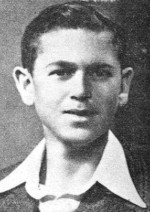
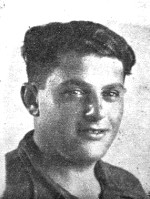
| Yitzchak was born on July 18, 1910, in the city of Vysotsk in Poland |
He received his first education in the Hebrew school. He continued in the Hechalutz Hatzair organization. Yitzchak did his Hachsharah in the Klosowa Hachsharah Kibbutz. He served in the cavalry in the Polish Army two years before making Aliyah to the Land.
Yitzchak made Aliyah to the Land, to safe shores, in 1934. He settled in the Ayelet Hashachar farm. He was immediately absorbed into the farm and the social group, and he was loved by all of us, young and old, for his simplicity, purity, and readiness to participate in any burden.
With the outbreak of the disturbances in 1936, Yitzchak joined the guards, and spent nights and days in the fields and routes, responsible for civil-defense patrol. In 1938, when volunteers were mobilized for the ascent to Hanita [the establishment of the outpost], Yitzchak stepped forward to claim his right to take part. He had the privilege of being among the first to ascend the mountain, and remained on guard there until 1939. When he returned to Ayelet Hashachar, it was decided to free him from his task and make it possible for him to return to a life of toil.
With the outbreak of the war in 1939, Yitzchak again stepped forward to claim his right to be drafted, and he stood his ground strongly.
He went out in 1940, and was one of the first to join the [Jewish] brigades. Yet, for four years he struggled intensely, filled with disappointment and bitterness toward those who obstructed our right to fight the vile enemy of our people and to spill our blood as Jews.[2]
Then the terrible news reached us that on March 29, 1944, the first day of Passover, he was injured in action at the front and died from his wounds.
He spent his youth in the home of Grandfather and Grandmother. He was left orphaned from Father and Mother when he was five years old. As his intellect developed, he grew and became independent when he reached maturity. He went to Hachsharah in Klosowa. He remained there for a year, and then returned to Grandfather's house. He went to Hachsharah in Dombrowitza, and after a while was sent to the Polish army. He spent two years there, and again returned to Grandfather's home, then to Klosowa until he was authorized for Aliyah.
[Page 210]
When he arrived in the Land, he set out for a kibbutz. He entered Ayelet Hashachar and immediately fulfilled an important role in patrolling.
He was always in the front ranks of the pioneers, among those who took part in the conquest of Hanita. During days and nights, on the routes and in places of danger, he fulfilled his role faithfully. That was the way it was until the outbreak of the war.
Then Yitzchak informed us that he became the head of a family. There was great joy in our home. With what joy did you come to tell us of the birth of your daughter Nurit. Every hour of leave was precious to you. Your words always accompany me, “My lovely daughter.”
Then the day came when Yitzchak left us and went out to the front with the Hebrew Brigade.
You fought. You fulfilled your task. You were a faithful soldier. From afar you concerned yourself with your family, with your brother, with your friends, and with your lovely daughter. Your letters were full of longing to return to the farm healthy and whole, to build your life along with your family who was beloved to you. Then fate turned bitter for you. The black day came for us; the light was extinguished…
Sturdy and healthy, cheerful, one who sang pleasantly, ever smiling, a true friend among friends. The children cleaved to him. Friends loved him. He always had something to talk about with the children, without a trace of artificiality – he was with them, and their conversation flowed freely and was full of content. He had a soulful need and great talent for conversation with a friend, for human contact with people, for simple, open friendly conversation, to be a friend in the social group.
His entire essence was suffused with vibrant, abundant life. He had an overflowing good heart; he showed a bright face to everyone; he had calm trust; he had the power of self confidence – it was impossible for the heart to not be attracted to him, to not feel a closeness and feelings of love.
He was a simple, unpretentious working man. He was a man of natural bearing – without contradictions or inconsistencies; always where he was needed, always present, often stepping forward of his own accord.
Behind the visible lightness of his manner lay the full weight of the serious, inward sense of duty – the deep awareness of obligation that marked a man of responsibility.
If a building group was created on the farm and there were issues with its composition – Yitzchak was there. When there was a need for a group of local patrols during the time of the disturbances – once again Yitzchak was among the first. When they were ascending to Hanita – Yitzchak was in the ranks of its first conquerors. With internal awakening, without stirring up problems, without stressing the “sacrifice”, he came and placed himself in the row: Here I am; and I went.
Is it a wonder that Yitzchak was among the pioneer volunteers when the first opportunity for the formation of a Jewish force during the world war opened up?
He, with his zealousness for the honor of the nation, with his Jewish roots, with his hatred for enemies, with Jewish human liberty fully imprinted upon his soul, and above all – with his natural feelings of responsibility – of course he arose and volunteered. He was in the First Company of the First Battalion of the Jewish Brigade.
For the privilege of fighting the enemy face to face; for the privilege of enlisting; for the consolidation of the units so that they might be fit to form combat units; for their Hebrew pioneering character – for all the essential things that formed the character and inner aspiration of Hebrew volunteerism – it was necessary to wage a bitter and prolonged struggle. It was clear that this struggle had no hope unless it rested on the volunteers themselves. Here too, Yitzchak stood as the man of responsibility for which he was known.
He earned for himself a permanent corner in the heart – the figure of a chalutz, a man of duty, a deeply committed character.
[Page 211]
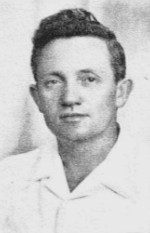
He was born in Vysotsk (Poland) in December 1928 to his parents Baruch and Sheindel Napkhan.
He made Aliyah with his parents in August 1935.
He was raised and studied in Jerusalem. After he graduated school with distinction, he continued his studies with technical courses in precision mechanics with great success.
|
He was a youth counselor and one of the first Palmach members. He was beloved by his friends, as well as dedicated to his parents. He participated in Palmach activities prior to the War of Independence. He took part in the battles of the Lower and Upper Galilee during the War of Independence. He did not heed the urgings of his friends to remain in Kibbutz Beit Hashitah as an expert in his field. His response was: “Where they go, I will go, and I will not sit with folded hands, with satisfaction from my profession, when it is necessary to defend our homeland with a gun in the hand.” He fought along the long front line from Ashdot Yaakov, through Deganit and Kinneret, all the way up to Metulla in the north.
He fell in the defense of Degania (in the battle for Semach) on March 3, 1948. The diary that he maintained was not found. Several letters that he sent to his friends in Alonim remain. In one of them he wrote: “Do not be surprised that I do not have a fixed address. The entire land is my address. I will only have a fixed address when I will be connected to the soil of the homeland. Every inch of land that workers toil over and cultivate with their sweat belongs to us, and with our blood we will defend it. From the blood that our soil absorbed, a free country will arise from our nation, full of burdens during its years of wandering in the exile.”
|
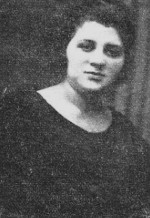
She was born in Vysotsk in 1905 to her parents Liba and Nisan.
She studied in Vysotsk. She was among the first in the town to make Aliyah to the Land. She made Aliyah in 1924.
She was a member of the Gedud Haavoda company. She lived, worked, and died in Jerusalem in 1927.
May her memory be a blessing.
[Page 212]
|
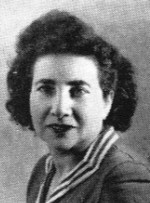
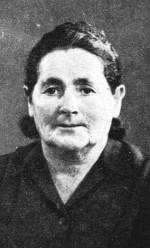
She was a modest, precious woman, cultured and of a high moral character. With this, she worked faithfully in the Zionist clubs and the labor movement. She was born in Vysotsk and received her education from the Hebrew school. As a teacher, she helped educate the children in the Hebrew national spirit, and was active in the Zionist pioneering youth movements.
She made Aliyah to the Land in 1932. The Women's Workers' Council sent her to organize women's labor at the Dead Sea Company in Atlit. From there, she transferred to the Farm for Women Workers near Petach Tikva and later to Tel Aviv, where she was active in cultural activities of the Workers' Council. She was selected as the delegate to one of the councils of the Clerks' Union. Even though she suffered from a lack of work, and her situation did not improve from an economic perspective for a long time – she did not despair, and was even able to strengthen and encourage others. She would say to complainers, “Patience, comrades, the Land will absorb you too!”
In her thirst for knowledge, she participated in a general sociology course at the University for Workers. She was a delegate at the sixth Workers' Convention and wrote about it in Dvar Hapelet and Hapoel Hatzair. She participated in clubs and seminars. Notebooks were found in her personal effects in which she wrote her impressions on the Jewish and general workers' movement, the professional union, the cooperative, and organizational questions of the Histadrut (including issues of the Edot haMizrach [Oriental Jewish Communities], the situation of the female worker in the Land, etc.) In her personal effects there were also notebooks and literary notes on the works of Yaakov Fichman, Brenner, Ahad Ha'am, poetry of Rachel, poetry of the Middle Ages, and monographs of Yosi ben Yosi, Ibn Shaprut, Menachem ben Saruq, and the Gaonic literature. She took interest in humor literature and wrote glosses on Jewish folklore, especially on the book Kearat Tzimukim by Dov Sadan.
With the establishment of the state, she moved from her work in the Mobilization Fundraising Campaign to work in the treasury office. She endeared herself to her comrades due to her good heart and her concern for her fellow, without differentiating based on class or goal. She was alert to what was taking place in the country. Even during her final moments, she was interested in the many details about what was taking place.
She had a good heart and a refined soul. During the times of unemployment, she knew how to share what she had with those in need. When she needed to employ a worker in her house due to her illness, she always made sure to treat her to a warm meal, a useful dress, and the like, in addition to her regular pay which she made sure to pay on time. She donated to social organizations: Magen David Adom, the League to Assist Tuberculosis Patients, the Deaf-Mute Society, etc.
Cruel fate had it that the decision to operate on her was made at Beilinson Hospital, specifically on her birthday (on December 21, 1958). She died eight days later, on 18 Tevet 5719.
May her memory be blessed!
[Page 213]
|
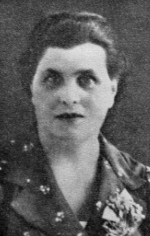
I first met Ethel, my wife and partner in life for thirty-three years, in 1925, almost immediately after she arrived in the Land. Work in general, especially for young women, was hard to obtain. Some of the young women, having no alternative, found work as domestics. However, Ethel, with her great energy, was not content with this. At that time, an initiative was organized among the young women to move into construction trades, in tiling, plastering, and the like. Ethel took up painting, despite the meager wages. Within a brief period, she learned the work to the point where after our wedding, when I was unemployed, I worked with her as a painting assistant. When the unemployment increased, we moved to Petach Tikva, where she worked for a certain period at an orchard, in pruning and various other jobs. In general, she excelled at her work and felt no weariness. She was healthy in body and spirit, and always in an elevated mood. She never complained about the difficult situation or the lack, even when the circumstances were truly difficult and there was scarcity.
Upon the recommendation of a friend of ours, we moved to live in Rehovot, where our first daughter was born. I worked almost regularly, and our situation began to improve. We purchased a lot for fifty liras with a four-year repayment plan, and erected a single room without any comforts. After some years, we added a wooden porch, and had the feelings of satisfaction. We raised three children in the single room, and even hosted many guests. Any relative, friend, or acquaintance knew that one could come and be a guest with Ethel, with a feeling that they are not a burden, and that we desired their visit. She always welcomed the guests with a smile and great satisfaction.
After living in Rehovot for fifteen years, we attained a three-room house. We did not suffer from insufficiency since our demands were not exaggerated. We can attribute everything that we own to Ethel, since her strong will also urged and encouraged me to action.
After we reached a state of calm, after the children got married, illness overtook her. However, Ethel did not make peace with her illness, she did not want to succumb. She fought strongly until finally the illness subdued even a strong body, strong willed and full of energy, such as hers. On a day that neither she nor we hoped for, she passed away. It was on 11 Adar II 5719, March 20, 1959, at the age of fifty-nine.
May her memory be a blessing.
[Page 214]
|
Chaim Perl was born in 1912 in the city of Vysotsk on the border of Volhynia and Polesye. Most of its Jewish residents were modest and good hearted, loving of their fellow Jew and fellow humans, educated in the ways of Torah and tradition. External Haskalah influences did not attract them.
Chaim was one of the finest sons of Vysotsk. In his youth he studied with the finest teachers and melamdim, and did well as a diligent and polite student. With his sharp eyes, he saw the situation of the Jews in Poland in general, and in remote towns in particular, and understood that the only solution in our hands was Zionism, Hachsharah, and Aliyah to the Land of Israel. Therefore, he joined the Hanoar Hechalutzi, and dedicated himself to Zionist activity, the national funds, and issues of education and culture with the entire fire of his soul. He also guided this and urged others. He went to Hachsharah in the kibbutzim of Pinsk and the area in 1933, and made Aliyah to the Land.
From that time until 1947-1948 he worked in physical labor – paving roads and in factories. He joined the army at the beginning of the War of Independence. When he was discharged from the army, he accepted a job as an accountant in the Ministry of Defense. He was full of life until the day he suffered a heart attack. He performed his work with faithfulness and dedication, and also received an appropriate prize. He was revered by all his friends and acquaintances for his intelligence, levelheadedness, energy, and uprightness of heart.
We weep over the great loss with the bereaved family.
He died on 29 Cheshvan 5720 (November 30, 1959)[3].
|
|
| Sara Lopata. One of the first to make Aliyah from Vysotsk to the Land in the year 1924. She died in Tel Aviv on 2 Adar, 5712 [February 28, 1952] |
[Page 215]
|
Dov Lykhtigshteyn was born on 14 Iyar 5664 [May 1894] to his parents Ben-Zion and Ethel. The family moved to Brestichka during his childhood. He went on Hachsharah with the Brit-El group in Yagoditurki in Galicia, and made Aliyah to the Land in 1925. He set his path in the Land in Ness Ziona and Petach Tikva as an agricultural worker and work director in orchards. In 1932, he joined the pioneering group that founded Kfar Yona. From there, he went to Netanya. He became connected with the Vysotsk [community] and came to know its people as if he had been one of them.
It is difficult to get used to the fact that Dov is no more! The heart does not want to believe that we will never again see Dov, who was overflowing with energy and understanding of life. With his energy, he immersed himself in the difficult day-to-day life, and, with his broad shoulders, advanced step after step, stage after stage, on his life path. He had a hearty laugh and smiling eyes full of life and love.
He always loved to see his family, and was connected to them with unbreakable bonds of love. Dov was a person who knew how to give good advice and assistance. It was good to know that Dov was around you. His presence instilled confidence in you, confidence that you can depend on him. Then the flame struck the cedars [i.e., the blow fell upon the finest], and his warm, good heart was cut short in mid-life, and with Dov, all his plans. A good husband, dear father and grandfather, was uprooted from the family. The family remained bereaved, with grief and pain in the heart.
Woe for those who have been lost and will not be forgotten.
Dov was a family man in every fiber of his being. Noble qualities were blended in his character. He was happy and cheerful to greet every family member who arrived in the Land. He welcomed each one with the sincere, enthusiastic love that was so typical of him. He rejoiced with everyone who came from Brestichka and Vysotsk. His heart was broad and warm toward all who arrived.
Dov was a sociable man. His connections to people with whom he came into contact were deep. Great sadness descended upon his friends and companions when he died. The workers with whom he worked wept at his funeral, for Dov was a good, dedicated friend, always prepared to help his fellow.
[Page 216]
Moshe Moravnyk, Netanya
Sara Petrukh-Moravnyk
|
>/p> He was born in Vysotsk in 1897, and grew up and was educated there. He learned to work, and worked with his father in the smithing trade.
After his marriage, he lived in a village with his family. He had five children. One day in 1941, after the conquest of the area by the Nazis, a manhunt was carried out for the Jews of the village. My brother Yitzchak Leib jumped out of the window with his two-year-old son and began to run. One of his daughters, his wife, and three other children ran in a different direction and were caught and murdered on the spot. The murderers also chased after Yitzchak Leib and his two children. The daughter was injured in her foot, and was caught and shot literally before the eyes of her father. “For some reason” Yitzchak Leib and his young son evaded the eyes of the murderers and survived.
He wandered in the forests for two years with his young son. He joined the partisans and fought in their ranks.
After the liberation, he wandered with those who were going to the Land of Israel. He remarried and a son was born to him. He arrived in the Land in 1948. His children grew up to the joy of their father. Slowly but surely, life returned and then…
He took ill with a malignant disease, and died on the eve of Yom Kippur 5720 [October 11, 1959].
May his memory be blessed!
When I draw from far-off childhood memories of him that remain in my mind, he appears before me as a brave, strong, fine, proud soldier in the Russian army.
That was wartime. Jewish youths evaded the army through various means, including self-inflicted wounds on their bodies.
His path was different, “It is better to be a strong Russian soldier than a weak Jew.”
He loved books, and he read a great deal during his youth. He had mystery books in his bed, and he read them during the evenings and nights. Under his pillow, one could find books by Tolstoy, Dostoyevsky, and Turgenev. However, Jewish historical literature was more important than everything. He had good taste, and always understood and grasped the main point. His love of knowledge accompanied him throughout his entire life. He would also find interest in a chapter of Tanach, a page of Gemara, and legends of our sages of blessed memory.
He loved quick wit, expressive language, the incisive remark, the apt metaphor, and the polished aphorism. Later, he drew close and became friendly with people with whom he could debate and deliberate, and he greatly enjoyed polemics. “For a wise person, a loss is also good,” he would conclude.
He was a Zionist throughout his entire life. He joined Young Zion and was active in that organization. He also prepared to make Aliyah to the Land during the Fourth Aliyah. He was held back for various reasons. However, he always carried his dream with him until he actualized it.
He was diligent and loved work. He began to work hard from his early childhood, and had golden hands. Hard metal heeded him. He made it into soft material, with great talent in the craft. All types of fine tools and implements came forth from his hand.
[Page 217]
She passed away seven days after turning 106. She was tall, with an upright stature in body and soul. She was full of life wisdom, politeness, and love of her fellow. She had a religious consciousness and was a fearer of Heaven. Her discussions were always spiced with adages of the sages of blessed memory, Torah thoughts taken from Tzena Urena, and explanations of the prayer book from which she worshipped three times a day until her last day.
Her path of life was full of hardships and suffering: the murder of her husband Reb Moshe Ayznberg during the years of attacks by Petliura's henchmen, the murder of most of her wide-branched family in the Holocaust – but she was not broken. She eulogized her only son, Chaim Ayznberg, who died suddenly in Tel Aviv, with the harrowing words of a bereaved mother, until she regained her composure a bit after a brief time, approached her daughters who were weeping bitterly over the great loss, and said strongly, “Enough! Do not speak harsh words, Heaven forbid, G-d has given and G-d has taken His portion, the soul, and my portion, the body, He has left for me.”
She made Aliyah in 1934 through the efforts of her son and her daughters. Her home in Vysotsk served as a place to host the Admor of Stolin, may the memory of the righteous be blessed, when he came to visit the town, and later on for his children, the Admors.
During her latter years, she lived with her daughters and sons-in-law, who knew how to honor her as an exemplary mother and woman, with the greatness of her qualities and moral character.
May her soul be bound in the bonds of eternal life.
|
>/p> He was born in Vysotsk in 1913 to his parents Yechiel and Chasil Borovik. He received his education in the same manner as all his friends in the town, in cheders and private classes. He was a member of Hechalutz Hatzair. From Hechalutz, he went out to Hachsharah in Pinsk in 1932, and made Aliyah to the Land in 1933.
He was in Kibbutz HaKovesh and settled in Kfar Saba.
Leibel Borovik was a handsome lad with a good heart. He was always happy, straight in his path, and prepared to help his fellow. He grew up in a home that did not know want. His parents were good, tolerant, and upright people. His sister Nishka died while giving birth to her firstborn son in the Russian exile.
Leibel worked as a driver throughout all the years that he lived in the Land. However, when his diabetes grew more severe, and he suffered from heart attacks, he prepared for himself an entry to the movie cooperative. However, suddenly on 3 Tevet 5722 (December 10, 1961), his heart stopped forever.
His memory will remain among our fellow townsfolk forever.
[Page 218] <9>
|
>/p> Gershon my dear, how can I write about you when the heart refuses to believe that you are no longer alive… You still appear alive before me; and passing before me like a movie, are those days and years from childhood, and adolescence, your Aliyah to the Land, your deeds and actions, until the day you left us bereaved and grief-stricken…
I will recall your mother's fear for your health. This was during the time of the First World War, when you were only three years old. Your father was stuck in Vilna, then under German rule. At home, there was hunger, fear, and tribulations. All the deep yearnings of her soul – those of a loving mother and the womanly longing she felt for her husband, who was somewhere out there in daily danger – she poured into you. You were the light of her eyes and the aid to enable her to withstand the tribulations that fell upon her.
Life did not pamper Gershon. Father returned home at the end of the war years, and Gershon, a six-year-old child, was already studying in cheder. With all of his longing for Father – the image was nevertheless strange to him. However, from the first moment, with his developed childlike sensitivity, with his refined soul, he knew that he had to honor the man in front of him. This trait, honoring parents and honoring everything surrounding it, was rooted in him until his final day. He also imparted that trait to his two dear sons.
Gershon studied with diligence and persistence. He moved to study in the Talmud Torah, for which his father fought for its existence. He absorbed the essence of a life of Torah and commandments, but nevertheless, he was attracted toward those of his age who were involved in the pioneering youth movements. Oh, how did his soul desire to leave the cheder and Talmud Torah to some degree, to go out to the fields and furrows, to play football. However, his father, a pious Hasid, stopped him, and Gershon accepted the verdict: honoring the father is above all.
Gershon lost his mother at the age of sixteen. With him was his sister Esterke and his younger brother Yitzchakle, and he encouraged them and guarded them. The tender bereaved children had the merit of a refined woman, Hindel Raskin-Katzman, their stepmother, may she rest in peace, who died in the Land – who knew how to guard their refined qualities and imparted them with a good, calm education. She was literally like a mother to them. How Gershon knew how to appreciate this!
The child grew up, and he had to wear the Polish army uniform. He couldn't bear to waste years for nothing. His soul desired to go abroad, to be independent. With the help of his aunts and uncles on his father's side, Gershon made Aliyah to the Land in 1933 along with his cousin Chaim Perl of blessed memory. Humble and modest, and his hands had never once engaged in work, he faced a new reality, but he was not fazed. He started to work in the window shutter factory of his uncle Burstein. His entire essence
[Page 219]
was now dedicated to bringing his remaining family on Aliyah. He saved coin after coin, and after two years, he greeted his loved ones with a beaming, happy face.
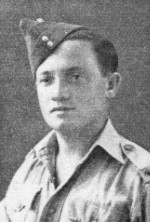
He was summoned to the ranks of the Haganah. From an internal impetus, he volunteered for all security activities. During the years of 5698-5700 [1938-1940] he wore the uniform of a guard. He volunteered for the British Army during the time of the Second World War. He spent four years in the army and in the artillery brigade. He was in Cyprus, Egypt, and Italy. He traveled through the cities of Europe helping with Aliyah Bet.
He was among the first to be drafted into the artillery unit of the Israel Defense Forces during the War of Independence. He always carried himself quietly and modestly, with dedication and great love for the nation and the homeland.
Gershon established a family in 1948. The good, enthusiastic Gershon built his happy nest with his wife Freda (from Dombrowitza, nee Bichik), a Holocaust survivor who made her way through the forests of Volhynia and Polesye with the partisans, through the lands of Europe, until she arrived in Italy and from there to the Land. That was the first time in his life that Gershon began to worry about himself as well, about his foundations. He purchased an automobile and worked as an agent in the Fromin factory.
|
|
| Gershon in the army uniform |
He was full of initiative, and did not spare his energy. He also purchased a dwelling. Great was the burden, but great too was the joy. He enjoyed his two sons, Chaimke and Amiram. He entertained them and played with them during his free time when they were small. He stood guard and helped them prepare their lessons when they entered school. He was a loving and beloved father, dedicated with all his soul. He was happy with every free day that he could be with them. He was a cherished friend and comrade to anyone who came in contact with him. He was a dear son to his father, a brother and friend to his only sister, and to his brother Yitzchakle whom he loved. Gershon was loved by the extended family, and he left them all behind – their grief is great…
Can Gershon be portrayed on 22 Iyar 5723 [May 14, 1963], the day of the Bar Mitzvah celebration of his oldest son Chaimke? “We decided to celebrate the Bar Mitzvah as is customary in these days. I do not know what will be in the future, but this celebration is my joy. At a wedding, there is already a second side to deal with, and here only we set the tone. I do not want to miss this opportunity, that I have merited to celebrate the first Bar Mitzvah, of my firstborn son.” Those were the words that he told me when he came to visit me in the hospital. Oh, what did his heart prophesy for himself at that time?...
He was a lean, broad-shouldered lad all those years – and how thin and skinny was he from the time he suffered his first heart attack. Only two dark eyes, burning and imploring, glistening in a tormented face… He suffered for about four years, and at times regained his strength. With the crushing of the soul, he knew how to overcome the moods of the spirit. He had a strong will to live. Already in his final letter to me, from August 27, 1963, when he left the Beilinson Hospital (after resting for months in Hadassah and the Ichilov Hospital), he wrote full of hope that the tribulations have ended, and he hopes to return to his strength quickly. Who would have thought that he only had one week left to see the light of life. He was taken to the hospital once again, he fought against the bitterness of death, but did not succeed. The flame was extinguished before its time.
May his memory be blessed!
Translator's footnotes
The Committee of the Organization of Vysotsk Natives in Israel
Translated by Jerrold Landau
The idea to publish a book to perpetuate the memory of our town has been alive within us from the time of the establishment of the Organization of Vysotsk Natives in Israel.
The grove named for the martyrs of Vysotsk in the forest of the Jewish National Fund in the mountains of Jerusalem, established through donations of natives of the town, delayed the realization of the idea of publishing the book due to financial constraints.
After the planting of the grove, we began the work for publishing the book. Material and money were collected, and we were prepared to begin the work.
Since the sum of money at our disposal was too small, and we did not receive any assistance from the Diaspora or from institutions in the Land, we searched for ways to minimize the expenses to the extent possible. We decided to do all that we could on our own on a voluntary basis.
Thus, the work was divided up among all the members of the committee, each person with their task. Yisrael Gutman, who was the first in the collection of material, continued this with special distinction. He contacted everyone whose input was relevant to the writing, obtained lists and written materials from them, and even interviewed people and transcribed their words. Rivka Dan typed all the material and participated, along with others, in fundraising for the book. Chaim Perlman, the regular treasurer of the committee, continued in his role and made special efforts to fundraise for the book. Aryeh Pialkow edited the book, arranged it, and brought it to print. Zahava Shtoper-Zamir and Mordechai Lopata assisted them all, as time permitted.
The following were on the editorial board of the book: Yisrael Gutman, Rivka Napkhan-Dan, Mordechai Lopata, Aryeh Pialkow, Chaim Perlman, and Zahava Shtoper-Zamir.
Meir Egozi (Vaks) sketched and prepared the maps, and we thank him for this.
As noted above, all the work of writing, preparation, and editing was done on a voluntary basis, after a regular day of work. Therefore, if the reader finds something here or there that is not as it should be, in the presentation or the editing of the material, it should be received in good spirit, and with our apologies.
Aside from the main sections of the book, we saw it necessary and proper to include three lists of names: The first – a list of the Holocaust victims of Vysotsk and its area, a list which was edited by us based on responses to questionnaires that we received from the relatives of the victims in the Land, and was completed by Chaim Perlman, Berchu Lichtenfeld, and Zeev Shtoper. The second is a list of those who died in the Land, prepared by the editors based on knowledge and memory. The third is a list of
[Page 223]
Vysotsk natives who are alive in the Land. That list was also edited by the editors based on connections and addresses in our possession. It is very possible that names are missing in these lists; and we ask the forgiveness of those concerned. The fact that many of our townspeople did not respond to the questionnaires about the Holocaust victims is certainly a primary reason for this.
In summary: May all who contributed, and all their good deeds be blessed. Thanks to them, the book has been published – and may their reward be the knowledge that they carried out the task that was entrusted to them, on behalf of our martyred brethren, dear to our hearts forever.
|
|
JewishGen, Inc. makes no representations regarding the accuracy of
the translation. The reader may wish to refer to the original material
for verification.
JewishGen is not responsible for inaccuracies or omissions in the original work and cannot rewrite or edit the text to correct inaccuracies and/or omissions.
Our mission is to produce a translation of the original work and we cannot verify the accuracy of statements or alter facts cited.
 Vysotsk, Ukraine
 Yizkor Book Project
 JewishGen Home Page
Copyright © 1999-2026 by JewishGen, Inc.
Updated 1 Sep 2026 by LA