 |
|
|
by Reizl Schochat (Schiff)
Translated by Sara Mages
When I come to describe my family, I must first tell about an earlier period of my family. The origin of our family is from the Maharam Schiff (R' Meir, son of R' Ya'akov Schiff z”l) of Pressburg, Czechoslovakia.
After a severe epidemic in those days, the entire Schiff family nearly perished and only one person remained of the entire family. He arrived in Lita and settled in the town of Siad (Seda). He was the one who brought with him the Schiff family tree. Here he married a young woman and reestablished the Schiff family, which began to branch out in the nearby towns, and reached the borders of Latvia. A few generations passed before the birth of my grandfather, who was one of three brothers born in the mid–nineteenth century in Seda, to the Schiff family. The three brothers were learned yeshiva students and my grandfather was ordained as a rabbi. However, all three of them began to engage in commerce.
My grandfather married Etta–Ita of Telshe and settled in Laižuva near the Latvian border. Here he managed a shop selling textiles. His brother, Ori, was married in Mažeikiai and from his extensive family came the rabbi, Dr. M. Nurok, who was a member of the Latvian parliament and the nephew of my father z”l. The second brother, R' Mordechai, married and settled in Pikeln (Pikeliai), a small town in Lita on the border with Latvia.
My grandfather had six sons and three daughters. Five sons and two daughters immigrated to the United States before the First World War. The sixth son is my father, R' Shmuel Schiff z”l. He married in Telshe (Telšiai) and settled there. My grandparents ran their household with the warm atmosphere of a traditional Jewish home and were known for their hospitality. My grandmother was known for her wisdom and righteousness. It was a wealthy home, rich in Torah, tradition and good deeds. My grandparents took care of the city's poor and especially tried to help the poor girls in the city to get married. On his business trips my grandfather made sure to find suitable grooms, and my grandmother arranged the weddings at her own expense and took care of all the needs of the brides and grooms. My grandparents' house was open to all in need and they helped wherever they could.
In the summer of 1914 I came, together with my brother Yitzchak z”l, to visit our grandparents and we enjoyed the hospitality and the beautiful living arrangements in this wonderful home. It was during the First World War, and in 1915 the decrees and deportations of the Jews of Lita to the expanses of Russia began because of the Russian's suspicion that the Jews were allegedly engaged in espionage on behalf of the Germans. Refugees arrived in Laižuva from Mazeik (Mažeikiai) and Tirkshla (Tirkšliai) and other towns in the area. Our house was full of refugees and we were waiting for the expulsion order. And indeed, it was not long in coming. My grandmother managed to influence the Russian commander of the city to postpone the deportation by twenty–four hours in order to stock up with food and help the needy who lacked essential food items.
During the course of the day we stocked up with food and clothing and left through Riga to Russia. On the way my grandfather caught a cold, got pneumonia, and died four days later. The whole burden now fell on my grandmother who was a very intelligent and talented woman. In Riga she sold shoes and boots that she brought with her from her shop, but the authorities did not allow the refugees
[Page 287]
to stay for a long time in Riga and we continued our way to the town of Świr in the vicinity of Vilne (Vilnius). In this town my grandmother opened a shop for the selling of textiles, but she planned to go on to the big city, Vilne, which at that time was very close to the front. However, her brother–in–law warned her that she was endangering him and my brother, and then they decided to continue on to Minsk, Belarus. On the way, they realized that the decision to go to Minsk was a mistake, but it was too late to go back. When we reached Minsk, the trouble began. We sent our entire cargo by train, but the Russian army, which suffered defeats on the front and retreated eastward, also reached Minsk. The city was full of refugees and it was difficult to find an apartment in the city. A Jew from Laizeve housed us temporarily in his kitchen until we managed to find an apartment. At the same time also our belongings arrived to Minsk and my energetic grandmother also continued here, in Minsk, to engage in commerce and supported us all, including my aunt Rivka–Leah.
My father z”l married my mother, Chaya z”l, in 1901, and they had a guest house in Telshe where I was born in 1909. In 1911, my twin brothers were born. Yitzchak–Yosef z”l and his twin who died immediately after his birth. My mother contracted a malignant disease, and my parents had to close the guest house and seek medical help for the mother in the hospitals of Riga, Dorpat (Tartu Estonia) and Petersburg. At that time, in 1914, my brother and I were sent to our grandparents who lived in Laižuva. My mother died in Telshe in the middle of the First World War.
Since she was very sick, my mother needed devoted care and, indeed, her loyal sister Rivka, from the town of Yelok (Ylakiai), took care of her. Before her death my mother asked her sister to marry my father so that her children would have a devoted woman to look after them. After my mother's death, my father did marry my aunt Rivka. At the same time, my father contracted dysentery, an epidemic that struck people during the German occupation, and many died. My aunt Rivka took care of my father with devotion and saved his life. One daughter, Leah, was born to them.
My father was a distinguished Jew, educated, and involved in the city's life. He engaged in public affairs, was one of the organizers of the fire brigade in the city and was admired by the entire population, Jews and gentiles alike. During the German occupation he traveled to Trishik (Tryškiai) to bring matzo flour for the city's Jews. However, someone informed on him and on the way he was arrested and imprisoned. When the matter became known in the city, the gentiles immediately organized a delegation of the city's dignitaries and demanded that the authorities would release him. As a result of the pressure, and the efforts of the city's dignitaries, my father was released from prison.
After the end of the First World War, when my father learned that my grandfather had left debts to people, he paid all the debts even though the war allowed the cancellation of debt.
In 1922 I returned with my brother, my aunt, and the rest of the family to Telshe. My father, who was a Zionist, was among the leaders of Mizrachi in the city. He was elected head of the community and was a gabbai (religious ritual assistant) in the synagogue where he prayed. When one of the prominent dignitaries in the city died, HaRav Moshe Perlman z”l, son of the Rabbi of Pinsk, my father filled his place in the teaching of Pirkei Mishnayot and Gemara. He was a man of broad horizons and was as interested in talks on secular matters as in talks on religious ones. My father was a Lithuanian Jew, one of the remnants of the previous generation, a glamorous figure and a wise scholar, intelligent and humble. He was loved by all his friends and acquaintances. He read both general and Jewish literature and also loved art in all its varieties. He also stood at the head of Chevra Kadisha (Jewish burial organization) and made sure that for anyone who gave charity [to the burial society] during his life, his relatives would not be obliged to pay large sums for his burial.
My father managed a wholesale grocery store and also received an agency for kerosene. He entered his brother–in–law, R' Baruch Yefe z”l from Gargždai (Gorżdy/Gorzhdy), as a partner. He showed special treatment for the poor and helped the needy. Thanks to his prosperous business he was wealthy and managed a home as befitted his status. He also gave great credit to his clients, took care of the quality of his merchandise, and if a customer had difficulty paying his debts, he wrote them off.
As a public activist he supported every Jewish institution in the city. As a Jew of great character he gave charity and helped anonymously, and also preached to his family to do so. He helped people without them knowing who was helping them. His love for the Jew knew no bounds. My father also knew how to help others without neglecting his business. If they were to confiscate a Jew's property because of a promissory note that wasn't paid in time,
[Page 288]
my father ran and paid for it so that the person would be saved from the foreclosure. He guaranteed promissory notes to anyone who asked and, eventually, also paid for them.
With the occupation of Lita by the Soviets, and when the authorities began to persecute merchants, they were impressed by his reputation and in the end only confiscated Shmuel Schiff's businesses.
My brother Yitzchak and I did not manage to acquire a proper education because of the war years, but we were assisted by teachers that my father z”l made available to us. I was educated by the principal of the teachers' college, Shalom Schochat z”l, a renowned mathematician who was not only a great teacher but also took care of all his students' needs. My brother, Yitzchak Yosef z”l, was very similar to my father and was also a merchant. He was loved by all his acquaintances and friends.
My father z”l was executed on 20 Tamuz 1941 together with all the men of Telshe by the Nazis and their Lithuanian henchmen. My brother, Yitzchak Yosef, was killed on 20 Tamuz of the same year. Half a year later his wife Rivka, perished together with her sister Sheina–Yafa in the Riniai forest.
I and my two sons, Chaim and Yehoshua, survived the Holocaust period thanks to the gentiles who knew us, gave us shelter in their homes and made sure we were safe. My sister Leah was also saved thanks to a Christian woman, a Righteous Among the Nations, who hid her together with five other Jewish girls. She passed the Holocaust years and immigrated to Israel.
I will not do my duty to my family if I do not mention the branch of the Schiff family in the United States. Five uncles: (Reuven, Abraham, Rabbi Mordechai, Rabbi Zalman–Ephraim and Moshe) and two aunts: Chaya–Gita and Tzira, immigrated to the United States before the First World War. HaRav, R' Mordechai, was one of the greatest of that generation, wrote many books and refused to accept the rabbinate in Cincinnati because he didn't want to use the Torah as means of making money. He was also famous in the United States and his name appears in the encyclopedia “Who's Who.” Rabbi Zalman–Ephraim lived for a certain period in the United States, immigrated to Israel, and established the yeshiva and kollel[1] “Ohel Torah Beth David,” in Jerusalem under the leadership of the Chief Rabbi, R' Herzog z”l. He returned to the United States on the eve of the outbreak of the Second World War.
Reuven, Avraham and Moshe, who also studied at the Telshe Yeshiva, were genius scholars, engaged in commerce and established a large chain of shoe stores, a department store and a few dozen factories. Abraham was president of the Jewish National Fund in the United States, and Reuven was Edward Warburg's deputy in the American Jewish Joint Distribution Committee [JDC]. Before the Second World War they wanted to bring my father and his family to the United States, but my father refused because he was concerned about kashrut (Kosher Law) and believed that consequently, he could not live his life there as an observant Jew. And so, the family perished by the cursed Nazis, may their names and memory be obliterated.
Reuven and Avraham took care of the former residents of Lita, who arrived in the United States after the Second World War, organized jobs for them in various factories and ensured their absorption. They made efforts to bring the Holocaust survivors to the United States and helped all those who approached them. They sent a delegation, headed by Rabbi Silver, to search for my sister and bring her to the United States, but she refused to immigrate there and preferred to immigrate to Israel. She brought my eldest son, Chaim, with her.
My uncles, who are very affluent people, were known as philanthropists and contributed greatly to the establishment of factories in Israel. They were known as great contributors to our country. At the request of the Israeli government, the nephew of Shaul Schiff, son of R' Zalman Schiff, helped to establish a large shoe factory in which many workers are employed.
I immigrated to Israel first. My son, Yehoshua, immigrated with his wife Dr. Rina, daughter of the lawyer Michels.
The image and memory of the Schiff family will remain in my heart until my last day.
May their memory be blessed and preserved forever.
Footnote
[Tr.] - Translator's footnote
by Tuvia Ba'al Shem
Translated by Paul Bessemer
As the years pass, our feelings and longings grow to commune with the memory of the martyrs of our community of Telshe and to summon up the image of their wonderful and unforgettable character (damut…diyukan). I fondly remember the history of Telshe, its simple and honest Jews, who lived traditional lives and educated their sons in Torah and the wisdom [of the sages], in handiwork and in decency. There was in them a sort of wholeness of that [type] from days gone by; generations had lived in the lands of Lithuania, but they were proud of their Jewishness and their faith, and they hoped for the days of the Messiah and for …t'murot be'olam [some] recompense in this life.
Telshe, my town! The heart sighs when a vision of you appears before my eyes. How was the town lost? How was it destroyed, toppled, shattered into pieces, never to return again. How were the houses of the city ruined, burned, collapsing into rubble, trampled by the Nazi troops and their cruel Lithuanian collaborators? How were the people lost? They were brutally murdered and buried in the earth of Rayin[1] and in Geruliai,[2] sour with the blood of Jews. These precious Jews are no more. The heart bursts with anguish when we see with our mind's eye all of our dearly beloved, the sanctified, whom we knew so well, and they are frozen in our minds, facing downward (שמוט), buried, [their bodies] twisted. Every Jew of Telshe, all went to [their] death: mothers, fathers, the elderly and the infant–all thrown together in death. All of them; none are left, and there is no way to bring them back; suddenly, you are seized by a spirit, a strong hand that casts you forward and your hands reach out for them, toward the past. You want to bring them back, to recognize them, to kiss them and embrace them…you spread out your arms, but cannot reach [them]….You cry out–but your call isn't answered…. When you think of them now, today, your heart constricts within you. And for a moment, you think: will those horrible days ever return? And you swear, and return and vow with clenched fist and pound [it into your other palm]: “No, never again!”
Photographs, photographs, photographs this is all that remains of them, [gradually] yellowing in old albums. And the eyes that gaze upon them stare [uncomprehending], still refusing to believe. The tears have already dried, but the pain and anguish [remain] unbearable. I close my eyes and I see, as if through a thick mist of blood and tears, Jewish Telshe, and it is far, far off, no [longer] of this world.
Over hundreds of years the Jews of Telshe struck deep roots in Lithuania. Branches of th[is] glorious and well-respected tree reached out into the entire world, and within a short period this glorious Judaism was cut down and eliminated from the world. Is there a greater and more profound tragedy than this? After so many years–the several relatives and dear [friends] remain before my eyes, the image of the town of my birth, Telshe.
Your name did stand as a crown of glory for your Jews over the generations, and their rights and virtues did not protect them before the wave of evil that came. No miracle occurred for them when the evil ones – the S.S.–came to butcher them in the greatest slaughter upon the lands of all of Lithuania. A great, miniature country in its own right was erased (nihkedah mini aretz rabah) – layers and layers, generations worth of cultural treasure – secrets that shall not [cannot] be measured in gold, and what remains of you is only the forgotten, mute graves of [our] brethren, missing headstones and a broken connection to that time. But the remnants of the Shoah of Telshe are in no way erased from the heart, because the town and people of Telshe are dear to us. The remnants of Telshe are like a burning candle of remembrance – an eternal light -- in [our] hearts.
Jewish Telshe! Town [home] and mother it was for us, a town in which a unique way of life and atmosphere was formed, from which the desire and aspiration to hold
[Page 290]
you up as a model and a spiritual center in Lithuania. Your inhabitants formed your special character, you were a city [community] of Torah and of Enlightenment. An upright generation arose and grew in your midst, a generation with an understanding of its own worth, suffused with national and humane aspirations. This wondrous edifice is [now] destroyed and ruined!
The eyes are filled with tears and the heart constricts with a deep pain when we remember the members of our family and our dear friends who were brutally murdered at the hands of these utterly bloodthirsty Nazi beasts. The city which, until the Second World War, was a town full of Jews and a wonderful community that had earned [for itself] honor and esteem, is now silent, as if there is none left to speak or to hear.
The years have passed since that tragic day in which our dear ones were deprived of their lives. We shall not forget what the Nazi Amalek[3] did to us, because it is a commandment and the highest of commandments for all generations: to remember and not to forget. And in remembering the ruin of Telshe, what was lost to us shall never again return, and at that point our heart fills with a mighty torrent of longing. After what surrounded us in that world of yesterday, that which was destroyed before our eyes and without any sin or transgression, we close our eyes and we see all of the martyrs as in a dream. Great G-d! Why has all this vanished and is no more? There is no person who can grow accustomed to this horrible thought, that the entire town of Telshe upon its Jews, that this entire branch [of Jewish life] has been forever lost. There once was the Judaism of Telshe and it is no more.
This nightmare will pursue us until the end of our days. May the souls of the martyrs be forever bound up in the bond of life.
|
|
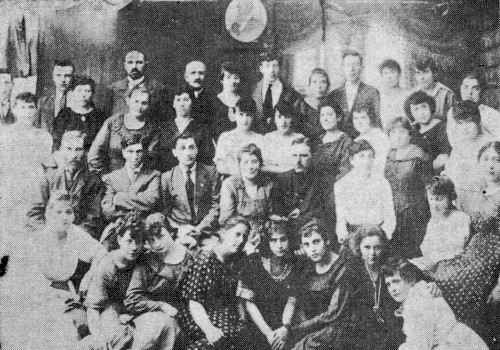
| The founding of the Zionist Party in Telshe before the First World War; among the participants: Bayla Shneider, Tzila Ba'al-Shem, Kaplansky, Yizgur, Itzikzon, Eyvin Halfit, Shewe Bra |
Footnotes
[Ed.] - Translator editor's footnote [Tr.] - Translator's footnote
|
|
JewishGen, Inc. makes no representations regarding the accuracy of
the translation. The reader may wish to refer to the original material
for verification.
JewishGen is not responsible for inaccuracies or omissions in the original work and cannot rewrite or edit the text to correct inaccuracies and/or omissions.
Our mission is to produce a translation of the original work and we cannot verify the accuracy of statements or alter facts cited.
 Telšiai, Lithuania
 Yizkor Book Project
 JewishGen Home Page
Copyright © 1999-2026 by JewishGen, Inc.
Updated 07 Oct 2026 by JH