 |
|
|
[Page 390]
by Chayim-Pinches Blaf
I should begin the history of Grabowiec natives in America with 1896, although it actually began much earlier. But when I myself arrived, I met a few surviving natives who had come at the end of the 19th century. Among them were Leybtshe Shneider and his family, the Shusters, and a few others whose names I cannot remember. I met them in their homes as well as on official occasions. I remember how interested they were in meeting us and feeling that they were at home.
I listened to their tales of their decades in America, and wasn't sure whether I should be envious of, or sorry for them. They were now elderly, vastly experienced in hard work and small achievements. I undertook to create a unified framework for these few Grabowiec Jews. I succeeded, to some degree, but had to contend with difficulties that resulted from the circumstances and conditions in which the Grabowiec natives lived in America.
Those who came in the 1920s, as well as those who came later after surviving the catastrophe, were able to receive help from us – support that was rooted in our early conviction that
[Page 391]
it was our responsibility to help our fellow natives.
In 1926, when my father – who was already in America – brought me over, and I arrived in the metropolis of New York on a March day, I was still a greenhorn, as they say in America. During the first few years, I was very homesick for the small town of Grabowiec, where I had been born and where I grew up. That is where I spent my youth and made friends and acquaintances. All of us were tightly linked by days of joy as well as days of sorrow.
To this day, memories of that small town are very much alive for me: memories of dreams and ideals that we created, ideals of salvation for the Jewish people and for all humans. I longed for the enthusiastic atmosphere in the town, which I could not find anywhere in the rich new land. I was especially haunted by recollections of our activity in the local Zionist organization. A group of us took a group photograph before I left, and later sent it to me in America. I spent hours and days looking at that photograph yearningly.
Eventually, I was able to find a congenial group of young idealists in the New York branch of Po'alei-Tziyon, who were quite active and lively. They held meetings, lectures, and campaigns for the Histadrut and the Jewish National Fund.[1]
All these activities were very satisfying. However, at the same time I felt that something was lacking. I thought that something needed to be done about our home town, specifically – the impoverished Jews of Grabowiec, to whom we felt very strongly connected. They were an integral part of our lives, and I was certain that we must not forget them. We owed a great debt to those warm folks, who lived in dire conditions, and needed our help.
[Page 392]
In 1923, I invited a group of Grabowiec natives in America to meet at Meir-Volf and Esther Korn's house. As the initiator, I was asked to open the meeting. I proposed that we create a Grabowiec relief fund, to aid needy families. We discussed the approaching Pesach; each of us reminisced about the difficulties of celebrating a proper holiday in Grabowiec homes. The response was very warm. I remember the talks by the meeting's participants. Moshe Zinger's son gave the first address:
“Chayim-Pinches, you're still a ‘greenhorn’ here, and you don't know that nothing can be done with the Grabowiec natives. I understand you completely, I know what pains your heart, but believe me, your efforts are a waste of time… We used to have a ‘Society’ in a synagogue, but people quarreled, and they had to give it up. There's no one to share this idea with. Listen to me, and forget about it…”
He spoke for much longer, but the content was the same, a combination of understanding and regret. Dovid Ennis (later my father-in-law) and Motti (Nachumtshe's son) were the last speakers. At the time, they were considered among the most educated natives of Grabowiec in America. Their speeches were similar to those of the first speaker, and they shook their heads regretfully when discussing my efforts, as though saying, “it's a waste of time.”
People said that I was obstinate, and I was indeed determined, demanding, explaining, and encouraging others, until the ice began to melt and the first glimmers of understanding for the project appeared. The Grabowiec Relief Committee in America was created.
Our capabilities were not great, and we couldn't do much or undertake major commitments. But it was nonetheless satisfying when we could help our nearest a bit, and feel that we had supplied them with plenty of food for Pesach. We
[Page 393]
had devoted much energy to actively helping the families we had left behind in Europe. Regardless of our limited means, we explored every means of helping them, creating social and cultural possibilities for the Grabowiec natives in America, and reciprocal relations.
After World War II, our local natives of Grabowiec understood that they could not sit idly by, but had to become active in the relief efforts for the unfortunate refugees, embers rescued from the conflagration that had annihilated everything. We must admit that we did not do everything for the few Jews of Grabowiec who had survived the terrible cataclysm. We were in touch with the handful of Grabowiec natives who found themselves after the war in Poland, Germany, and even in prosperous America. But our hearts often mourned our
|
|
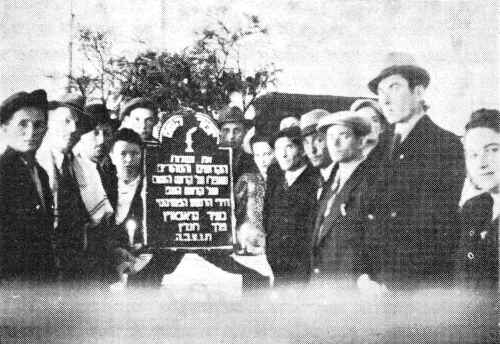
| A postwar memorial for the martyrs of Grabowiec, held by the survivors in Lichtenstein, Germany. It was the first news we in America received about our lost Grabowiec fellows. |
[Page 394]
own helplessness and lack of financial means for providing long-term aid. We received moving letters from people who asked for help; sadly, we could not fulfil all their requests. We should say, however, that the matter of aid was always on the agenda at our meetings. Each of us was delighted to hear about another Jew or family that had survived. As mentioned above, a few survivors reached America and our relief efforts were redoubled. It should be remembered that over time some of the older generation passed away, and the new immigrants gave us new strength. Discussions about Israel became part of the conversation at our meetings. Considering the Grabowiec natives in our new home, we began thinking of providing help for the Grabowiec natives in the Jewish homeland: we organized special aid for the Grabowiec committee in Israel, and helped create a mutual aid fund to support those in need.
Did we do enough for our survivors? A realistic look at our activities makes it clear that more efforts would have yielded more, but we could not create the right conditions for a broader undertaking.
The idea of creating a Yizkor Book commemorating the murdered martyrs of Grabowiec was a stimulus to intensive action.
The Book Committee came into being in 1964, in Israel. I was present at that meeting, and brought back to America regards from our fellow Grabowiec natives in Israel. I told them that I had found very devoted fellow townspeople who were totally in solidarity with the idea of a Yizkor Book. I was excited to have found highly intelligent people who were very excited by the
[Page 395]
idea of preserving the memory of our martyrs for eternity. I felt that I had discovered a new type of young people. The Grabowiec natives in Israel were imbued with youthful enthusiasm. As I convey their message here, I append the heartfelt addition.
“Blessings upon you, Grabowiec natives in Israel for undertaking this enormous, sacred mission and turning it into a reality: publication of our Yizkor Book!”
I am overjoyed to see our dream materializing. We promise that we will do everything to help you with this hallowed project. I would like to emphasize that many of our local members are also extremely active. Our organization, the Grabowiec section of the Jewish National Workers Alliance (Section 490), was founded in 1936.[2] It carries out the mission of helping its members who are needy or ill. Its major mission now is aiding the State of Israel. Our organization includes many natives of Hrubieszow, and now bears the name “Grabowiec-Hrubieszow Section 490.”
Our work for the State of Israel and the United Jewish Appeal as well as for our Jewish schools is as follows. We contributed over $100,000. 125 new families have joined our organization. We gather once a month, on a Saturday night. The meetings are especially lively when a visitor from Israel comes, a fellow native of Grabowiec or Hrubieszow. We are particularly proud of the visit by Yosef Almogi, an Israeli government minister, who was born in Hrubieszow; he came to see us during a visit to the United States. We're also in touch with our fellow townsmen in Australia, Argentina, and Canada. They visit us often, drop in on our organization, and participate in our meetings, where they're always greeted very warmly.
Our Grabowiec and Hrubieszow townspeople
[Page 396]
have created a family atmosphere in the organization. The secretary of the section, Yechezkel Korn, has become part of the book committee. He is a warm, friendly person, and we take this chance to thank him for the help he has thus far given us. He feels a member of the Grabowiec family, among other reasons – because his uncle was Arish Korn of Grabowiec.
All our members are profoundly connected with the State of Israel. Many have already visited there, but they are concentrating most of their efforts towards raising their children in the spirit of love for Jews, the Jewish people, and the Land of Israel. It is our deepest hope that this Yizkor Book, commemorating the Jewish community of Grabowiec, will become sacred to our children and grandchildren and a reminder for generations of a community and rich way of life, that is gone forever.
Let the scream that rises from this book reverberate forever and never still its demands down the generations.
|
|
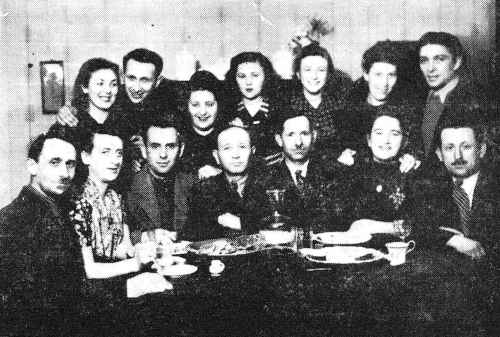
| Grabowiec survivors at a meeting in Germany, sharing experiences and discussing their futures |
[Page 397]
C |
 |
[Page 398]
In CommemorationIt was extremely difficult to collect and organize the materials concerning the great tragedy, the extraordinary catastrophe that overtook the Jews of our town. An error may have inadvertently crept in, a detail that does not conform to the reality of that time, or something that has been minimized or exaggerated. The passage of time, the difficult experiences that each of us underwent, and the fact everything was set down by nonprofessional writers striving to memorialize the life and destruction of our town – all these have played a role. For the same reasons, certain events and experiences may have recurred in our text. We wanted to present that world in the most beautiful and elevated terms possible, a world that was wiped out by the most devilish destroyer of all time. It was a world of sanctity and bravery that preserved its character even during the period of a gruesome slaughter that is unparalleled in human history and may sound unbelievable. But the list of names of hundreds of Jews of Grabowiec follows below. They were murdered by the Nazis and flung into pits dead or alive. These are the names of those whose shed blood will never cease to scream and demand:
May the revenge exacted for this innocent blood be immense.
Jewish Grabowiec is no more. We have all lost our nearest and dearest, along with everything we called ‘home.’ There is no consolation, for it is impossible. Each of us will carry the pain to the grave. To our last day, we will safeguard the hallowed memory of our martyrs.
Translator's footnotes:
|
|
JewishGen, Inc. makes no representations regarding the accuracy of
the translation. The reader may wish to refer to the original material
for verification.
JewishGen is not responsible for inaccuracies or omissions in the original work and cannot rewrite or edit the text to correct inaccuracies and/or omissions.
Our mission is to produce a translation of the original work and we cannot verify the accuracy of statements or alter facts cited.
 Grabowiec, Poland
 Yizkor Book Project
 JewishGen Home Page
Copyright © 1999-2026 by JewishGen, Inc.
Updated 06 Oct 2026 by JH