 |
|
|
by Mordkhe Armoni (Zamek)
Translated by Tina Lunson
|
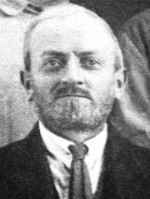
Mr. Avrom Segal lived outside the town, on an estate with a large field. The estate consisted of a water factory, a residence for the family, a barn with horses and cows and a large shed for wagons and various farm equipment.
In the factory he made kvass, lemonade and soda water for the whole shtetl and environs. In the soda factory there was a large, deep cellar where he held ice. In winter they hacked out pieces of ice from the frozen Narew River, brought it in on sleds to the cellar and stored it there so it would not melt, and it would be enough for the summer to cool the drinks that the factory distributed to the shops and also to private people. Especially on Shabes, every home had a copper siphon with soda water, placed in ice and wrapped in a wet sack. It would be a cold drink after the tsholent stew. In the factory Jews and goyim worked together.
The house where Reb Avrom Segal lived with his family was a large house with many large rooms. The entrance was through the kitchen, and there were
[Page 257]
always people sitting there waiting for Reb Avrom. By day mostly goyim came, who wanted advice about what grain to sow or with questions about a sick horse and the like. In the evening Jewish craftsmen often came to drink a glass of tea, look into a newspaper to see what was going on in the world and also to find out if there was any work for them there.
During the First World War, when the Germans were in Poland, the Jewish youth in Rozhan played theater. The last rehearsals, sometimes on a Friday night, were held at Segal's house because of the large rooms and the friendly proprietor.
Reb Avrom Segal was the only Jew in the town who sent his son to study agriculture, in an agrarian school by “ORT”. He loved the field and the field work as one who worked the earth for generations. The field and the surrounding fields were the substance of life.
He began his workday very early. He was often seen standing in his talis praying before breakfast, when others were already preparing to eat lunch.
He knew the population of the entire area, Jews and Christians, poor and rich – with their merits and flaws. It happened that once a pair of horses were stolen from his barn during the night. He knew where and who to turn to in order to solve the theft. Not only in Rozhan but in the whole area, even to Makow and Pultusk, he had many connections.
Reb Avrom Segal was one of the Jewish representative personalities in the town. In every era and under every dominant authority his house was the inn for the commander. Even in the time of the Russians, before the First World War when there were maneuvers around the forts, the commandant stayed in his house. With his smooth and sharp tongue, he could achieve the highest places. When things in town felt a little uneasy as regards the Poles, Reb Avrom was one of the first Jews who went to the priest to plead that he take action to calm the population. When they arrested a Jew for a political suspicion or an administrative matter, Segal was one of the first who went to plead for him.
In the old tsarist times, when they caught Jewish boys for the military and shipped them far off, it sometimes happened that a boy was taken ill. People would come to Reb Avrom Segal to ask him to travel there to get information about his condition and what they could do to help. Also, in Rozhan when someone needed his help in town hall or with the district police in Makow, Reb Avrom would at his first opportunity harness up his sulky or sled and drive to Makow.
In 1920, when three of us Rozhaners were in Erets-Yisroel, a fourth Rozhaner came to us in Jaffa: the esteemed guest Reb Avrom Segal. We all sat down to hear what had happened in the last six months since we had left Poland, especially what had happened in Rozhan and with our families. Then
[Page 258]
our guest's eyes grew dark as he began to tell the terrible and horrifying things that the Rozhan Jewish population had gone through.
When the Bolsheviks arrived in Rozhan, they arrested 14 men from the finest proprietors in the town, mostly Poles, but Avrom Segal among them. Because the commandant of the Bolsheviks was staying with him in his home, he was freed. Soon people came to him to plead that he intervene for them to release the other arrestees, especially the apothecarist who was needed for the entire population. He was successful and the apothecarist was freed, but the rest of the arrestees were deported and were killed.
After the Poles had driven the Bolsheviks from Poland, the Rozhan Jews began to take revenge on their Jews, arresting and killing, under the pretext that all Jews were Bolshevik spies. Jews went into hiding. The Poles did not find Reb Avrom, so they arrested his two sons and sent them off to the Pultusk prison and from there to Warsaw to a military prison. In every place they were murderously beaten and ordered to confess that they were Bolshevik spies. Reb Avrom wanted to go to the police and explain his intervention for the apothecarist and try to free his sons, but the family and friends would not allow him to go and risk his life.
The only path left to him was to leave Poland and travel to Erets-Yisroel. That took months. The whole family Segal had to hide. Then the Poles requisitioned their belongings.
In Erets-Yisroel Reb Avrom traveled around for several months in search of black soil to settle on. With the help of his son-in-law Nakhum Sokolov he settled in the village of Binyumina. After that his wife and children came, as well as the two sons who had been arrested, and the whole family worked the fields that they had acquired in Givat-Ada.
Two sons and a son-in-law left agriculture and went to the city. One son, Meyshe of blessed memory, remained true to his youthful ideal and did not leave the soil. His whole life he went around like a Pioneer from the 1920s, in khaki trousers, until the last day of his life.
Reb Avrom Segal, who was born in a Polish village, Podoshtsi near Makow, and worked his best years on Polish soil as an agriculturist, lived out his last years in Givat-Ada, on the black soil of Erets-Yisroel.
May their memories be a blessing!
|
|
JewishGen, Inc. makes no representations regarding the accuracy of
the translation. The reader may wish to refer to the original material
for verification.
JewishGen is not responsible for inaccuracies or omissions in the original work and cannot rewrite or edit the text to correct inaccuracies and/or omissions.
Our mission is to produce a translation of the original work and we cannot verify the accuracy of statements or alter facts cited.
 Różan, Poland
 Yizkor Book Project
 JewishGen Home Page
Copyright © 1999-2026 by JewishGen, Inc.
Updated 19 Oct 2026 by JH