|
|
|
[Page 509]
Translated by Gloria Berkenstat Freund
The Kultura [culture] Society, which played such a large role in Zawiercier Jewish cultural life over the course of a few years, was founded by a group of young people at the Sztajnkeler's house. Among the founders were: Altshe Kromalowski, Leibush Staszewski, Yitzhak Goldman, Itshe Kozlowski, Itshe Meir Bornsztajn, Eshtshe Lajbowicz, Chaya Erlich (now Mrs. Goldsztajn in Israel), Manya Landau, Perl Borszikowski, Ester Zakes (secretary, led the library). Among the first members, there also was a group that belonged to Hashomer Hatsair [the Youth Guard - Socialist Zionists]. The group soon left the organization.
The Kultura Society had its start thanks to the important accomplishment of Yitzhak Goldman, who was a Myszków-Żarki Hebrew teacher. There was a large library in Myszków that the well-known literary patron, A. Y. Sztibl (founder of the Sztibl publishing house), supported in the memory of his wife.[a] The number of Yiddish books was especially large. Zawiercie, at that time, did not have a good library. Yitzhak Goldman would bring books to Zawiercie from the Żarki Sztibl Library for a small circle of friends. Thus, was created an interesting circle for good books and there was a discussion about the necessity of creating a Jewish cultural society in Zawiercie. In 1925, this group called a general meeting at the Hakoakh [The Strength] sports club in Goldminc's house at Kopalnia Street. It was decided to [seek] legalization for the cultural union. An organizing committee was chosen for this purpose. After the legalization as the Kultura Society, the new dynamic cultural center developed widespread activity. Lectures, recitations, scenic presentations, literary evenings, theatrical performances were organized and very colorful informational work was carried out among the varied Jewish strata. For example: giving lectures and reading from their works were:
[Page 510]
|
|
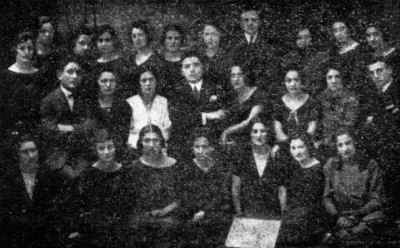
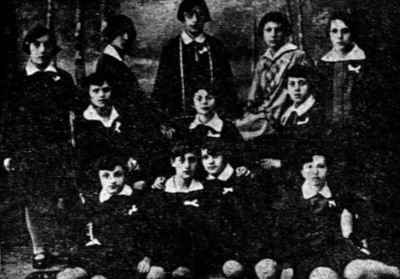
| The managing committee of the Kultura Society in 1925 |
I.Zerubbabel, Dr. Kruk, Elkanon and Ahron Tseytlin [Zeitlin], as well as M. Rawicz, Yehoshua (Stanislaw) Wigodski and so on. Ida Kaminska, [Zugmunt] Turkow, Dodik, alone or with their theaters, gave recitations, scenic appearances. There also [appeared] Shmai Rozenblum and Elihu Goldenberg as reciters of poems.
We would also arrange performances on our own. Every Shabbos [Sabbath] afternoon or Friday night we arranged literary-communal conversations. Discipline reigned over the entire work and, particularly, with regard to the literary-communal conversations. Goldman would lock the door to those who came late to the literary-communal conversations.
Yitzhak Goldman was the living spirit of the Kultura cultural society. He was its chairman and as such, he devoted a great deal of his health and strength so that Kultura would bloom.
The young from the synagogue, working intelligentsia and workers also joined the Kultura Society. The society organized a beautiful, progressive library with a few thousand books. It collected and bought books for this purpose, as well as sold books for income. Parallel to the Kultura library was the general Jewish library (librarian – Monja Landau).
[Page 511]
The Kultura Society numbered 200-300 members. In addition to a vast program of cultural activity, Kultura would invite the intelligentsia who would come on a visit to Zawiercie to give lectures, take part in discussions and so on.
There was a buffet at the library. The society also arranged dance evenings. In time, Kultura became a leftist organization. It worked with the communist aid organization MOPR (Międzynarodowa Organizacja Pomocy Robotniczej [International Workers' Aid Organization]). This was expressed in the character of the cultural activity: the society began to arrange various progressive-leftist literary and communal events. The celebrations of [Y.L.] Peretz, in which Peretz as a socialist was stressed, were particularly successful. The Pilsudski regime began to persecute the society. Two secret agents from the political police – “the large one” and “the small one” from the Defensywa [Defense – Polish security authority] – constantly harassed the activity of the society. In the end, after three to four years of activity, the Defensywa imprisoned the main activists before the 1st of May and held them under arrest until the 3rd of May. They closed the society and took the books from the library. We had earlier [removed] some of the books because we expected harassment.
Thus was the Kultura Society suppressed in the very midst of its blossoming.
One of the effects of Kultura was that it shook up the Hasidic houses. That time in Poland had a revolutionary effect, particularly among the young Jews. A number of them searched for a way to root themselves in the Polish reality and it was believed that this would be possible only if the reality in which they lived were radically changed. This was not absent in the Hasidic houses, perhaps, because, more than others, the atmosphere that reigned in the Hasidic houses was driven by the impulse to pull themselves out, to alter their own lives and life in general. Thus, Kultura had a great influence on the children of Hasidic parents, particularly on the daughters.
I remember that we once organized an evening of entertainment at the premises
[Page 512]
of Kultura, with a buffet in honor of the Society. Several members remained at the premises for the entire night in order to create a fund. Suddenly, there was knocking on the door. We heard that Reb Itshe Erlich was standing in front of the door; we hid (I think in a closet) his daughter who was with us. We told him that she was not here. In addition, we argued with him that we were not doing anything bad; we were only trying to raise the culture of the community through a library and lectures. He left. We thought that we had convinced him and that his daughter would have no problems
Reb Itshe Erlich was a good Jew, but we were nice, earnest children.
Original footnote:
by Nakhum Drezner
Translated by Gloria Berkenstat Freund
|
In approximately 1928-1929, when Goldman resigned from his office as chairman of the cultural society, a large number of those who had organized the society left it: a number got married, some left for other cities or for abroad. Drawn into Kultura were people from the professional movement. The Polish police began particularly to frown upon the organization. They began to harass and to persecute the society and its members so much so that the [books at the] library were subject to being confiscated.
An Esperanto group, led by Klara Borzikowska and Ester Zaks, was created at Kultura.
In May 1929 or 1930, the police arrested a large number of members of Kultura and held them under arrest between the 1st and 3rd of May.
The library continued to exist for a time after the arrests. The leaders of Kultura and of the library, despite
[Page 513]
their different opinions, decided to give the library, which was threatened, to the general Jewish municipal library that was created especially for this purpose. The premises were in Shmuel Sauka's house. Manya Landau was the librarian of the Jewish municipal library.
It should be recorded that every political or politically-oriented organization or movement such as the professional unions had a small library for its members. Only the library of the cultural union was noticed in the street.
The library that was created in 1916 almost did not exist. In any case, it was not noticed.
Kultura, the cultural society, had a great societal effect on the city – it particularly influenced the young.
by Yitzchak Shteinkeler
Translated by Jerrold Landau
It was 1916. The First World War was still in full force. The Jewish youth in the town, who were of school age or of the age of learning a trade, hung in midair from a communal perspective. They were not looked after, and they roamed the streets of the city without a clear purpose, without a path. There were no institutions that would give it a framework. There was no cultural or social corner that might arouse a sense of vitality within them. Their lives took shape in the home, which was shaken by the ravages of war and was not able to rouse them to broaden their horizons of education, both as a young citizen of the complex world and as a Jew.
Those youths, relatively few in number, who succeeded in studying in the high school (primarily the Polish one) felt in their skin and bones that they were liable to deteriorate if nothing would be done to fulfil their needs within a comfortable Jewish framework that would befit the character of youth on the threshold of maturity.
The German occupation at that time was as a mighty wind following the stifling heat of Tsarist rule in Poland, which had retreated in panic before the armies of Kaiser Wilhelm and his ally, the Austrian Emperor.
[Page 514]
|
|
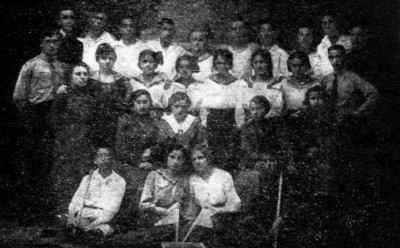
| The first ones of Hashomer Hatzair |
The Jewish settlement in Poland, including in Zawiercie, breathed easily after the Cossack nightmare. The Germans and Austrians did not forbid Jewish cultural activity. On the contrary, they regarded the organizational development of the Jewish community positively, since the occupation authorities thought that this would ensure a support base within the Slavic population whose true character had not yet become fully apparent.
As the front grew farther from Zawiercie, various political and communal groups suddenly sprang up, which later coalesced into more established organizations. The struggle for the soul of the Jewish population of Zawiercie began. The Zionist groups, and especially the young Zionist intelligentsia, felt that they had to stand on guard, preach that this temporary period of occupation was not the solution, and that the solution was the Land of Israel, its settlement, the establishment of full Jewish life there. They began to search for an outlet for their pent-up energies. Such was the group that later consolidated into Tzeirei Zion, around the first Jewish public library in Zawiercie. They did not yet even have solid patterns, but they had a clear plan to bring the Zionist word to the Jewish youths, to the youth of Zawiercie, in whom they placed great hopes.
We, the students of the Zionist schools in Zawiercie, maintained some sort of contact with that Zionist group through various means. We regarded them as sort of mentors, and we held them in great esteem. However, we were influenced to no less an extent when we saw how the Polish youth had begun to arouse themselves to national life and organize clandestinely, such as in the Harcerz scouting organization and the Sokol sports movement.
[Page 515]
We knew that the focus of their aspirations – the Polish homeland – was not the be-all and end-all for the Jewish youth. A portion of the high school students had previously studied – a few years previously – in the modern cheder [cheder metukan] of the beloved maskil Reb Shabtai Szpiewak of blessed memory, the enthusiastic Zionist, who already in 1921 had sent his oldest son Yosef to the Land of Israel. The Orthodox people on the Jewish street nicknamed that school “Cheder apikorsi” [The heretical cheder]. We drew our first knowledge of the Land of Israel from him. We learned Hebrew, Tanach, and grammar from him in a most enlightened fashion. In short, Reb Shabtai planted the first seeds in us. That seed, planted in the aforementioned modern cheder, began to sprout in our young souls. All that was needed was a redeemer. It should be noted that the older people began to organize at that time (the Germans did not go to extremes [in interfering]).
Now it happened that one day, a group of youths from Będzin appeared in Zawiercie for an excursion. They appeared in their full splendor with their scout uniforms, unusual hats that made an impression, and large staffs. We, the youths, were very impressed by this display. Hampel, Ishek Birnzweig (Isser Beeri), Ishek Firstenberg, and others were in this group.
In the wake of this visit, Fela Bornstejn invited a number of youths to her presentation on the topic of the need to establish a chapter of Hashomer Hatzair in Zawiercie as well, in the pattern of the chapters in Zagłębie. (As far as I recall, at that time there were no chapters of Hashomer Hatzair in Congress Poland other than in Zagłębie). Ziga Binder (today an important psychiatrist in Kupat Cholim of Tel Aviv), who was studying at that time in Kraków, spearheaded the founding of Hashomer Hatzair chapters in Sosnowiec and then in Będzin. As is known, Kraków received its Hashomer influence from Vienna. Dr. Eliezer Riger (later the director of the David Yellin seminary in Jerusalem and the director of the education ministry of the government of Israel) and David Horowitz (currently governor of the Bank of Israel), stood at the helm there.
We began to organize immediately after that meeting. The first group was formed. It was not long before we were already a camp of several tens of Hashomer members. We organized courses in Hebrew, knowledge of the Land, and hygiene (Y. Baumac, then a student, lectured). The purpose of those courses was to train heads of new groups, as well as to deepen our knowledge in the field of study of the Land of Israel and the People of Israel. From among the people of Zawiercie, the main lecturers (aside from the aforementioned Dr. Baumac) were Y. Frank, Sh. Chorgel, M. Isserowski, D. Landau, Sh. Klugman, and others. They were members of Tzeirei Tzion, but they helped us to the best of their ability. From the nearby town (primarily Sosnowiec) the following came: Markin (later Maks Erik, an honorable historian of Yiddish literature. He was taken out to be killed in the Soviet Union), Iza Szladowska (today Dr. Peker in Tel Aviv), Shimon Lubelski, Ziga Binder, and Rega Lis-Binder (today with her husband Ziga in Tel Aviv). They lectured to us about various issues. It seems to me that Lutek Reznik, today a sculptor in Tel Aviv, also came.
[Page 516]
|
|
| A Hashomer Hatzair group |
The work was conducted with enthusiasm. The youth found their way and knew where their faces were headed.
Among the first Shomrim in our city were Yitzchak and his brother Wolf Shteinkeler, Meir Isserowski, the Kasier brothers (Moshe, David, and Yitzchak), Lolek Wigderzon, Shlomo Spiwak, Toshiek Bornstein, Falek Perlin, Lopek Brandeis, Zelig Sobelman, Ishiek Goldminc, and others. Among the first girls were The Bornstein sisters (Fela, Ewa, Genia), Esterka Helberg (currently in Tel Aviv), Esther Goldberg, Bronia Hendler, Andzia Edelis, Guta Lewartowska, Szwarchauer, Bronia Brauner, Bronka Liberman, and Bluma Freiberger. The following were in the younger groups: Regina Helberg, Mindzha Zylberberg, Andzia Szwarc, Fela Torgownik, Lola Bochner, Bronka Weksler, Hela Szolewicz, Lea Zalcberg, Notka Wigderzon, Andzia Perlin, Karola Swyka, Hela Kasier, the Steinkeler sisters (Genia and Bronia), Fela Bochner, Mania Baumac, Hela Greicer, Fingerhut, Hela Feiberger.
The first Hashomer excursion of the entire region took place in Zawiercie already on Lag B'Omer 1917, with participation of chapters from Będzin, Dąbrowa, Sosnowiec, and Częstochowa. The enthusiasm in the city was great when hundreds of Jewish youths appeared in its streets organized in nice rows, accompanied by a flute band. Drummers walked at the head of the group. That was a holiday in the city, and the excursion was a strong Zionist demonstration.
That excursion gave a new impetus to the movement. The movement grew in numbers as well as in quality.
[Page 517]
Only a small group of half assimilated students – Refael Janowski, Michael (or David) Janowski, Helman, Berman, and others – attempted to form a scouting movement for assimilated youth under the name of Berek Joselewicz. In truth, they desired very much to enter into the general Harcerz, but they were not allowed. The doors of that movement were locked in the face of “Yahudomim”.
That group did not do very much. It quickly disappeared from the horizon of our societal life in the city. It had no influence on the trajectory of our work and thoughts.
Whereas we grew, ever growing. Our wide-branched activity brought us to the point where youth from the nationalist strata began to stream to us – and not only high school students. With the passage of years, as the founding initiators left, they took upon themselves the objective of maintaining and developing the movement. During the first period that I am describing, we reached the point of having 180-200 Hashomer Hatzair members, and possibly even more.
Differences of opinion and fundamental debates arose during the period of the first convention of the regional chapters that took place in 1918 in Będzin, and that was supposed to be a sort of gathering prior to the national convention in Łódź in 1919. Shimon Lubelski, who drew closer to the left-leaning Poalei Tzion, espoused the view that the movement should be more broadly Jewish rather than restricting itself solely to Zionist and Land-of-Israel education. Debates regarding that were aroused even among us. I was in favor of continuing the path that was based on our activities to that point, whereas Esther Goldberg supported Lubelski's opinion. This matter aroused stormy debates. Esther was chosen to represent the opinions of the majority, and I, to represent the minority which was in favor of continuing the existing path.
|
|
| A group of Hashomer Hatzair elders |
[Page 518]
After some time, the Herzliya movement was founded. The prime founder was Meir Isserowski. Tensions and disputes arose between the two movements, and, in the end, both of them lost the majority of their members.
The Hashachar organization was founded in 1921. I was among its founders. The two movements gave forth to young women such as Jadzja Landau, Sara Berger, Andzia Haberman, Sara Brauner, Regina Landau, and others. And from among the young men: Plawner and others. Y. Goldman and others joined Hashachar. Hashachar was a Zionist group that stressed the doctrine of A. D. Gordon. It should be noted that young men and women from Orthodox households joined the movement, and this aroused battles among families.
With time, Hashachar shrank relative to the two movements of Hashomer Hatzair and Herzliya.
After two years, Hashachar returned to the bosom of Hashomer Hatzair. With the renewed merger, we again became an honorable movement in the city. We actively joined all Zionist activities. We were present at the international convention that took place regarding matters of KPE”Y (Kupat Poalei Eretz Yisrael), which was the basis for the establishment of Bank Hapoalim. We participated in the selling of shares of Bank Hapoalim, in the conducting of collections for Keren Hayesod, and other such activities.
The movement greatly weakened with the Aliyah of the best of the Hashomer youth.

by Meir Isserowski
Translated by Jerrold Landau
The vital need for establishing this organization and its functioning in full measure was felt without bounds in its full actual urgency. When it was established in 1916, the finest of the local youth became involved with it, most of whom had acquired their knowledge in the educational institutions of the city.
That period coincided with the peak of the blossoming and growth of Hashomer Hatzair, and the deep popularity that the Tzeirei Tzion organization had gained for itself, which encompassed the best and finest of those who were enthused with the Zionist vision, and who aspired to social advancement. With all this, a broad field still remained for large-scale activity among the ranks of the youth who were studying in the upper grades, of whom there were many, who did not find their path in Hashomer Hatzair with its elitist character and its command-oriented sporting discipline. To the same extent, they were far in those days from connecting with the societal-political communal body, for, with all this, they could not find an arena for the desires of their souls that were fermenting with the storm of the streams that were surging around them.
[Page 519]
Herzliya devoted only a small amount of attention to the characteristics that typify every regular organization, and the formalities involved in such, similar to connections with the outside world, and the like, that have an element of wasting precious time for empty formalities. It always dug toward the deepening of national consciousness, strengthening the understanding of the renaissance of the values of the nation and its historical heritage, the strengthening of the connection to the Land that was shaking off its desolation with the dynamism and pioneering that demanded so much from every youth who thirsted for action toward realizing the vision.
Herzliya toiled and nurtured with great understanding the blessed blend between general knowledge that one could obtain in a natural way from the school – and the treasury of Jewish knowledge that delved into all the Jewish values and the renaissance that Herzliya imparted to its charges. This arena included discernment and delving into areas connected to various fields of knowledge which light up the paths of renewal of the nation, the Land, and the language. In this way, Herzliya persistently sought to create harmony and complementarity, a comprehensive fusion and synthesis between two worlds that were united into a single natural whole. With lectures and debates, parties, studies, field trips, and the like – the path of broadening the horizons, of avoiding seeing the matters through a narrow lens and restricted vantage point of the Jewish world being only a separate entity was always preserved.
We frequently employed analogies and comparisons, correspondences, and complementarities from every sphere of life, society, and art, while distancing ourselves from a narrow scholastic domain, dry learning bereft of the spirit of the age, and the gathering and piling up of knowledge devoid of contemporary significance. All this was intended to equip and fortify the young soul, which for most of the day drew its sustenance from a foreign culture, so that it might spend as many unbroken hours as possible within a circle and environment imbued with yearning and aspiration for the finest ideals of the Jewish Renaissance in the broadest sense of the term.
|
|
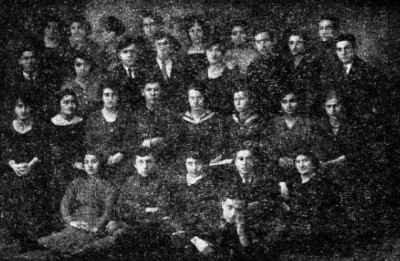
| A group of founders of Herzliya |
[Page 520]
|
|
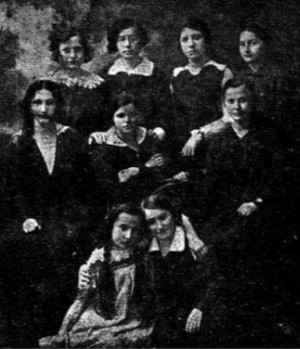
| A group of female Herzliya members |
Side by side with this intellectual orientation, no attention whatsoever was diverted from practical and vigorous activity, and the closest ties were maintained with the other Zionist organizations in the city.
Indeed, these were great days, days of mission and action, a period pregnant with renewal and awakening, of taking hold of the roots hidden in the dawn of the nation and in the mists of ancient generations – days of carrying forward the course that spanned the tragedy of a people's existence in exile and its yearning for full freedom and redemption, for the restoration of its liberated identity and its mastery of the soil of its homeland, while embracing deep-rooted ties with all that is beautiful and noble in the cultures of the world.
And thus, the flame was ignited and the simple faith consolidated, because
“Upon the soil of the nation, and in the depths of its soul, the Divine Presence [Shechinah] would yet shine and sparkle.”
It is possible that this description may seem somewhat exaggerated in relation to the limited scope of this organization in the city, yet such was the state of mind and the feeling. Thus, there stirred within our hearts an aspiration, charged with immense tension and power, to break through the boundaries of reality. I believe that in this ideological sphere, inner fervor should not be measured by the size of the cell, but by the wellspring of youthful purity and the eternal longing to become part of the fabric of a world reborn.
by Avraham Shlomo Grinblatt
Translated by Jerrold Landau
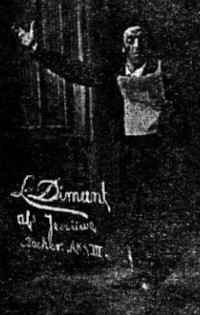
Troupes of amateur actors began to organize prior to the First World War, and especially during that war. Brandes, an official of the A.A.Z. hospital, was a director and actor. One troupe was directed by Horwitz, who was a bookkeeper at Bank Wzajemny [Mutual Bank]. Leibel Dimant was an actor and a veteran director of a troupe. Yosel the Grete's played as a “character actor” in his troupe. They especially performed on Purim. At times, they would perform in the house of Reb Shabtai Spiwak, and would attract a large audience. Szywek, and the Dombrowski (Eliezer and Shlomo), similarly performed.
|
|
| Leibel Dimant in the role of Yeshiva Bochur [lad] |
Szywek was a dance teacher. He was the first to arouse a sense of rhythm among the people of Zawiercie.
From among the melamdim in the city, I recall Moshe Plawner (Kushka) in the house of Wolf Bochner. His wife was the “Rebbetzin” Rachel, who went from house to house teaching “Ivri” [Hebrew]. The melamed Reb Yitzchak lived in Czebiner's house (later in Koniecpolsi's house). A Hebrew teacher, a native of Staszów, whose name I have forgotten, lived with Oksenhendler in the new market. He was a Hebrew teacher, and excelled in teaching Gemara. I also recall Grunem the and the melamed Mlelow.
[Page 522]
There were also amateur painters and sculptors in Zawiercie. The engineer Yehoshua Bochner (son of Velvele Bochner), and David Meir Grinblatt, who along with the well-known Jewish painter Anshel Manowicz, designed the synagogue of Żarki, were involved in painting. Chaiml Edelis and Leibel Dimant, who worked in the glass factory, were also involved in painting. Leibel Dimant, David Meir Grinblatt, and Yehoshua Bochner set up a studio in Velvele Bochner's house. Later, Alter Shamash's son began to paint, and after that, the well-known painter Henri Weinglik [Weingluck]. He graduated from academies and became a professional painter. Currently, he is in Canada. Alter Shamash and Shmuel Hoffman were wood sculptors.
The Leizerowicz family formed a sort of teaching dynasty in our city. The elder Leizerowicz came after the teacher Zlotnik died. During the time of the First World War, Leizerowicz the father felt himself more of a Pole than a Jew (it was the same with his son). He came to Zawiercie around 1918-1920. At first, he served as principal of the private school, which later received the status of a public elementary school. His son took over the leadership of the school after he died.
Jewish teachers in Zawiercie were: Rafael and David Janowski, Meir Isserowski (in the Yesodei Hatorah school), Sh. Spiwak, L. Wigderson (Mizrachi school), Esther Goldberg, Hela Kreizer, Malka Kreizer, Mania Bleifer, L. Wigderson's sister, all of whom taught in the elementary schools for Jewish children (under the leadership of the son Leizerowicz). The following were teachers in educational institutions (but I do not remember where): Berl-Dov Blatt, Yitzchak Szteinkeler, Wilek Torgownik, Wilek Ruszinek, Davidek Sobelman, Andzia Haberman and Yankele Ehrenfrid.
From among the scribes [sofrei STaM] I recall the son-in-law of A. M. Janowski (the father of Rafael and David Janowski), and one other elderly man whose name I do not remember. They said about the elderly scribe that, after an official of the hospital purchased a piece of parchment from them to write the founding scroll of one of the hospital buildings, and paid well, his wife said, “I'd be doing just fine if I had to make my living from Jews.” The meaning was that this was the only transaction she had with gentiles.
I remember the women's charitable organization. The active workers included: the wife of Reb Kopel Hendler, Sara Lewartowski, the wife of Reb Berish Szniderman, the wife of Ever Percis, and others. There were various charitable organizations in the Orthodox circles. Among the participants were the wife of Reb Yechiel Windman, the widow of Reb Hendel Landau, the wife of one of the Turners, and others.
Excelling in the outside world: Wiktor Weintraub, the son of the treasurer of T.A.Z. He currently serves as a professor of humanities at a university in England. Jerzy Helman excelled as a musician. The following Zawiercians worked and currently work in journalism: Shabtai Klugman (K. Shabtai), Sh. Spiwak, Dr. Shlomo Froman, David Landau, and others.
[Page 523]
|
|
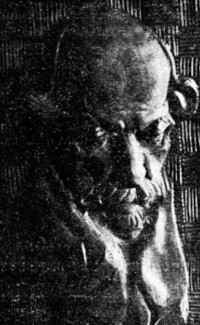
| A sculpture by an artist from Zawiercie |
The following are involved in literature: Moshe David Kasier (in the United States); Stanislaw-Yehoshua Wigodski (a grandson of a Zawiercian) in Poland; Moshe-Mietek Neiman, the editor of publications of the Ramat Hakovesh Kibbutz; Shmuel Roz, the editor of Hatzofeh for children.
It is worthwhile to note that the assimilationists set up a scouting movement for assimilationists called Berek Joselewicz. The driving force for this was the engineer Mamelok. The following were active in it: Rafael and David Janowski, Jerzy Helman, Bankier, Dolek Semiaticki (son of a photographer), Wanda Berkowicz (daughter of a dentist), and the girls, Rabinowicz and Banker. It seems to me that Ania Bornsztejn and perhaps also to some degree the young Wiczic participated in this. That organization disbanded after some time.

|
|
JewishGen, Inc. makes no representations regarding the accuracy of
the translation. The reader may wish to refer to the original material
for verification.
JewishGen is not responsible for inaccuracies or omissions in the original work and cannot rewrite or edit the text to correct inaccuracies and/or omissions.
Our mission is to produce a translation of the original work and we cannot verify the accuracy of statements or alter facts cited.
 Zawiercie, Poland
 Yizkor Book Project
 JewishGen Home Page
Copyright © 1999-2026 by JewishGen, Inc.
Updated 13 Nov 2026 by JH