 |
|
|
[Page 255]
by Yehudis Leshem
Translated by Theodore Steinberg
In our town of Gorzd, as in other cities and towns, there were very fine and interesting people. They will surely be depicted by some natives of Gorzd in our Yizkor Book, and there was no lack of interesting types and personalities in our town.
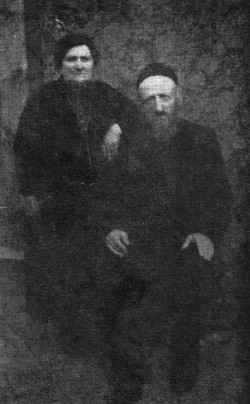
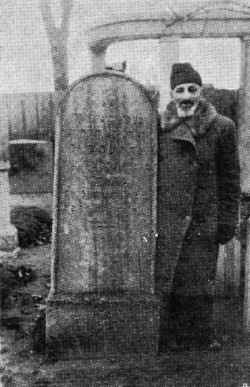
One of the very colorful and striking personalities for us in Gorzd was Fayvl Melamed, who is deeply engraved in my memory, and at every opportunity when I recall our town of Gorzd, his figure emerges in my memory.
Fayvl Melamed was a man with a clear conscience, a tzadik. He was a well-known community volunteer in the Jewish kehillah. A Jew, a scholar, loved and trusted by everyone who knew him. And who did not know him? A man with a soul that was pure as crystal and whose heart was warm toward everyone. Everyone had confidence in him and he was trusted by all levels of the town's population.
Fayvl Melamed was not wealthy. He ran a small apothecary. I remember how he would carefully weigh things on a small scale that was specially made for apothecary items. He would weigh with special precision the medicinal cures for patients that the doctor had prescribed for the ill.
Although Fayvl Melamed was neither wealthy nor eminent, he never refused to lend a couple of rubles to a needy Jew, and in town people knew that if someone needed a
[Page 256]
loan, he could easily come to Fayvl. Fayvl did not ask a lot of questions about when and how the loan would be repaid. He trusted everyone, as everyone trusted him, and everyone who was in need found his way to Fayvl's heart…
Fayvl Melamed had a wonderful family. His wife, Risha, was just like him. She was a righteous woman–a woman with a good heart, ready to help everyone. And just like her husband Fayvl, she was always busy with her housework and with helping Fayvl in his shop. She was a “woman of valor,” always in motion, always busy; but in her free time, one could see her sitting by the window with her “Qorban Mincha” [a prayer book] in her hand, as she chanted from the book. Understandably, she never failed to pray…
They had five sons and two daughters. Sadly, only one son, Yitzchak, remains alive. He now lives in Chicago and is known as “Dr. Rabbi.” I recall dear Micah, my friend from childhood. Micah was a community activist in town. I remember how he helped me at the time of the relief action for the Polish forced laborers in the village of Vizeitz whom the Germans had taken into captivity in 1917. The Germans held 400 people in a prison camp in difficult, inhuman conditions.
I remember Fayvl Melamed in connection with a certain experience from my early years, when I was a young woman of perhaps sixteen. In Gorzd there was a volunteer charitable organization called the “Linas ha-Tzedek.” Its main job was to help people who were ill, giving them moral and practical help, mainly by staying with them at night, bringing them their medication at the right time, helping them to sit up when necessary, and so on. This was an important charitable organization that would also bring a doctor to the needy, help the sick person with medicine if he could not buy it himself, and so on.
There were many such organizations in Lithuanian cities and towns. I remember a case when I was walking down the street at 5 o'clock one Shabbos morning after I had spent the night with a sick young woman in the town. Suddenly I ran into Fayvl Melamed in the street. It was cold and dark outside. (In those days the streets of Gorzd were neither lighted nor paved.) I was walking home in the dark, deep in thought, after my night's duties, when I suddenly encountered Fayvl. At that early hour he was already on his way to the beis-medresh to pray. Fayvl was nearsighted, and he did not notice me. When I got close to him, I greeted him with a cordial, “Gut Shabbos”--and he immediately responded to my greeting with a polite “Gut Shabbos–Gut Yahr” and then asked, “Who are you, my daughter?” I answered that I was Yudiska, Pessa-Hirscha Leibes' daughter, and he immediately said, “Oy, my child, where are you coming from so early?” When I told him that I was coming from a sick woman with whom I had spent the whole night, he said, “That's a great mitzvah. I'll walk you home…”
In our town of Gorzd there was no lack of dear, good people, and was was then not a good person? Every person in his or her own way impressed with good qualities, and who could count them all up? Who could describe them? Our
[Page 258]
sacred duty and responsibility is to establish an eternal light, a memorial light, in their sacred memory in our Gorzd Yizkor Book. Therefore I have allowed myself in this case to share some words to sanctify the precious memory of one of those dear Jews, Fayvl Melamed, who is a symbol for all the good Jews of our town who were killed as martyrs in the time of the bloody destruction. May his memory, and the memory of all of the town's Jews, be sanctified forever.
by Dr. Hershl Meyer
Translated by Gloria Berkenstat Freund
The question about “the righteous suffer and the wicked prosper” began to torment me before my Bar-Mitzvah. It came to me witnessing my father's suffering; I would speak about this with Zyzke Zusmanowicz. He was a little older than me and thought himself a philosopher. However, barriers soon arose between us that divided us. He had received almost no Biblical nor Talmudic education and, in addition, he was emotionally cold. I was led to Rambam's Guide to the Perplexed by Yankl Gamsoy, a spectacles-wearing young man in his thirties, with reddish hair, a mild face and of whom it was said that in the Slobadker yeshiva [school for the study of Torah] he was considered a genius. He always rummaged in books and prayed near our bench barely moving his lips. In addition to the question of “the righteous suffer and the wicked prosper,” I also discussed the question of “choice” and “predestination.” I learned a great deal from Yankl.
Yankele, the barber, taught me the alef-beis [alphabet], as well as plodding through the Bereshis [Genesis] portion of the Khumish [Five Books of the Torah]. He was a short, lean, pointy-noised man with a sparse beard, sunken yellow cheeks and the voice of a cooing dove. Before noon he was a barber; after noon he was a teacher of small children, preparing several children to learn in kheder [religious elementary school]. During the first few lessons several kopekes [small coins] were thrown on the sefer [book, usually a religious one]: “An angel had thrown it down,” he said, for learning well. He would always come into our home in a great hurry and question me. Before I would translate a verse into Yiddish, he already had the pointer on the next one. I would hear my parents speak together saying that it would be impossible for me to go the Reb Gershon-Feywe's kheder. First, because
[Page 260]
he would not admit such a mischievous child (I was a wild one and would fight with the Heiling boys) and secondly, because of the high tuition…
Reb Gershon-Feywe was a Jew of stately appearance; as straight as a string, with a beautiful four-cornered white beard and with the manner and understanding of an educated aristocrat. His “kheder” consisted of a small room in which three purple velvet chairs, on which no one ever sat, stood in a corner – few were worthy of the honor. He would accept only a few children whom he would first examine thoroughly. He was also known by the fact that he touched no child with his hands. One day I went to him by myself to ask him to take me into his “kheder.” He bent down to me, looked at me silently, asked me what I knew, questioned me a little and sent me away saying “I want to talk with your father.” Later when my mother wanted to restrain her Sambatyon [legendary impassable river beyond which the 10 Lost Tribes can be found; “restrain her Sambatyon” is an idiom meaning control a difficult child] a little, she would call out: (not without a certain pride) – “A fellow who went alone, without our knowledge, to Gershon-Feywe!”
My father, seeing the zeal with which I threw myself into all kinds of scholarly books and that I was also trying to learn English, agreed to my traveling back to Plungian, but on the condition that I would take a lesson of gemara [rabbinical commentaries] with Reb Leipzig, a distinguished scholar from Kelme who then lived for a time in Gorzd. I took the lesson with Itske Melamed, the son of the scholar Feywl, and just about the marriage treatise. Itske possessed a sharp sense of the comic: the contents of the lesson with Reb Leipzig's certain naïve gestures and grimaces would immediately cause him to cramp, choking his laughter. Looking at one another, we would both burst out into spasms of laughter. Not me and not Reb Leipzig
[Page 261]
knew why we were laughing – until, one day, he “dismissed” us both.
Elya the shoemaker lived with his family in a side alley in a few small rooms where he silently worked at a poorly lacquered table, pieces of leather, a broken down chair, a rubbed out oil cloth, a small hammer, a small pliers, a chisel, a few knives, patterns and other tools. This was his workshop. His young, genteel face, his small dark eyes, radiated with an inner light. When he looked at someone with his thin smile it seemed “that he knew something about which he did not speak.”
From time to time I would come to him with a few shoes to be repaired. Once, noticing a little closet with books in a small side room, I asked him what he was reading. “There is not enough time for this,” he answered, pointing to the pile of shoes. He asked, “And you, do you already read books?” Boasting, I answered, yes, a book by Rambam and I began to speak about the problem of “knowledge” and “free will.” He laid down a boot on which he was putting a sole, scratched a tuft of hair, thought for a while and then said: “You are confusing yourself with simple speculations. If God knows or not, for instance, if a fire will break out in my house. I am sure that here, Gershon Yankle's son will not be the one to start it. What we do depends on our upbringing, knowledge and sense. Elya the shoemaker had a deep effect on me.
Bere-Welwe the baker was blessed with an encyclopedic memory; he never wrote anything down, but knew exactly the dates of all births, marriages and the yahrzeitn [anniversaries of a death] for everyone in the shtetl; knew exactly every life history including that of their grandfathers and grandmothers. He knew everything that happened in the shtetl during the course of generations. And if someone needed to learn something about this, he went to Bere-Welwe…
[Page 262]
– He was a poor man, who had a sick wife. Baked bread and challah [braided egg bread] for Shabbos [Sabbath] in a tiny little room of his small hunchbacked straw covered little house, from which it seemed that steam was gushing out. He regularly walked a little bent over in thought in old, flour covered clothing, curling his half gray, half black beard with two fingers. When he met someone walking in the street, his face smiled, his eyes brightened as if asking, “Ask something, I can tell you so much…”
Every city – Jews in Lithuania would say – had its “city meshugenem” [crazy people], but small shtetlekh like Gorzd could not permit itself such a “luxury.” It was satisfied with a little, “a disturbed one,” someone “who had a screw missing in his head” or was just strange. Gorzd had two such: One was Shmuel-Hirshke, who loved the bitter drops [liked to drink whiskey]. When he was a little tipsy, the group of jokers would begin good naturedly to bother him, to elicit from him very spicy remarks – “Agreed – agreed”
– he would answer them in a bass voice – “I will tell you such that you have never heard before, but first let me turn to the side, so that I will not see how you gather a few groshn for me”…
The second one was Mendl-Dovid, a tall, slender, stately Jew who working at a job with a merchant, would from time to time travel to Memel. As a rule, he would speak to the point on everything, but only recall the word “stones” and he would remain standing as if bewitched. A strange fire would begin sparkling in his eyes when he began talking about accumulated stones: “What stones – sapphires, emeralds, a fortune, I can buy up the entire shtetl with one of them.” The shtetl clowns would say to him, “If Reb Mendl-Dovid sold several of them to the rich Memel merchants then you would become rich.” “Who told you that I will not sell,” was always his answer – “but they do not yet buy!”
by Moshe Katz (Kibbutz Ramat Rachel)
Translated by Sara Mages
I remember the Jews of Gorzd only vaguely, a childhood memory. I was eight years old when I left the town for a place of study, and only visited my father, R' Yiztchak Yehudah Leib (Itze Leibele), twice a year (I did not know my mother because she passed away when I was a four-year-old toddle). A short time later my father z”l also moved to a new place. Although I did not cut my ties with Gorzd, because I occasionally visited my mother's relatives there, I cannot describe the Jews of Gorzd in a faithful manner that would be worthy of the memorial that we are erecting for our loved ones. I cannot even portray my father in a way that befits him, because I did not know him well enough to sketch his wonderful character. Nevertheless, I will portray him as a son's duty to his father.
My father was born in Vabolnik [Vabalninkas] the Biržai district. As he grew up, he came to Riga [Latvia], his parents' city of origin, and was accepted by the cantor Shlomo Rosowsky, who was the most famous cantor at that time. My father was gifted with an absolute pitch and a musical talent. He traveled with this cantor through the cities of Russia and reached Helsinki, where he served as a cantor for several years. Later, he arrived in Gorzd where he married Nechama, daughter of “Moshe Bere Rishes,” the name of my grandfather, the father of my future mother.
My father endeared himself to the town's Jews with his pleasant voice, although he never held a permanent position as a cantor. Only in later years he wandered through the towns of Lithuania in the framework of “to listen to the singing and the prayer,” to supplement his livelihood. He was called to the Torah by the name, Yitzchak Yehudah, son of Yahushua David HaCohe, but in the town he was known the nickname Itze Leibele, maybe also because of his short stature. He was a humble Jew, but proud of his Judaism. He blessed the bad just as he blessed the good and rejoiced in his lot. He was always ready to welcome the Messiah, and he was afraid that he would miss welcoming Him in the first moments of His appearance… He was honest and believed in every person wholeheartedly. Although he came from a Litvak [Lithuanian] family of opponents [of the Hasidut], his behavior was in keeping with the custom of the Hasidism.
He defended all Jews and knew how to make them happy at the synagogue and
[Page 264]
at other celebrations. I remember visiting the town on Simchat Torah when my fathered traveled to Tevrig to serve there as a cantor for the High Holidays, the holiday of Sukkot and Shemini Atzeret. R' Yosel Furet (Peires) the slaughterer said to the town's rabbi, R' Shabtai (Spesil Shapira) “when Itze Leibele is not here, something is missing in Simchat Torah”… My father was not only a cantor with a pleasant voice, but was what the “experts” said, a Jew who knows how to read music notes. And indeed, my father wrote notes with the speed of shorthand, even if he had to copy a melody from a distance. When my father visited the town, the brothers, Leizerke and Gutke, Zucker sang cantorial pieces together with my father. My father also taught them to read music notes. The Zucker brothers had wonderful voices and were gifted with musical talent, and my father predicted a great future for them. From what I have heard, both brothers perished in the war as soldiers in the Soviet army. Perhaps, by mentioning them in a few words, I have made a small contribution to their memory. They were both good friends of mine, and I especially loved Lazerke with all my heart.
My father stayed away from gossip and slander as a tzadik [righteous man].Therefore, the town's women sometimes came to him to ask for an incantation against the Ayin Hara [evil eye] for their sick child.
My father, R' Yiztchak Yehudah Leib (Itze Leibele), was a lean and weak man in his body, but he knew how to stand firm in his opinion. I remember an incident after Lithuania gained its independence and soldiers were stationed in Gorzd. There were not enough barracks to house the soldiers, and the town's Jews were ordered to house them in their homes. Our house had two apartments, and my father housed the soldiers in one of them. I remember that the soldiers treated my father with respect and addressed him with the title “Panas Rabinas,” meaning, Mr. Rabbi. But an incident occurred on Passover. One of the soldiers left half a loaf of bread in the corridor after my father was promised by the soldiers, and also by the officers, to be careful during the holiday of Passover. My father complained that they had failed him in Bal Yere'ah and Bal Yimatzei[1]. The officer investigated until one of the soldiers admitted that he had done it out of forgetfulness and asked for forgiveness from my father. My father believed the soldier's words and asked the officer not to punish him. And there was an incident with the eruv[2] that my father installed. We had a gentile neighbor, a bad person by nature, although I am not sure he hated Jews. The gentile couldn't tolerate the
[Page 265]
poles and the wire before his eyes. The eruv, which was near his yard, bothered him and forcefully tried to remove it. My father strongly opposed this gentile until the person in charge of cleaning appeared, and preached morals to the gentile who was harassing my father and his commandments. In this case too, the gentile asked my father for forgiveness. My father dreamed that one day I would leave to study at Yeshivat Chofetz Chaim in Radin [Raduń], with the genius tzadik of that time, Rabbi Yisrael Meir HaCohen [Kagan]. He also dreamed that one day I would wear the robe of a scholar, a garment befitting a man who learns the Torah from his rabbis.
I remember an unforgettable experience when I came to part from him before I made aliyah to Eretz Yisrael in 5693-1933. When I entered the house, my father began to dance and sing with enthusiasm and devotion, and I saw that he had a strong desire to infect me with joy as well. I did not know the meaning of his joy. But, after he calmed down a little, he told me that people told in Riga that our family tree, on the side of our forefathers, and great-great-grandparents, was discovered and it reached to Ezra the Sofer[3]. The joy was not as much from the lineage itself, but from the knowledge that he was indeed a true Kohen, Kohen Tzedek as our name, Katz[4], suggests. When we parted ways, he saw fit to order me to study a Gemara page every day (or a least a chapter of Mishnayot), keep my mother's day of remembrance. To visit HaRav Kook[5] (because he knew my grandfather in Latvia), and most importantly, to learn a little “music,” meaning to “sing.” He added, and said: “remember, my son, a Jew who doesn't know a little music is, God forbid, not a perfect Jew…” And indeed, my father was right, if you know music it can dispel melancholy. Unfortunately, I only fulfilled one wish, and that was: I visited HaRav Kook in Jerusalem the first week of my arrival in Israel. Another wish I still fulfill, I every now and then peek into “the book.” But I remained an “imperfect Jew” because, unfortunately, I was not endowed with a talent for music. I regrate that I could not fulfill my honest father's wish. Mt father had another fine trait, love of order and cleanliness, not because “a scholar that a stain on is seen on his garment is bound to die,” but that was his nature from birth. And indeed, his clothes were spotless, his beard was always well-groomed and neat especially in honor of the Sabbath. My father sang Shabbat hymns even over herring and a slice of bread, as he would have sung if he had sat down to a righteous Feast of the Wild Ox and Leviathan[6]. He performed the Havdalah service on Shabbat night over a cup of tea without enough sugar the way he blessed the best wine.
My father, Itze Leibele, did not push to go in first. He always knew to honor
[Page 266]
his fellow man. I remember that during my visit on Passover eve, after a “period” of studying at the yeshiva, he wanted to honor me as a guest who would enter before him. I refused out of respect for my father. So, he gave me a prayer book and said, with a sacred book in your hand you must enter first…
Four spiritual leaders of Lithuanian Jews served as a revered symbol for him to follow in their footsteps. They were :the Vilna Gaon [R' Eliyahu Zalman], Rabbi Chaim [Soloveitchik] of Brisk the symbol of a Lithuanian scholar and Rabbi Yisrael [Lipkin] of Salant. Rabbi Yisrael Meir HaCohen, “Chofetz Chaim,” head of Yeshivat Radin and the symbol of morality and humility. He always regretted not having attained at least a “sixth” of their attributes… Now, as I myself have reached old age, when I try to weave the image of my father from childhood memories and ask him where his beliefs and piety came from, I understand that these personalities served as role models for him.
There was a Jew in Gorzd, Bere Velve. A particularly wonderful character that my father liked and loved to talk to about the wonder of creation. The man had a phenomenal memory, a walking encyclopedia, and a better researcher than him. These two, my father and Bere Velve. were soulmates, my father loved his stories and Bere Velve loved my father's singing.
I heard about my father from a woman from Plungiany, who was in Telz Ghetto, and was not far away when my father was murdered. And the act was as follows: The murderers demanded him to sing (I don't know if they knew him as a man who could sing) but he refused, saying: “My singing, is a prayer in a synagogue for decent Jews and not to murderers like you who will murder me after I sing before you.” He slapped the officer in the face, seeking to express his pride, and the pride of all the Jews of the ghetto. The officer shot him on the spot. I haven't checked the truth of the woman's words, but I take comfort in them, because perhaps he was spared hellish torment. May the memory of the righteous, my honorable father R' Yiztchak Yehudah Leib, be of a blessing!
There were many other Jews in the town whose names deserve to be remembered and described faithfully. This will certainly be done by the townspeople who lived in the town until its annihilation. But I feel obligated to describe at least a few of them, even if only in a few words, because they played a part in my life after my mother died. One of the characters is Leah Bere Moshe'es my grandmother's sister, and her daughter Mirka Leah. A Jewish woman in all her body and soul whose lips murmured prayers from Tz'enah Ur'enah. For her living she knitted socks for the town's families. I remember her walking down the street with a sock threaded on the knitting needles,
[Page 267]
and on the elbow between the forearm and the arm. In her basket were several eggs for sale to the housewives, and a prayer on her lips…
Mirka, her daughter, is etched in my memory as a young woman with a heart of gold who loved to laugh. She served as “housekeeper” and manager of the store that remained after my mother's death. Both of them, the youngest daughter and the mother, regrated that my mother did not get to see her only son who would surely grow up to be a scholar… And I will never forget another character from my childhood, Fruma Rishe Melamed of the Volpewich family. It is appropriate to describe the members of the Volpewich family, but I will not dare to obscure their image. I will only express in a few words my love for the dear character, Fruma Rishe, my mother's cousin. Fruma Rishe's mother, Toibe Hene, was my grandfather's sister, he is Moshe Bere Rishes. Fruma Rishe was a modest and righteous woman who was always in a hurry, and order and cleanliness reigned in her home. She cared not only for her family members at home, but also for those who left for “independence”… Her concern was also for people who needed to be given at least a little food in secret. And Fruma Rishe took care of them. This dear woman took care of me and my sister, Shifra, just like a loving mother with the help of her daughter Shipke, who is also a figure I admire.
With her kindness, Fruma Rishe bathed us, fed us, and even clothed us without hearing any complaints from her sons and daughters. In her free time, which was not many, she sat by the window in daylight and read Tz'enah Ur'enah[7] aloud and in a melody. I remember her husband. Feibel Melamed, only in his appearance. but from a rumor I heard that he was righteous man in his manners. When I came to my relatives to receive a parting blessing before I made aliyah to Israel, Fruma Rishe said worriedly: “such a young boy, how will he travel alone, who will take care of him without a relative and a redeemer…?” Max Volpewich, a young man who was loved by people, was among the first to be murdered. He reassured Fruma Rishe saying: Mosh'ke is bold and mischievous, he will know how to get along. I haven't seen Max since 1933, I did not know him in his adulthood and I regret that.
And I still remember Moshe Leizeer Itzkis, a somewhat strange but precious character. Once, in Beit HaMidrash, I was frightened by his mighty shout of “Amen,” which was heard in the distance and seemed to echo from one end of the world to the other. He believed that calling Amen out loud would bring the coming of the Messiah closer. Moshe Leizeer Itzkis was a Jew of above average height, and a red beard adorned his face. He worked in a butcher shop, and it seemed
[Page 268]
that his job had hardened his character, but not. As I heard from the Jews of Gorzd, he engaged in giving in secret, charity for charity's sake, and even borrowed money to give charity. I admired him as a good and devoted Jew, and I knew he did good things for people, but in my childhood, I was afraid to stand next to him when his voice thundered when he said Amen…
And there was a Jews, our neighbor across the street, R' Moshe Zucker (“Zuckrel” was his nickname in the town). His height certainly did not reach one and a half meters. He lived in poverty and hardship but never complained about his fate. He often came to my father to talk to him, to sing and hear melodies. They mostly spoke longingly about the coming days of the Messiah, to the point that they began singing melodies about the arrival of the Messiah.
Constant laughter was on the lips of Zucker's sons, Leizerke and Gutke, and they always sang. The two brothers had an uncommon memory and they never forgot anything. Leizerke was my schoolmate. They both tried to infect me with the cantorial music of Yossele Rosenblatt, Syrota and Kwartin, but my ears were sealed to music. They were very sorry for that, especially Leizerke. The two were cheerful pranksters who matched my “level.” They are a personal loss to me.
My contemporaries, former residents of Gorzd, probably remember Rabbi Heshil, the “Shtiebel Rabbi.” A Jew, a strict teacher who, despite his strictness, also managed to teach… His beard was very long and his glasses, in a simple thin frame, rode on the tip of his nose. He looked at his young students over his glasses, not through them. In his anger, he bit his finger to soothe his anger. If a student misbehaved, he hit the bench once with his stick and once on the student's shoulder - but with mercy, a Jewish compassion. A rabbi's compassion for his student, whom he must nurture for the future… I don't know if he was a scholar, but I do know that he was a very successful teacher of young children. He was humble and content with the position of teacher of young children. All of us, my contemporaries, some of whom who live to this day, are lawyers, physicians, scholars, simple people and kibbutz members, owe the foundations of their education to the “Shtiebel Rabbi.”
Gorzd was a town full of precious and wonderful characters. However, as I said, I was a child when I left the town and I regret that I cannot dare to describe these dear Jews. and I certainly deprived those whom I dared to describe. I hope that the natives of Gorzd, who lived in the town, will do better than me. And that is our duty. All of us together we will place a memorial candle for their pure souls.
Translator's footnotes:
Bal Yimatzei: This prohibition means that chametz should not be found in one's home during Passover. back
by Dr. Ben-Zion Inberi-Burshteyn
Translated by Sara Mages
Dr. Eglishtein was born in Gorzd to his parents R' Alaia and Pesa Eglishtein (the mother came from Płungiany). When he reach Bar Mitzvh age he traveled to Yeshivat Slonim and studied there until the age of twenty-one. In the yeshivah he was ordined to the rabbinate, but he did not want to be a rabbi and decided to prepare for entry exams to the univercity. For that, he traveled to Königsberg [Germany]. There he studied, prepared, and was accepted to the university to study medicine. The matter greatly upset his father that his son became a heretic and left the study of the Torah.
For most of the years Dr. Eglishtein worked as a physician in Gorzd. In 1914, he left Gorzd and lived in Płungiany. A few years later, the Jews of Gorzd asked him to return to them.
He was a specialist physician and the residents of Gorzd greatly trusted him. The gentiles of Gorzd, and the surrounding area, greatly admired him.
Dr. Eglishtein participated in community affair and sometimes represented the Jews before the authorities. After the great fire, caused by the Germans in the First World War, he acted and appealed to all the Jews of Gorzd not to leave the town and to rebuild it.
His fate was probably as the fate of all the Jews of Gorzd who found their tragic death at the hands of the Nazis.
R' Hirshe Arenstein was known by this name in Gorzd. He was a homeowner and a grocery store owner. Before the First World War he was among the traders who traveled to Liepāja (Libau) [Latvia] and brought wholesale groceries for all the shopkeepers in Gorzd.
In 1905, he was drafted into the Russian army and participated in the Russo-Japanese War. During
[Page 270]
|
|
the First World War he served for a several years in the Russian army, in one of the battles he was wounded in his ear and remained ill for many years. Since then, he has lost his hearing in his one ear. He always worked hard and preferred to do all the work himself.
He was involved in all community affairs and was an active member in Chevra Kadisha.
He was 64 when he tragically died at the hands of the Nazis.
[Page 271]
My mother's father was called in our home, Der Higer Zeyde [the great grandfather], because my father's father also lived at our home. To distinguish between them, we, the grandchildren, called this grandfather Der Poylisher Zeyde [the Polish grandfather], because my fathers' father came to us from Poland.
In Gorzd, my mother's father was known by the name R' Aharon Hertze. He was born in Riteve [Rietavas], and in his adolescence studied at the Minsk Yeshivah. In his adulthood he also studied the Doctoring of Kabbalah. When he established his home in Gorzd he devoted himself to studying the Torah. For thirty consecutive years, he taught the daily Gemara page in Gorzd to the members of Shas Society. It was said of him that he was knowledgeable in was knowledgeable in all the Shas [the six orders of the Mishnah]. In his old age his eyesight weakened but he did not need glasses, and while studying, he bowed his head and buried it in the book.
R' Aharon Hertz was a homeowner and a merchant. He engaged in the linen trade. He also had a wholesale grocery store. He stood in his shop with the Gemara open before him.
In his old age he only devoted himself solely to studying the Torah. He was eighty-three at the time of his death.
Moshe Leizer-Itzik's was his name in the town. R' Moshe Korbman was a unique character. He was a butcher and his butcher shop was on the main street which was called Tamoczne Gas. He stood out in his red beard and erect stature. His speech was aloud and it seemed as if he was scolding you. His strong voice was always heard during the prayer. And when he said Amen to the cantor's blessings, he swept along with him many of the worshippers who hurried to say Amen with him.
Not many in Gorzd knew what a good soul was hidden in that body. R' Moshe Korbman cared for the town's poor with dedication and did so through secret giving. He investigated and found out who the needy were, those who did not reveal their plight, and brought money to their homes so that they too could prepare properly for the Shabbat. And this is how he used to do it: on Thursday evening, after the end of trading in the market
[Page 272]
|
|
and shopping at the stores, he entered the shopkeepers, who helped his blessed operation, and received sums of money from them as charity for a few days. That evening, he distributed these sums among the needy families who were only known to him - giving in secret in the purest sense of the mitzvah. A few days later he returned the loans to the shop owners.
This was the personality of R' Moshe Leizer-Itzik's.
[Page 273]
R' Mordechai Zusman was born in Gorzd in 1889 and was named after his father with the addition of the name of his father's father, Mate Hatze Sheys. In 1903, at the age of 14, he immigrated to the United States. There, he studied, worked and succeeded. In America he established a family and lived in a small city, Terre Haute Indiana. His home was known as a religious Zionist home. He was hospitable and his hand was open to charitable matters and Zionist fundraising campaigns. In 1935, he made the first aliyah to Eretz Yisrael and tried to settle in Tel Aviv. However,
|
|
when he failed to do so he returned to the United States in 1940 and settled in the city of Indianapolis. Several years after the establishment of the State of Israel he returned to Israel, settled in Jerusalem and lived there to his last day.
In Jerusalem he devoted himself to Torah study and acts of benevolence. In Jerusalem he was active in charitable organization, in which he invested his own money and raised money from his many friends in the United States. R' Mordechai Zusman cared for the poor in Mea Shearim and Geula neighborhoods. He distributed clothes and food packages for the holidays, especially for Passover, and also distributed cash among them. He was active at a medicine warehouse in Jerusalem, and those in need would come with a doctor's prescription and receive the medicines for free.
[Page 274]
R' Mordechai Zusman attended the conference of former residents of Gorzd, which took place in Mount Zion, for the unveiling of the tablet in memory of the martyrs of Gorzd. Later, he also came to the meeting of former residents of Gorzd in Kibbutz Ramat Rachel.
In his last years his health has deteriorated, and it was especially difficult for him to walk. Nevertheless, he continued to set times for Torah and continued to attend Talmud classes daily to his final days.
On 21 First Adar 5738 (28.2.78), R' Mordechai Zusman passed away in ripe old age. He left behind a widow, son and daughter, six grandchildren and a great granddaughter.
by Rywka Naveh (Katz)
Translated by Gloria Berkenstat Freund
Who does not remember him? A small Jew, thin, he would go through the shtetl [town] all week and knew exactly with whom it was necessary today to sweep out the chimney. He always carried a thick rope on his back wrapped like a bagel, on which hung a small ladder, although it was never clear to us children why he carried it. An old ladle was always in his right boot with which he would empty the inside of the chimneys with a skillful hand. We children often would follow him and would envy him for how nimbly he would climb on each roof like a cat. A ladder that reached to the brick, red chimney lay on the thickly covered [wood] shavings. He always wore a hat, for which no one was able to determine the color it once had been. His blackened pants, stuck into the boots, stood as a good neighbor for the above-mentioned ladle. We would compete to determine if the hat was once brown, or perhaps a grey, because it was always black, as was his entire physiognomy, even his beard. We could not stop marveling how it was possible that on Shabbos [Sabbath]
[Page 275]
Itse had a new beard – but a grey one!... And his bright eyes always looked out from his black face – now they did not shine, but on Shabbos they looked like everyone else's eyes. We never knew his family name because who would have thought to call him anything but “Itse the Chimney Sweep.”
Hoga-Mira's Itse
There was a second Jew with the same name in Gorzd: Hoga-Mira's husband Itse. Or as we would call him: Itsele. This Jew did have a family name; he was called Golis, but we did not refer to him with only this name, but “Professor Golis.” Why? Because there was no greater expert in Gorzd for clumsy or – God help us – broken feet and hands than Itsele. He was a small [man], half blind, one eye closed. He would tap his way and would walk with pride. He usually would leave the worry about earning a livelihood to his wife. Hoga-Mira necessarily was very hard working in her trade and every business man in Gorzd knew it was his obligation to give Hoga-Mira something for Shabbos and often in the middle of the week, too. However, if someone, God forbid, did something to a joint, a hand or a foot, Itse immediately would appear and like a “doctor” would work with the moaning patient until the joint was placed back in the correct place. Then he would call out with pride: “Did you hear a click? It went in!”… In addition to this specialty, he also offered a series of special advice and means of healing almost every illness. The income from joints would flourish mainly in the winter, when the snow would fall overnight and cover the street with [ice], flat as a mirror and we would go on the street trembling and often falling and hurting ourselves. Many Gordzer sprained feet went through Itsele's hands….
by Dvoyre Shoys
Translated by Gloria Berkenstat Freund
My late husband, Leibe, would tell me many stories about his father, Yankl Shoys. He was a particularly open type of scholar, a follower of the Enlightenment, who was skilled in Jewish and worldly secular studies. He read a great deal and was interested in the astral system, knew the names of the stars, their context. He was very interested in astronomy, and Einstein's “theory of relativity” [on which he would base his study] was not unknown to him. (Leibe, his son, truly inherited the love of astronomy from him.) Despite being a pious Jew; he would speak boldly about the solar system, about the earth, that it is round and that it turns on its axis in space, accompanied by the moon.
He was very progressive and educated for that time.
Yankl Shoys was a well-known personality in Gorzd. As a communal worker he took care of the poor strata of the shtetl. Whoever needed help, an interest-free loan, arranging for care for a sick person, help for poor brides – nothing passed without his help and he did it not because of mitzvus [commandments], simply because he was a sympathetic, characteristically dear person with a good heart.
Yankl Shoys also was versed in political questions. He would make things clear to people who were barely skilled in political problems. He analyzed confused political matters with his sharp mind, and his explanations and interpretations were to the point, accessible and easy to understand.
Besides these qualities, he possessed a healthy sense of humor, always told suitable jokes. His humor had
[Page 277]
a special charm and much folksiness flowed from his jokes and parables.
I met my husband's parents in Kovna, already as Leibe's bride. When I stuck out my hand to Leibe's father during our first meeting, he said with a smile on his face that showed a satisfied spontaneity: - “Thank God, a Jewish daughter!”
Zelda Shoys
She was a quiet, good woman and very devoted to her husband and to her children. She was a very sturdy, toiling Jewish woman. She already was standing and baking bread herself at four o'clock in the morning, milked the cows, was occupied the entire day with the customers in her shop.
She bore her responsibility to raise the children with great determination and honor, endeavored to satisfy everyone and to fulfill everyone's desire.
She was very Germanized in speaking and appearance. However, she did not stand out locally from the other women in the shtetl when speaking.
*
The two older sons emigrated early to South Africa. The oldest and the youngest of the two children, Leibe and Freydka remained in the house. Leibe also left the home early and only the youngest daughter, Freydka, remained.
Freydka was a simple girl in weak health and worked as a knitter.
Of the entire Shoys family, [only] Zisl Shoys and I
[Page 278]
(a newly arrived member of the family – Leibe Shoys' wife) survived. Zisl now lives in South Africa with his wife, daughter, son and grandchildren. Despite the fact that I never saw Zisl and only heard of him from the stories of his brother Leibe, I considered him as my own brother. And although his letters were sometimes short and to the point, they speak of his high culture, genteel heart, good and fervent opinions.
The idyllic life of the Shoys family was interrupted by the Hitlerist murderers. They chopped down the last tree of the many-branched Shoys family.
[Page 279 - Yiddish] [Pages 293-296 - Hebrew]
by Khana Asif-Mendelson / Batya Matalon Mendelson
Translated by Theodore Steinberg
Wolf Shimon and Liebe Stoch were the parents of our mother, Pessa Mendelson. We, her two daughters, Khana and Batya, were born and lived in Kovno, but we loved the town of Gorzd and we eagerly went there in the summers together with our mother or by ourselves.
We remember the streets and houses in Gorzd; the place in the middle of the town where there was a market every Thursday; the woods near the town, which the people called “the garden”; the Minija River that went around the town and in which we would bathe on hot summer days; Tamozhne, the main street, that led to the old German border.
But we remember best the house our grandmother and grandfather, Liebe and Wolf Shimon.
The house stood on a small hill, so one could see from there the surrounding houses and areas. Near the house was a barn with one or two cows. As children, we would often stand by as the cows were milked and drink the fresh, warm milk. Behind the house was a little garden and a small cage for hens.
[Page 280]
We remember the day for washing laundry. All the women of our family, together with the servant girl, took part. At dawn we loaded a wagon with kettles and laundry and headed for the river. There we made a fire and boiled kettles with laundry on it. Then we took the laundry to the river and rinsed it in the flowing water.
Wolf Shimon was born in Darbyan, a town near Gorzd. His father, Yankl-Hirsch, was an ordained rabbi and worked in manufacturing. Wolf Shimon studied in a yeshiva and was a good, skillful young man. People proposed a number of matches for him. In the end, he married a young woman from Gorzd, Liebe Hellig. They settled in Gorzd and lived there until the end
We heard this story about the first years of their marriage. Wolf Shimon complained that his young woman could not bake challahs for Shabbos as well as his mother. Therefore, every week, the coachman from Darbyan would bring his mother's challahs. This greatly annoyed his wife Liebe. She told the coachman that she would bake challahs and get them to him, and he should bring them as usual as though he had brought them from Darbyan. Wolf Shimon really liked those challahs, and then Liebe told him that she herself had baked them. And then the “challah transport” between the towns came to an end.
They had four sons and four daughters. All of the sons made their way to South Africa. The oldest, Victor, went in 1909 when he was fifteen. After him went Samuel (Sam), Meir (Max), and Hirsch (Harry). The daughters remained in Lithuania. The oldest daughter, Pessa, married Shimshon-Kalman Mendelson and settled in Kovno. Leah, who was quite beautiful, graduated from the German gymnasium in Memel. She married Raphael Sussmanovitch in 1930. The wedding was in Memel, in the luxurious Hotel Victoria. They settled in
[Page 281]
Gorzd and had two children, Yekhezkel and Rachel. The youngest daughters, Rebecca and Royska, were not married and lived with their parents.
During the First World War, their large house, which they had built some years earlier, burned down. They also had to flee the town and hide in other towns. When they returned to Gorzd, they built a new, smaller house.
They had a business in dishes and utensils for home and kitchen. Wolf Shimon was the director of the Gorzd branch of the “Jewish People's Bank.” Therefore he often came to Kovno for the meetings of the bank directors. He would stay at our house. All of our friends were amazed at his fine figure. He walked smoothly, not bent over, and he dressed according to the latest fashion.
We heard that Wolf Shimon also had a position in the Gorzd post office. Both positions, in the bank and in the post office, were on a voluntary basis.
Wolf Shimon had a beautiful, pleasing voice. He was a chazzan in the shul. On Shabbos, for his father's yahrzeit, he would entertain the people in shul.
At the end of his thirties, he closed his business. From then on, they lived on the support of their sons in South Africa. The sons wanted to bring their parents to them in South Africa, but the parents could not decide. Their mother Liebe said she could not leave their daughters. So they all stayed in the town until the awful misfortune–the German occupation and their deaths in 1941.
The last time that our mother Pessa heard from her Gorzd family was a few weeks after the outbreak of the war, in July of 1941. In a note that was sent via a Gentile from Gorzd
[Page 282]
Rivkah wrote to her sister Pessa that their father, Wolf Shimon, with his ten-year-old grandson Yekhezke and all the Jewish men of the town were sent to Germany; their mother, Liebe, with her three daughters, Rebecca, Royska, and Leah, and her five-year-old daughter Rachel were driven out of their home and were settled in a barn in a nearby village, Loygaln. At the end of the letter, Rebecca begs her sister to help save them.
This was the last evidence of the family in Gorzd! Our mother Pessa could not help them, because the misfortune also affected the Jews of Kovno: ghetto, concentration camp, hunger, and extermination. Only a few remained alive, among them we two sisters and our mother Pessa. Our father Shimshon-Kalman Mendelson, was killed in Auschwitz. Our mother Pessa died in Israel in 1941.
|
|
[Hebrew page 293] |
by Aryeh Frak
Translated by Sara Mages
I remember Berl Akerman from my childhood. My family lived in one of the houses of the German, Frantz. His house was big and long, about a half kilometer from the German border on the road to Laugallai.
Berl Akerman was one of the important homeowners in Gorzd, and even though he was not a particularly religious man, he used to go to pray in public three times a day at the Great Beit Midrash.
He was an educated man and a fan of foreign languages. As an educated man he was fluent in several languages, he spoke German, Russian and Lithuanian. For example, he knew all of Ivan Krylov's fables almost by heart. He was a rare type, loved cleanliness and was meticulously dressed. Every day he got up early in the morning and cleaned the ground around his house, which was an example for other houses.
[Page 283]
As a man steeped in Jewish tradition he knew the Talmud, the Gemara and the Mishnayot. He was in friendship; with R' Zevulun, and even though Zevulun was busy with his family's affairs, he used to go to Berl's house to give him a lesson in the Gemara or at Beit HaMidrash in his free time.
His two orphaned nieces lived in his house and took care of him. They ran the house in exemplary order, maintained his health and managed the kitchen. They cooked for him dishes that he particularly liked. One of his nieces, Masha was her name, made aliyah to Eretz Yisrael and passed away in Tel Aviv. It seems to me that the second emigrated to America.
Since his house was close to the German border until the First World War, before Lithuania gained its independence as a country, the townspeople said that Berl might have made a decent living smuggling all kinds of goods brought from the Memel region. (and who didn't make a living from smuggling at that time? because the residents who lived near the border made a living in this way).
Berl Akerman passed away at the age of 85, ten years before the outbreak of the Second World War and before the annihilation of Gorzd Jews.
May his soul be bound up in the bond of life.
by Rut Kark (of the Kazin family)
Translated by Theodore Steinberg
My father's name was R` Yitzchak Katzin. In Gorzd, he was called the Head of the Yeshiva. Gorzders remember that my mother was called Mrs. Head-of-the-Yeshiva.
My father was born in Plongyan. In Gorzd he established a yeshiva where young men and children came to study, and not only from Gorzd. There were also many poor children, and my father arranged for them to have food, and more than once he arranged for warm clothing for the cold winter months.
[Page 284]
My father was a great scholar, but he was a very liberal person. He never considered himself great, and he was always welcome at the celebrations of the poor. I remember how he used to come home from the beis-medresh during winter in the ice and snow, late in the evening, with his little lantern, and he still had patience and time for every poor person who came to the house.
In summer, poor people from other towns would come to Gorzd and my father would give them notes for where they should go for a Shabbos meal. The guests would usually meet the citizens on Friday in the beis-medresh and go home with them.
One time, three poor men remained in the shul, for no one had taken them home. When my father brought them home from shul, my mother, who was quite used to guests, said, “This time I don't have enough food for everyone.” My father immediately responded, “Chaya, if you add a little water and a bit of heart, it will be a good soup to serve.”
Gorzders remember my brother Shlomo as a man who had his father's good heart. He raised seven orphans–among them a pair of twins who were orphans from the day of their birth. They were from a family that lived not far from us. I remember that people referred to them as “the orphans.”
by Rivka Naveh (Katz)
Translated by Gloria Berkenstat Freund
The Zilberg's house was one of the very last houses on Tamoczna Street. Fields stretched behind the houses that led to the German border - we in Gorzd called it di gryne [the green].
The house stood in a garden and a small gate from the street led to a veranda with windows full of flowerpots.
Shmuel-Dovid was one of the most esteemed business owners in Gorzd and their house was a center of communal activity. Everyone in the Zilberg family actively led the Zionist work in Gorzd. As young people, we would be proud when Ela or Eta Zilberg would give us the honor of going [with them] on the “emptying.” This is what we called going to all of the houses in the shtetl [town] and emptying the Keren-Kayamet pushkes [collecting the funds from the Jewish National Fund household containers in which donations had been placed].
Kalman Zilberg was the chairman of a series of committees at communal institutions as, for example, the firemen, People's Bank and other philanthropic institutions. Gorzd Jews acted with great respect for the Zilberg family and to their communal activities.
Of the Zilberg family, Professor Moshe Zilberg is in Venezula and Ela Zilberg [is] in London.
by Yizhak Glick
Translated by Gloria Berkenstat Freund
My father, Reb Yankel Glick, was born in Gorjd to his father, Reb Yizhak Glick. Grandfather was a Talmid Chacham and a wealthy person. My father was one of the respected citizens of Gorjd. His seat in the synagogue was on the east wall, together with the Rabbi of the community. Father was called Yankel Glick, and my mother was called Hinde Dem Rebbes. As was customary in those days, sons and daughters of rich people were married to Rabinical families, since the “Yichus” was of great importance. My father was the son in law of Rabbi Yossale Jaffe, who was a descendant of a Rabbinical family for twelve generations. Rabbi Jaffe was the communual Rabbi of Salant, and from there he came to serve in Gorjd. After a few years he was called to serve as chief Rabbi of Manchester in England.
Father was good looking, tall and had a round beard. He was an upright person, modest, meticulous and strict. His clothes were always clean. I remember the black hat he used to wear. On Saturdays and festivals he wore a top hat and a long dress suit, and everyone remembered the fur (“ Pelz”) with the tails that he wore in winter.
I remember well our two – story house which stood opposite the market square. Behind our house we had large areas of land which extended to a far distance.
[Page 287]
We used to sow vegetables, mainly potatoes and cucumbers, and father would send the goods to the town of Memel. The fieldwork was done by non Jews, supervised by father. His other occupation was with spirits. The non Jews were fond of drinking. On Sundays and market days many of them came from the villages, and the house was full with them.
In the 1914 war we escaped from Gorjd until after the war. On returning we found that the house has been burned out and our economic situation was bad. We lost our dear mother who went to England before the war to visit her parents and could not return because of the war. She became ill and passed away in England. It was now up to father to bring up the children. I remember that we then lived in a street where there were few Jews and also our landlord was also a non Jew. It was close to the non Jewish cemetery. As children the place arose our curiosity, and also fear.
We dreamt about Erez Isarel. Father was a dedicated Zionist. How happy he was when he was able to emigrate there. The Jews of Gorjd were happy with us and many envied us. Father, my sister Hanze with her husband, and my sister Sarah settled in Jerusalem. Father never left Jerusalem until his last day. He passed away at the age of 82 and was buried on the Mount of Olives.
May his memory be blessed.
by Abba Zussmanowitz
Translated by Gloria Berkenstat Freund
My father, Zusia the watchmaker, made a living by repairing watches, in his spare time, he was involved in communal affairs. He was a board member of the bank and active in various community affairs.
As a young man, he was the commander of the fire brigade (I inherited that position from him in my hometown of Herzliyah).
There was an interesting story circulating in our family about my father's excellent craftsmanship as a watchmaker.
The town clock on the tower, not far from the public park, did not work for many years because no one could repair it. Not until Zusia the watchmaker came along and succeeded in making it work again by making a little wheel with his own hands.
In reward for his work, the local nobleman gave Zusia a big present of lumber and other construction materials, enough to build a two-story building. The family lived in this house until World War I, when a big fire broke out in Gorszd and the house burned down.
Father lived long enough to immigrate to Eretz Yisroel and resided in Herzliyah until the day he died (1937).
by Shoshana and Dina (of the Magid family)
Translated by Sara Mages
When we made aliyah to Israel as young children our hometown, Gorzd, barely remained imprinted in our memory. And yet, Gorzd is very close to our hearts, because it is manifested in the image of our grandmother Tsivya Katzin, and our mother Yehudit Magid. With their unique personalities, they represent the town in Lithuania for us. We did not know our grandfather, Nathaniel Katzin, personally.
Our grandmother was a pious woman in the full sense of the word.
She taught us what true love is for people, and to do them kindness. Her home was always open to everyone in need. The poor of little Tel Aviv knew
[Page 289]
her and loved her. If one of them knocked on her door and asked for a handout, he never left without a bowl of hot soup in the winter and a refreshing drink in the summer.
She was a religious woman out of deep inner faith.
When she was young her little son died of an illness. His funeral was held on a Friday. With the entrance of the Shabbat she put on her holiday clothes, blessed the candles, and sanctified the Shabbat. “Today is Shabbat,” she said, “it is forbidden to mourn.” Only after the end of the Shabbat she devoted herself to her heavy grief.
While she was religious and observed a minor commandment as a strict one, she had great tolerance for people. She knew how to understand others, and to understand means to forgive. She was endowed with an open mind to everything that was happening in the world.
She was an educated woman. We remember her sitting hunched over books, mainly sacred books and the writings of Chazal [Jewish Sages].
Her conversations were distinguished by great intelligence and originality, yet she was modest. We never heard her gossip. She knew how to find ways to the hearts of young people who loved to be around her and enjoy her wisdom and radiant personality.
We loved to hear her stories about her hometown, the wonderful people who lived there, and her intellectual brothers.
To this day, our grandmother symbolizes to us the good and the beautiful in a person.
She bequeathed her special qualities to her only daughter - Ida Magid.
For women of her generation, our mother was exceptional in her broad education, her perfect command of many languages, and her intellectual prowess. She was well-versed in world literature and knew how to get along with people. She was also endowed with openness and tolerance towards others.
How good is your lot, Gorzd, that these were your daughters!
by Chasya Shif-Platus
Translated by Sara Mages
My father, R' Shmuel Yakov Platus, was born in Luknik [Luokė]. My mother, Zise Platus, was born in Gorzd in the name of Aronstein.
My mother was an honest woman, was always interested in the fate of the poor and her heart was given to helping the needy. Every Thursday she prepared for the Sabbath not only for her family, but also for a poor family who were already happily waiting for the Sabbath. Almost all night long my mother cooked all the food and baked challot. On Shabbat eve the woman came to take all the food from my mother and was happy that she has something to give to her children in honor of the Shabbat.
This is how the Jews lived in the small towns of Lithuania.
My father was a great scholar and also a slaughterer in several cities in Germany. He was an honest man who was devoted to the study of the Torah and to fulfilling the commandments. I remember he got up at three at night to study the Torah. In 1930, after the passing of my father, my mother and I were left alone because my brothers immigrated to Germany and later to Australia and Israel. At that time I started to be interested in the pioneering movement Hapoel HaMizrachi[1], and was the secretary of Hapoel HaMizrachi in Gorzd. A Bible study group was established, and the lessons took place at our home under the direction of Zev Shavel. Halutzim [pioneers], who came from various towns in Lithuania, gathered at our house for hakhshara[2] in Gorzd and found a warm home with my good mother.
In 1936, we made aliyah to Israel, and for us it was the fulfillment of all our aspirations. Life in Israel in those years was not easy, but we were happy and content. My mother was with us all these years. She always said that thanks to the good deeds she had done in her life we stayed alive and were saved from the Holocaust.
My mother passed away in 1953. I remember my dear parents with great respect. And future generations will know to tell that in the small towns of Lithuania lived Jews, who persevered in the study of the Torah and were smart and kind-hearted.
Translator's footnotes:
by Ben-Tzion Gloyn
Translated by Theodore Steinberg
|
Bereh-Shmuel Hogger and Yasha-Elya the Sexton. They were well-known for making themselves known…
You can surely believe me that
I remember him as an important person.
I recall just as well Gersha-Fayva my rabbi,
Hogga-Mira was faithful to everyone. |
[Page 298]
|
Beilke and Gutta laughed heartily. I still remember their father, old R` Zevulun.
Sheva the Cripple
Shabbos for us in the town
I will make |
by Aryeh Frak
Translated by Sara Mages
Shlomo Milner was born in Gorzd in 1913. In his adolescence, he studied the Torah in one of the largest yeshivot in Lithuania and later joined the religious pioneering movement. Upon his aliyah to Israel in 1934 he moved into working life and held many jobs. Starting from the conquest of the wilderness, work at the Dead Sea factory and ending with the pioneering boat building factory on the Tel Aviv seashore and on the banks of the Yarkon River. In 1942, he answered the call of the national institutions and volunteered for the British Army to fight against the Nazi oppressor, and from there, he moved to the Jewish Brigade and participated in its wanderings across Europe. At the end of the war, he returned to working life as a construction worker in Tel Aviv and started a family there.
In April 1947, he joined “Cooperative Nadbach.” He was a modest and quiet member, who did not want to stand out, and fulfilled his duty with the precision and dedication that characterized him. His work in this profession, which many have tried and failed at, was the most difficult. He adapted to his profession with astonishing speed and achieved an extraordinary record in work productivity. In addition, his attitude to work was very responsible, and his friends felt his absence from it. He used to write down in his notebook all the details relating to the work, the composition of the materials, etc. It wasn't his job, but his approach to work encouraged him to go above and beyond his duty. His approach to work was that of an intelligent person, who strives to know everything for himself and does not automatically follow the orders of his superiors. He left a diary full of details about the day's events from his service in the brigade, but he did not get to write about his experiences in the War of Independence.
On the day of the Declaration of the State he enlisted along with his younger friends. His relatively advanced age entitled him to lighter service, and his wife's pregnancy also entitled him to concessions, but he was sent to the front and an enemy bullet took his life.
Our friend, Shlomo Milner, fell on 22 Iyar 5708 – 30 May 1948, two weeks after his enlistment. He did not get to see the face of his daughter, whom he had been waiting for with trembling joy.
Shlomo will remain in our memory as a symbol of loyalty and devotion to the people of Israel and his country, to his family, his work and to the values of life. And such were all the Jews of Gorzd who followed the order of their hearts to fulfill the hope of the Jewish people.
May his soul be bound up in the bond of life.
by Ida Kamil
Translated by Sara Mages
Nachum Manat, son of Yeshayahu and Sheina [Yafa], was born in 1916 and passed away on 28 June 1978.
Nachum and Refael Manat were twins, the youngest sons who were orphaned at the age of one. He had two more brothers and four sisters who were murdered by the Germans.
His parents died within a week of typhus. It has been told that great understanding and affection prevailed between them, and it was said on them: “The beloved and pleasant in their lifetime, and in their death, they were not separated.” This spirit of unity, affection and devotion prevailed among the children. They were called, “The Children” (Di kinder), in the town, as it was an unusual case
|
|
of children being orphaned simultaneously… The father's sister raised them with great love until the girls grew up and began to run the household. The two older boys worked at a young age to earn a living.
At the age of sixteen Nachum joined the Mizrachi movement and left for hakhshara with the goal of making aliyah to Israel. Despite family opposition he decided that his future lay there, and at the age of nineteen he made aliyah to Israel. At first, he worked as an agricultural laborer in Kfar Saba, later
[Page 301]
he moved to Kfar Yehoshua, lived with a farming family for whom he worked. He was like a son in the family, and it's no wonder, because who wouldn't like a smiling, kind-hearted, and modest young man like him. In 1941, he enlisted to the Jewish Brigade. He received his training in the British Army near Jericho and then moved to Egypt.
Living conditions in the desert were harsh and affected his health. He suffered from ill health and was hospitalized in a military hospital and transferred to a lung disease institute in Jerusalem. She was in this institution for four years and his health improved a little. At the hospital a young woman named Tova took care of him. She liked him very much. On the eve of the War of Independence, there was a shortage of food and water in Jerusalem, and the British government transferred the patients to Yaffo. Tova followed him and they got married there.
Dvora Marin of the Burstein family from Gorzd arranged their wedding, a modest wedding of those days. Two years after their marriage, Tova appealed to the British government to hospitalize Nahum in a sanatorium in Switzerland since he was considered their war disabled. As his lung condition worsened, he was sent to Switzerland for two years to recuperate. When he returned to Israel, his condition improved and their eldest daughter, Yafa, was born. There was no end to his joy. In 1956, their son, Yeshayahu, may he live long, was born. From now on, the parents' names have come back to life, and he is the only left to keep the family tradition.
When their daughter, Yafa, was ten years old, she fell ill with brain cancer and underwent complicated surgery. The surgery was supposedly successful. His wife, Tova, hid the bitter truth from him, but Yafa passed away at the age of thirteen and a half… He probably had tremendous mental strength that helped him overcome and recover. In 1963, their daughter, Sima, was born. He took care of the children with great devotion and love.
His son tells: the kindness of my father, Nachum, is indescribable. He always smiled and was happy for us and never hit me. When I misbehaved he rebuked me gently and lovingly. He also helped us with our studies and encouraged us. His daughter tells: It's hard to describe his love and concern for me until his final moments. He always spoke to me and explained things to me pleasantly and gently. His stories were about his childhood, his home, and his friends.
My father fell ill before I finished elementary school and his health deteriorated. He became weak and his vision was impaired. A black cloud descended on our home. We tried to encourage him, and he tried not to be a burden on us, but his illness overcame his will to live. He was taken to the hospital, fought with death for three months and could not.
May his memory be blessed.
by Yudika
Translated by Theodore Steinberg
|
Sarah the baker lives here, the little house with three windows. In the windows are bagels and challah, and the blue sky with them.
The sky of a summer evening,
Lithuanians come from the village
and enjoys as they eat.
And Sarah pats their backs:
But on Friday night disappears |
[Page 303]
|
In the darkness she blesses the candles And Sarah–Shaboss-like, is still.
And one-by-one the little houses |
|
|
JewishGen, Inc. makes no representations regarding the accuracy of
the translation. The reader may wish to refer to the original material
for verification.
JewishGen is not responsible for inaccuracies or omissions in the original work and cannot rewrite or edit the text to correct inaccuracies and/or omissions.
Our mission is to produce a translation of the original work and we cannot verify the accuracy of statements or alter facts cited.
 Gargzdai, Lithuania
 Yizkor Book Project
 JewishGen Home Page
Copyright © 1999-2026 by JewishGen, Inc.
Updated 6 Oct 2026 by LA