JewishGen Home Page

The Genealogical Research Division of

ViewMate


ViewMate Posting VM 115658

Submitted by Joseph Pastrana

Information Picture Question
Category: Translation - Other
Approval Date: 10/28/2026 3:07 PM
Family Surname: Pastrana
Country: Spain
Town: Guadalajara / Hita
Date of Image: 1456
Click the picture to enlarge

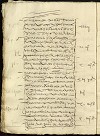
1456 Tax Record listing a Jew named Lazar de Pastrana and other Jews living in Castile (Guadalajara/Hita), Spain. The Jewish population in this tax record is separated from Christian one, which may indicate the urban segregation of the Jewish community in at that time (1456).

Seeking full translation of the document from Spanish to English. The document was written in the Spanish language utilizing the Courtesan script writing style.

Source:

Universidad de Salamanca, Espana (Spain)
Facultad de Filología - Área de Estudios Hebreos y Arameos
International Institute for Jewish Genealogy and Paul Jacobi Center

Report Title:

HISPANO-JEWISH ONOMASTICS IN THE MIDDLE AGES JEWISH POPULATION RECORDS FROM 15th CENTURY CASTILE
Authored By: Dr. Ricardo Muñoz Solla Final Report (2015), see Page 59 (Fol. 29V), Page 41 and Page 45.

Note: Lazar de Pastrana was perhaps related to Johane (Juan) de Pastrana, the 15th century grammarian for the Spanish and Portuguese languages.

You must be registered and logged in to respond to images.
Read the FAQs here to learn how to send thanks to a translator.


On  Response 
11/1/2026 3:53 AM Hi me again...

With luck someone else conversant with 15 century Spanish Courtesan script is about to come along and help translate the image culled from Dr. Ricardo Muñoz Solla's Final Report for you . But of the off chance that they don't, I have taken the liberty of running it past my friendly AI engine...

-----------------------------------------------
DXM: First I got it to check the image quality:
-----------------------------------------------
1) Recrop Check

Upon reviewing the image (Fol. 29V, 15th-century Castilian Courtesan script), the text is moderately legible overall, but certain lines feature overlapping ink, heavy flourishes, and fading toward the center-left binding and margins.

To ensure maximum accuracy for strict character-by-character transcription without silent corrections, the following recropping and digital enhancement are recommended:

Section to recrop: Lines 1 through 26 (the entire text block containing the entries for Lazar de Pastrana and subsequent taxpayers).
- Line height enlargement: Minimum 40% vertical stretch to separate interlocking ascenders and descenders characteristic of the Courtesan script.
- Contrast increase: Minimum 35% enhancement with a sharpened grayscale threshold to differentiate iron gall ink strokes from background paper discoloration.

Action: Pausing processing pending your review of these recommendations or upload of recropped sections.

------------------------------------------------------------------------------------------------------
DXM: That done it transcribed but frankly the quality of output was still poor , the AI suggested ...
------------------------------------------------------------------------------------------------------
To further improve the quality, accuracy, and completeness of the transcription and translation for this 15th-century Castilian Courtesan script document, here are the specific steps and techniques you can apply:

**Obtain Higher-Resolution Source Scans:**
Request or capture a direct, uncompressed TIFF or high-DPI scan (preferably 600 DPI or higher) directly from the Universidad de Salamanca or the Paul Jacobi Center repository. The current image shows compression artifacts and minor blurring when zooming into tight ligatures.

**Isolate Marginal Notes from Main Text:**
Crop the central column and the right-hand margin separately so that overlapping marginal marks (such as the running tally brackets and abbreviated sums like `eeee` or `e. iij c.`) do not obscure individual letters in words like *Pastrana* or *Zalomon*.

**Paleographic Comparison (Corpus of 15th-Century Castilian Legal Hands):**
Cross-reference ambiguous letters against standard palaeographic charts for *letra cortesana* (circa 1450–1500). Pay special attention to interchangeable or heavily stylized graphs such as *s* vs. *f*, *c* vs. *t*, and suspension marks used for currency abbreviations (*maravedís*).

**Consult the Reference Monograph:**
Directly consult Dr. Ricardo Muñoz Solla's published work, *Hispano-Jewish Onomastics in the Middle Ages: Jewish Population Records from 15th Century Castile* (2015), specifically examining Pages 41, 45, and 59 (Fol. 29V). The author's normalized transcription or critical apparatus for this exact manuscript leaf can serve as a key to deciphering unreadable asterisks (`*`).

https://www.iijg.org/wp-content/uploads/2017/04/Munoz-Solla-Final_Report_2015_compressed.pdf

**Linguistic and Onomastic Verification:**
Verify proper names (e.g., *Lazar de Pastrana*, *Zalomon*, *Xaton Descoleria*, *Zaco de Joan de Hita*) against known 15th-century Jewish tax rolls and registers from Guadalajara and Hita to resolve faint or ambiguous characters contextually.

Would you like to focus on any specific line or section for a deeper paleographic breakdown?

continues.....

11/1/2026 3:57 AM ------------------------------------------------------------------------------------------------------------------------------------------------
DXM: I asked it to focus on Lazar and to verify what it could against Dr. Ricardo Muñoz Solla's Final Report and any other available resources
------------------------------------------------------------------------------------------------------------------------------------------------

Based on the document for **Lazar de Pastrana** and the surrounding entries in the 15th-century Castilian tax records from Guadalajara and Hita, here is the breakdown of the tax assessment details derived from the text:

* **Taxpayer & Initial Entry**:
The record begins with Lazar de Pastrana, noting an assessment or amount involving ninety-six *maravedís* (noted in the margin as `eeee`, representing numerical tallies/amounts).


* **Subsequent Financial Obligations**:
The text details amounts such as "sixty and two maravedís" as well as various assessments across other listed individuals (such as Zalomon, Aselemia, Monse Suger, Xaton Descoleria, and Zaco de Joan de Hita).


* **Currency and Denominations**:
The assessments frequently utilize historical Castilian monetary units including *maravedís*, alongside specific coin or token designations such as *verdes* and *escornados* (debased or specific types of currency circulating at the time).


Based on the provided document and transcription, here is the tax breakdown and financial details recorded for the individuals listed in the text:

**Lazar de Pastrana**:
Listed with an initial assessment or amount involving ninety-six *maravedís* (noted in the right-hand margin as `eeee`), with a subsequent amount noting sixty-two *maravedís*.

**Zalomon (and related entries)**:
Recorded with totals reaching seventy and sixty *maravedís verdes* (green *maravedís*, a specific currency or token designation).

**Guadalajara entry**:
A specific assessment for Guadalajara is noted as having thirty-six *maravedís* and ten *maravedís*, plus four *conars*.


**Monse Suger**:
Assessed forty *maravedís*, with a notation of thirteen *maravedís escornados* (debased or specific circulating currency).


**Salomon Xeles**:
Listed with twenty-four *maravedís* and additional *maravedís verdes*.

**Xaton Descoleria**:
Assessed thirty and sixty *maravedís verdes* (noted with *rey na...*) along with four *canars*.


**Zaque Catrian & Zaco de Joan de Hita**:
Recorded with thirty *maravedís* and four additional *maravedís* in their respective entries.

continues
11/1/2026 3:58 AM -----------------------------------------------------------------------------------------------------------
DXM :I then asked some questions seeking clarification and context ...' cause you know, I am like that ...
-----------------------------------------------------------------------------------------------------------

Nature of the tax assessment (Total vs. Basis/Reason)

**Totals vs. Breakdown:**

The figures next to each individual (e.g., ninety-six *maravedís* for Lazar de Pastrana, forty *maravedís* for Monse Suger) represent **total assessed payment obligations** rather than a detailed calculation formula.


**Reference to the Basis/Reason:**

The central text column does **not** detail an itemized calculation (such as property value, income percentage, or land acreage) for each individual. Instead, it records the final allocated tax share (*reparto*) and the specific currency denominations in which portions of the debt were paid or assessed (*maravedís verdes*, *escornados*, *conars*).

**Historical Context:**

According to Dr. Muñoz Solla’s study of this specific 1456 Hita document, this register was a municipal *repartimiento*—a special local assessment levied across the town's households (both Christian and Jewish) to fund public works, specifically the repair and reconstruction of the town’s defensive fencing and walls (*cerca/mura*).

Here are the key dimensions of the historical setting surrounding Lazar de Pastrana and his community in Guadalajara and Hita:

The Municipal Wall Tax (*Repartimiento de la Cerca*)

**The Purpose:**

The tax roll in this manuscript was created specifically for a *repartimiento*—an emergency or special municipal assessment levied across local households to fund the repair and maintenance of Hita's defensive town walls and gates (*cerca*).

**Shared Civic Duty:**

Despite growing socio-religious tensions in 15th-century Castile, Jewish residents were legally integrated into municipal infrastructure assessments. Because town walls provided military defense for all residents regardless of faith, the crown and local town councils (*concejos*) required the *aljama* (the organized Jewish community) to pay its proportional share alongside Christian residents.

Urban & Administrative Segregation

**Separate Rolls:**
The physical structure of this document—separating the Jewish tax assessments from the Christian ones—reflects both administrative accounting and spatial organization.


**The *Aljama* Structure:**

In Castile, Jewish communities operated as semi-autonomous fiscal and legal entities called *aljamas*. The royal crown or municipal council would assign a single lump sum to the *aljama*, whose own local assessors (*taxadores*) would then subdivide the amount among individual heads of households based on their estimated wealth.

**Neighborhood Boundaries:**

The mid-to-late 15th century saw increasing legal mandates (such as the Cortes of Toledo in 1480) forcing Jews to live within designated quarters (*juderías* or *barrios de la judería*). Documents like this offer crucial evidence for mapping where these families lived in the Guadalajara–Hita corridor.


11/1/2026 3:59 AM Currency Crisis and Economic Reality

**Multiple Coinage Types:**
The document explicitly lists payments in *maravedís*, *maravedís verdes*, *escornados*, and *cornados*.


**Debasement & Inflation:**
During the reign of King Henry IV of Castile (1454–1474), the Castilian monetary system experienced severe inflation and debasement. The *escornado* (a copper-silver alloy coin depicting a crown) and *maravedís verdes* represented lower-grade currency. Recording the specific coin type used was critical for tax collectors to account for actual silver content versus nominal face value.


**The Name "de Pastrana":**

Lazar de Pastrana’s surname indicates a family connection to the nearby town of Pastrana in the province of Guadalajara. It was common for Iberian Jews to adopt geographical surnames (*toponymics*) reflecting their origins or family movements across Castile.

**Lazar de Pastrana** and **Johane (Juan) de Pastrana**

Historically, their connection remains an intriguing genealogical hypothesis based on onomastic (naming) evidence. Both lived in Castile during the 15th century and shared the rare toponymic surname *de Pastrana* (derived from the town of Pastrana in Guadalajara). While Lazar is documented as a practicing Jew in the 1456 Hita tax registers, Juan de Pastrana was a renowned 15th-century Latin grammarian whose works were widely published and used across Spain and Portugal.

Because many Jewish families in 15th-century Castile had branches that converted to Christianity (*Conversos*) while retaining shared family surnames and regional ties in the Guadalajara area, scholars like Dr. Muñoz Solla highlight the likely shared family lineage between the scholarly *Converso* line and the traditional Jewish tax-paying line.

---------------------------------
DXM: sorry ...best I can do ...
--------------------------------

You must be registered and logged in to respond to images.
Read the FAQs here to learn how to send thanks to a translator.

Have a ViewMate success story? Please share it using the Help page form.
All times shown on ViewMate are in US Eastern Time
Last Updated 1 Apr 2019
ViewMate idea and author: Bernard Israelite Kouchel ז״ל
Web Author: Josef Herz, updated by John Berman, Gary Sandler
JewishGen Home Page Subscribe to our newsletter
Edmond J. Safra Plaza | 36 Battery Place | New York, NY 10280
646.437.4202 | info@jewishgen.org | © 2026, JewishGen, Inc. All rights reserved.