|
Eastern Europe FAQ
Frequently Asked Questions about
Jewish Genealogical Research in
Eastern Europe
Revision 3.0 – Nov 1, 2012
• Introduction:
· Writing to archival repositories
· Hiring a researcher
· Visiting the country
· Using records on microfilm
· Bibliography
• Country Resources:
Belarus, Bulgaria,
Croatia, Czech Republic,
Estonia, Germany,
Hungary, Latvia,
Lithuania, Moldova,
Poland, Romania,
Russian Empire, Russia,
Slovakia, Ukraine.
• List of Regions and Provinces
|
This document attempts to provide basic information about
accessing records of genealogical value from Eastern Europe.
It is in three parts:
- An introduction,
describing the four ways to access records,
and a bibliography of basic reference works.
- A country-by-country description
of resources.
- A list of regions,
former provinces and counties, and where they are today.
INTRODUCTION:
Jewish genealogical research in Eastern Europe is challenging.
Millions of records of genealogical value exist, but they are
scattered throughout dozens of archives and repositories.
There are basically four ways to access records in Eastern
Europe:
- Write to archival repositories.
- Hire a researcher.
- Visit the country for
on-site research.
- Use records on microfilm at the
LDS Family History Library.
1 — WRITE TO ARCHIVAL REPOSITORIES
While Eastern European archives do contain records of
genealogical value, many are extremely unorganized.
Unlike American archives, with their microfilms, Soundex indexes,
inventories, finding aids, and catalogs, many East European
archives have few inventories or finding aids; some don't
even know what records they have.
Some archives are lacking basics such as photocopy machines and
reliable telephone service. Requests can take many months
to be filled, if the archive even answers mail requests.
Conditions vary widely from archive to archive, but in general,
they are not customer-service oriented, as American and Western
European archives are.
2 — HIRE A PRIVATE RESEARCHER
There are several American-based record searching services
that are popular among Jewish genealogists. Among them
are FAST and Routes to Roots. All claim to service all of
the countries of the former Soviet Union, but each has their own
strengths in certain countries.
-
"FAST" (Feldblyum’s Archival Search and Translations)
has been in continuous operation since 1992.
Research is conducted anywhere in the former Soviet Union,
subject to ever changing local conditions.
Turnaround time is from one week to one year.
Project cost depends on the scope of research and can
run from $300 to $3000.
FAST, 8510 Wild Olive Drive, Potomac, MD 20854.
(301) 424-2654. Boris Feldblyum.
Email: <boris@bfcollection.net>.
Website: <
http://www.bfcollection.net/fast/fast.html>.
-
"Routes to Roots" is run by Miriam Weiner, who travels
to Poland and Ukraine several times a year. Requests
typically take two days during one of her scheduled trips.
Her prices are higher than her competitors, but she has many
satisfied customers. Her specialties are Ukraine,
Belarus, Poland, and Moldova. {See ads in Avotaynu}.
Routes to Roots, 136 Sandpiper Key, Secaucus, NJ 07094-2210.
(201) 866-4075. Miriam Weiner.
Website: <
http://www.routestoroots.com>.
-
There are other reputable researchers based in specific
countries, noted in the individual country sections below.
3 — VISIT THE COUNTRY FOR ON-SITE RESEARCH
As of today, most people going to these countries have
had little trouble gaining access to local archives, but your
situation may depend upon the mood of the individual archivist.
Writing to the country's central archives first may help gain
access to regional and local archives, in certain countries.
But you may get no response or a statement that their permission
is not needed. Reality may depend upon the local bureaucrat.
Again, conditions vary widely from country to country.
Travel conditions are very primitive in some countries.
Unless you speak the native language, you will need to hire a
local guide/translator. See various travel report articles
in Avotaynu, especially the Summer (#4) issue of each volume.
4 — RECORDS ON MICROFILM AT THE LDS FAMILY HISTORY
LIBRARY
The LDS (Mormon) Family History Library, in Salt Lake City,
Utah, has the world's largest collection of microfilmed records
of genealogical value, including Jewish records from Eastern
Europe. (For more information about the FHL, see the
JewishGen FAQ at <
http://www.jewishgen.org/InfoFiles/faq.html>,
Q #13).
Using LDS microfilms is the easiest, most direct, and least
expensive of the four approaches, if records from your area
have been microfilmed.
The FHL has made a systematic effort to microfilm any
records that have genealogical value from all over the world,
including Jewish records. They have an extensive collection
of 19th-century Jewish records from Poland, Germany and Hungary.
Listings of these records, by town, were published in
Avotaynu:
- Poland (1700+ microfilms) - II:1 (January 1986)
- Germany (2100+ microfilms) - III:1 (Winter 1987)
- Hungary (800+ microfilms) - IV:1 (Winter 1988)
These listings have been reprinted elsewhere, including
The Encyclopedia of Jewish Genealogy.
However, these listing are over 10 years out of date —
millions of new records are microfilmed and added to the
collection every year.
Check the FHLC for the most recent listing.
Since the fall of the Soviet Union, the FHL has begun to
microfilm records previously inaccessible.
Records from Belarus, Estonia, Lithuania, Russia, Slovakia,
and Ukraine have recently become available.
See below under the specific country sections for details.
There are now 30 microfilm cameras operating in Eastern Europe,
but it will be many years before a substantial number of
Jewish records are microfilmed and available.
The key to finding records in the FHL collection is the
"Family History Library Catalog" (FHLC), the card catalog of
the holdings of the library in Salt Lake City, available on
microfiche and/or CD-ROM at all local Family History Centers
(updated annually), and online at
www.familysearch.org.
The most important part of the FHLC is the LOCALITY section,
where records are organized by jurisdiction: By Country,
then Province/State, then County/District, then City/Town.
Each heading is organized as follows:
[Country], [Province], [Town] - [Topic]
for example:
POLAND, LUBLIN, CHELM - JEWISH RECORDS
GERMANY, PREUSSEN, BRANDENBURG, BERLIN - CENSUS
Instructional guides to using the FHLC are available from the
Salt Lake Distribution Center, 1999 West 1700 South, Salt Lake
City, UT 84104, Tel. (801) 240-2504:
- "Using the FHLC", #30966. 48 pages. (75 cents).
- "How to use the FHLC", #53191. Video. ($5.00).
BOOKS (GENERAL)
The following works are helpful for anyone doing research
on Eastern Europe. Books about specific countries are
noted in the individual country sections below.
Where Once We Walked: A Guide to the Jewish Communities
Destroyed in the Holocaust. By Gary Mokotoff and
Sallyann Amdur Sack with Alexander Sharon.
Revised Edition. (Bergenfield, NJ: Avotaynu, 2002).
736 pages. ($85). ISBN 0-886223-15-7.
{A gazetteer of over 23,500 Central and Eastern European
localities, arranged alphabetically and phonetically,
with references for each locality}.
[First Edition was 1991, 514 pages, ISBN 0-9626373-1-9].
A Dictionary of Jewish Surnames from the Russian
Empire. By Alexander Beider.
(Teaneck, NJ: Avotaynu Press, 1993).
760 pages. ($75). ISBN 0-9626373-3-5.
and
A Dictionary of Jewish Surnames from the Kingdom of
Poland. (1996). 608 pages.
($69.50). ISBN 0-9626373-9-4.
and
A Dictionary of Jewish Surnames from Galicia.
(Bergenfield, NJ: Avotaynu, Inc., 2004).
624 pages. ($85). ISBN 1-886223-19-X.
{The most comprehensive scholarly studies of
Jewish surnames in eastern Europe}.
Following the Paper Trail: A Multilingual Translation
Guide. By Jonathan D. Shea and William F. Hoffman.
(Teaneck, NJ: Avotaynu, 1991, 1994). 241 pages.
($29). ISBN 0-9626373-4-3.
{Genealogical translation help for 13 languages, including
Romanian, Czech, Polish, Russian, Hungarian and Lithuanian}.
Pinkas haKehilot
[Encyclopedia of the Jewish Communities].
Various editors. Published by Vad Vashem, Jerusalem,
1969-date. More volumes planned.
{Chapters on nearly all Jewish communities with population
over 100. Countries defined by pre-WWII borders}.
In Hebrew.
- Romania: (2 volumes: 1969, 1980).
- Germany: (I: Bavaria, 1972;
II: Wuerttemberg, Hohenzollern and Baden, 1986;
III: Hesse, Hesse-Nassau, Frankfort, 1992).
- Hungary (1975).
- Poland (I: Lodz region, 1976;
II: Eastern Galicia, 1980;
III: Western Galicia and Silesia, 1984;
IV: Warsaw region, 1989;
V: Volhynia and Polesie, 1990;
VI: Poznań, Pomerania and Danzig, 1999;
VII: Kielce and Lublin, 1999;
VIII: Vilna, Białystok, Nowogródek districts, 2005).
- Netherlands (1985).
- Yugoslavia (1988).
- Latvia and Estonia (1988).
- Lithuania (1996).
- Libya and Tunisia (1997).
- Greece (1998).
- Slovakia (2003).
Archives and Manuscript Repositories in the USSR.
By Patricia Kennedy Grimsted. Princeton University Press.
{Most comprehensive description of the Soviet archival
system. Academically, not genealogically oriented.
Becoming dated}.
- Moscow and Leningrad (436 pp., 1972).
- Estonia, Latvia, Lithuania and Belorussia (929 pp., 1981).
- Ukraine and Moldavia (1107 pp., 1988).
In Search of Your European Roots.
by Angus Baxter. Third Edition.
(Baltimore: Genealogical Publishing Co., 1985, 1994, 2001).
327 pages. ($18.95).
ISBN 0-8063-1657-8.
{Cursory guide to European research. Includes some
information on East European and Jewish records}.
JewishGen InfoFiles:
There are informational files, organized topically and by country,
about various aspects of Jewish genealogical research in many
countries, available on the JewishGen Web site at: <http://www.jewishgen.org/InfoFiles>.
Avotaynu: The best source for up-to-date
info on Jewish and Eastern European genealogical research is
Avotaynu: The International Review of Jewish Genealogy,
a quarterly publication, founded in 1985.
It is the premier publication documenting the field today.
Avotaynu subscriptions are $32 (North America) or
$40 (overseas) per year, and back issues ($10 each) are
available from the publisher:
Avotaynu, Inc., P.O. Box 99, Bergenfield, NJ 07621.
Tel. (201) 387-7200 or 1-(800)-AVOTAYNU.
An index, by country, to the first fifteen volumes of
Avotaynu is available on the web at
<http://www.avotaynu.com>.
COUNTRIES:
In this section, modern Eastern European countries are listed
alphabetically. Countries included are
Belarus,
Bulgaria,
Croatia,
Czech Republic,
Estonia,
Germany,
Hungary,
Latvia,
Lithuania,
Moldova,
Poland,
Romania,
Russian Empire,
Russia,
Slovakia and
Ukraine.
Each country's description consists of:
- HISTORY: Border changes for the last 200 years.
- RECORD-KEEPING: How vital records were kept.
- ARCHIVES: Address of country's main archives.
- BOOKS: Useful reference works.
- ARTICLES: Significant periodical articles.
- LDS MICROFILMS: Status of FHL holdings and projects.
- SPECIAL INTEREST GROUPS (SIGs).
BELARUS:
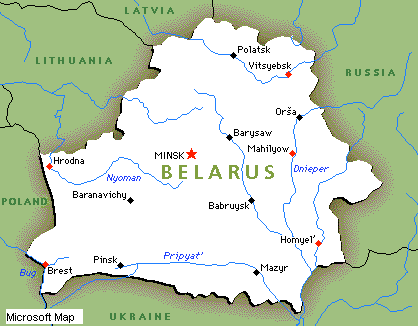 HISTORY:
Formed from former Russian Empire gubernias of Minsk,
Mogilev, southern Vitebsk, SE Vilna, and E Grodno.
Western portions (Grodno, Vilna, western Minsk) were in
Poland 1919-1939.
RECORD-KEEPING:
See under "RUSSIAN EMPIRE".
ARCHIVES:
National
Historical Archives of Belarus;
55, Kropotkina str., Minsk, 220002, BELARUS.
ARTICLES:
- "Byelorussian Archival Holdings", by Harry Boonin,
Avotaynu VI:3 (Fall 1990), pp. 10-15.
- "What We Know about Genealogical Records in Belarus",
by Harry Boonin, Avotaynu IX:4 (Winter 1993),
pp. 6-8.
- "Belorussian Archives Revisited", by Vladislav E. Soshnikov,
Avotaynu X:3 (Fall 1994), pp. 12-14.
- "Sources for Jewish Genealogy in Belarussian Archives",
by Vladislav Soshnikov, Avotaynu XI:3 (Fall 1995),
pp. 31-32.
- "Jewish Genealogical Research in Belarus", by Vlad Soshnikov,
in Avotaynu, XVI:3 (Fall 2000), pp. 19-21.
LDS MICROFILMS:
Microfilming began in 1993. Projects in progress in Minsk
and Grodno, but do not currently include Jewish records.
Some Jewish records have been
microfilmed, and became available in 1995.
Inventory of the Jewish records filmed at Minsk archives
(22 towns) listed in Avotaynu X:4 (Winter 1994), page 7.
For microfilm numbers, see JewishGen InfoFile
<
http://www.jewishgen.org/InfoFiles/by-rec.txt>.
Early revision lists (1795, 1811, 1816, 1842) microfilmed in
Minsk in 1995. 126 microfilms. See Avotaynu XII:1
(Spring 1996), page 9 for microfilm numbers.
(also at <http://feefhs.org/mf
/by/by-polt1.html>).
SPECIAL INTEREST GROUPS (SIGs):
BULGARIA:
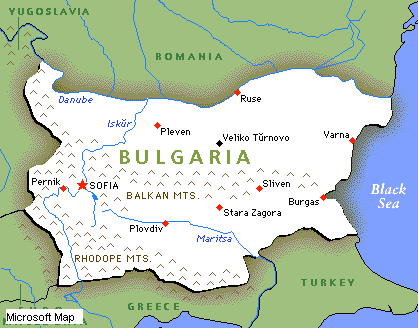 ARCHIVES:
Centralen Darzaven Arhiv; ul. Slavjanka; Sofia; BULGARIA.
RECORD-KEEPING:
Civil registration began in 1893.
LDS MICROFILMS:
Civil registrations are being microfilmed since 1992.
Records for the Sofia area, 1893-1912, now available.
CROATIA:
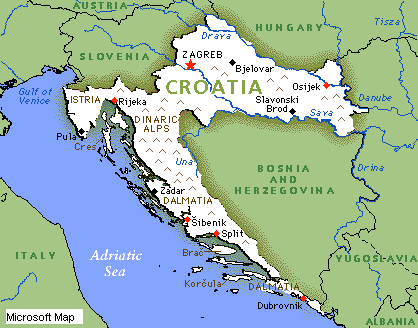 HISTORY:
Province of Hungary until WWI.
Part of Yugoslavia 1918-1991.
Independent 1991.
ARCHIVES:
Hrvatski Drzavni Arhiv
(National Archives of Croatia)
Marulicev trg 21; 10000 Zagreb; CROATIA
Tel: +385 1 48 01 999
ARTICLES:
- "A Beginner's Guide to Croatian Research", by Thomas K. Edlund,
in FEEFHS Quarterly, VII:1-2 (Spring/Summer 1999), pp. 7-37.
(Summary).
- "Researching Jewish Family History in Croatia, Slavonia and Hungary",
by Malcolm Scott Hardy, in Avotaynu XVII:3 (Fall 2001), pp.
28-34.
- "Finding Jewish Family Records in Croatia", by Ed Zwieback.
May 2000.
A JewishGen InfoFile.
LDS MICROFILMS:
Filming in Zagreb, 1985-1997.
Over 2,500 microfilms, including Jewish vital records for 15 towns.
SPECIAL INTEREST GROUP (SIG):
See under "HUNGARY" below.
CZECH REPUBLIC:
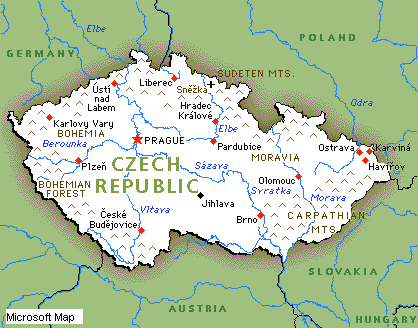 HISTORY:
Formed in 1993 when Czechoslovakia divided.
Comprised of the pre-WWI Austrian provinces of Bohemia, Moravia,
and parts of Silesia (Böhmen, Mähren, Schlesien).
ARCHIVES:
Statni Ustredni Archiv v. Praze; Malastrana, Karmelitska 2;
118 01 Praha 1; CZECH REPUBLIC. Tel. 531 551.
BOOKS:
- A Handbook of Czechoslovak Genealogical Research,
by Daniel M. Schlyter. (GenUn, 1985, 1990).
131 pages. ($15). ISBN 0-912811-06-4.
{Excellent in-depth guide to research, detailing record types,
archival addresses, microfilms available, translation helps,
etc.}.
OUT OF PRINT. A revised version, to be entitled
"A Handbook of Czech and Slovak Genealogical Research"
was planned.
ARTICLES:
- "On-Site Jewish Genealogical Research in the Czech and
Slovak Republics", by Edward David Luft; and
"Archives in Bohemia and Moravia", by Claire Bruell, in
Avotaynu XII:3 (Fall 1996), pp. 15-19.
- "Connections in the Czech Republic", by Claire Bruell,
in Avotaynu XII:2 (Summer 1996), pp. 21-26.
{A Travelogue}.
- "The Complete Catalogue of Records... Bohemia and Moravia",
by Edward David Luft, in Avotaynu VII:3 (Fall 1991),
pp. 20-21.
- "Survey of Jewish Monuments in the Czech Republic",
by Samuel Gruber, in Avotaynu IX:2 (Summer 1993),
pp. 22-24.
- Also see Avotaynu IX:1, 63 {Book reviews}.
- "Getting Started with
Czech-Jewish Genealogy", by E. Randol Schoenberg and
Julius Mueller.
- "A Beginner's Guide to Czech Research", by Shon. R. Edwards,
in FEEFHS Journal, VIII (2000), pages 6-40.
An updated 2005 version is online as
Czech
Research Outline.
LDS MICROFILMS:
Czech records have not been microfilmed by the LDS, and
there are no current plans, due to the Czech government.
SPECIAL INTEREST GROUPS (SIGs):
ESTONIA:
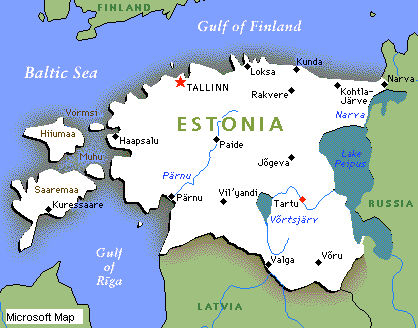 HISTORY:
Independent in 1918, formed from Estland gubernia and
northern Livonia gubernia of the Russian Empire.
Republic of U.S.S.R. 1940-1989. Independent 1989.
ARCHIVES:
- Eesti Riiklik Ajaloo Keskarhiv
(Estonian State Historical Archives);
J. Liivi 4; 202400 Tartu; ESTONIA.
Holds records before 1917.
- Eesti Riigiarhiiv
(Estonian State Archives);
Maneezhi 4; 15019 Tallinn; ESTONIA
Holds records after 1917.
BOOKS:
- A Guide to Jewish Genealogy in Latvia and Estonia,
by Arlene Beare. (London: JGS of Great Britain, 2001).
76 pages. ($10). ISBN 0-9537669-2-6.
ARTICLES:
- "Judaica in the Historical Archives of Estonia", by
Tatiana Shor, in Avotaynu IX:3 (Fall 1993), pp. 15-16.
LDS MICROFILMS:
All Jewish birth, marriage and death records in Estonia were
microfilmed in 1993-94:
(Narva 1911-1926;
Rakvere [Vezenberg] 1921-1926;
Tallin [Revel] 1872-1940;
Tartu [Dorpat, Yuriev] 1897-1926;
Valga [Walk] 1919-25;
Viljandi [Fellin] 1917-1926;
Võru [Werro] 1883-1925).
Revision Lists and other census records were filmed 2001-2003.
SPECIAL INTEREST GROUP (SIG):
See under "LATVIA" below.
GERMANY:
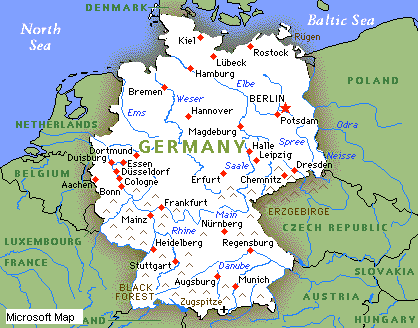 HISTORY:
The territory of Germany has varied considerably over the
centuries. Until 1871 Germany consisted of numerous
independent kingdoms, duchies, principalities and states,
whose borders often changed and merged. In 1871,
all states except the Austrian states were consolidated
into the German Empire, under the leadership of Prussia.
After WWI, some areas ceded to France, Belgium, Denmark;
Posen and parts of Silesia and West Prussia ceded to Poland;
northern tip of East Prussia (Memel) goes to Lithuania.
After WWII, East Prussia divided between Poland and Russia;
most of Pommerania, West Prussia and Silesia go to Poland.
RECORD-KEEPING:
Depends upon the state. Not consistent until 1876.
ARCHIVES:
Internal provincial border changes often make it hard to
determine which archive has the particular records you
need. Some archives are:
- Staatsbibliothek (Unter den Linden 8; Postfach 1312;
O-1086 Berlin), a major library;
- Zentralstelle fur Genealogie (Georgi-Demitroff-Platz 1;
O-7010, Leipzig) holds vital statistic records for more
than 400 communities;
- Bundesarchiv (Berliner Strasse 98-101; O-1561 Potsdam).
<http://www.bundesarchiv.de>.
- Leo Baeck Institute (15 West 16th Street, New York, NY 10011).
(212) 744-6400.
<http://www.lbi.org>.
BOOKS:
- Germanic Genealogy: A Guide to Worldwide Sources and
Migration Patterns, by Edward R. Brandt, et al.
(St. Paul, MN: Germanic Genealogy Society, 1997).
2nd edition. 370 pages. ($24). ISBN 0964433737.
{Best book on German research}.
- In Search of Your German Roots: A Complete Guide to
Tracing Your Ancestors in the Germanic Areas of Europe,
by Angus Baxter. Fourth Edition.
(Baltimore: Genealogical Publ. Co., 2001; updated 2008).
121 pages. ($12). ISBN 0-8063-1656-X.
- Research Outline: Germany. (Salt Lake City:
Family History Library, 1994, 2004). 60 pages. (75 cents).
{Good overview, provides many additional sources}.
Now online at
http://www.familysearch.org/Eng/Search/Rg/images/34061_Germany05.pdf.
- Address Book for Germanic Genealogy, by Ernest Thode.
6th edition. (Baltimore: Genealogical Publishing Co.,
1997). 196 pages. ($25). ISBN 0-0863-1526-1.
- Library Resources for German-Jewish Genealogy, by
Angelika Ellmann-Krüger with Edward David Luft.
(Teaneck, NJ: Avotaynu, 1998). 80 pages. ($20).
ISBN 1-886223-09-2.
- Stammbaum: The Journal of German-Jewish Genealogical Research.
31 issues, published 1992-2007.
Available online at:
<
http://www.lbi.org/publications/periodicals/stammbaum>.
ARTICLES:
- "Jewish Records Held in Leipzig Archives", Edward David Luft.
Avotaynu VII:4 (Winter 1991), p. 28. {An inventory}.
- "East German Genealogical Records", Peter W. Landé.
Avotaynu VIII:1 (Spring 1992), pp. 32-33.
- "Leo Baeck Institute Resources...", by Franklin &
Mecklenburg. Avotaynu VIII:1 (Spring 1992),
pp. 39-40.
- "The Complete Archives of German Jews", comp. by Peter Landé.
Avotaynu IX:1 (Spring 1993), pp. 28-32.
{An inventory, by town, indicating what's in New York,
Jerusalem, Germany}.
- "German Laws Regulating Access to Genealogical Records",
by Jurgen Sielemann, in Avotaynu X:2 (Summer 1994),
pp. 25-30.
- Edward Luft and Peter Landé have both written many extensive
articles on German-Jewish genealogical research in
Avotaynu.
LDS MICROFILMS:
- Over 2,000 microfilms of Jewish vital records.
Filming in Leipzig and Berlin in recent years.
- 1939 Nazi Census of Non-Aryans. 292 microfilms.
See The German Minority Census of 1939: An Introduction
and Register, by Thomas Kent Edlund. (Avotaynu, 1996).
64 pages. ($9.50). ISBN 1-886223-00-9.
- Note: FHL Catalog's provinces are based on Germany's
1871-through-WWI border jurisdictions.
SPECIAL INTEREST GROUPS (SIGs):
WWW SITES:
German genealogy home page: <
http://www.genealogy.net/gene>.
Includes German genealogy FAQ and other helpful guides.
HUNGARY:
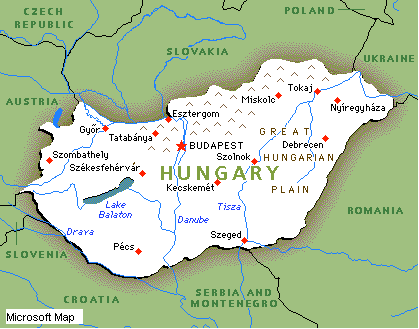 HISTORY:
Kingdom, part of Austro-Hungarian Empire 1867 to WWI.
Modern Hungary is much smaller now than it was before
the end of WWI in 1918. The former kingdom of Hungary
included some areas now in Slovakia, Ukraine, Romania,
Croatia, Serbia, and Austria.
RECORD-KEEPING:
Starting in 1851, each religious community was required to
keep vital records for the government. Civil registration
began in 1895.
ARCHIVES:
BOOKS:
- Contents and Addresses of Hungarian Archives,
by Edward Reimer Brandt. 2nd edition. (Clearfield Co.,
1993, 1998). 88 pages. ($15). ISBN 0-8063-4607-8.
{Addresses of 70 archives, maps of county changes}.
- Yad Vashem Names Project, Nevek, directed by
Dr. Gabriel Bar Shaked.
Vol. I: Names of Deported Jews from Hadju County (1991).
Vol. II-III: Names of Jewish Victims of Hungarian
Labor Battalions (A-J 1992, K-Z 1993).
Vol. IV: Names of Hungarian Jewish Women in the Stutthof
Concentration Camp.
ARTICLES:
- "Resources for Jewish Genealogical Research in Hungary",
by George Eotvos, in Avotaynu XIII:4 (Winter 1997),
pp. 17-19.
- "Some Problems of Genealogical Research in Hungary",
by Gyorgy Landeszman, in Avotaynu VII:3 (Fall 1991),
pp. 17-19.
- "Given Names and Hungarian Jews", by Richard Panchyk, in
Avotaynu XI:2 (Summer 1995), pp. 24-29.
- "What Hungarian Censues Can Tell Us", by Richard Panchyk,
in Avotaynu XIII:3 (Fall 1997), pp. 34-36.
- "Group to Document All Hungarian Holocaust Victims",
by Carol Clapsaddle, in Avotaynu VIII:1 (Spring 1992),
pp. 37-38.
- "The 1869 Austro-Hungarian Census", by Edward David Luft,
in Avotaynu XVII:3 (Fall 2001), pp. 25-27.
LDS MICROFILMS:
The LDS have microfilmed all available Jewish vital records
up to 1895 (for localities now within the borders of modern
Hungary); records up to 1910 are now being microfilmed.
For vital records after 1910, contact the Consulate General
of the Republic of Hungary (in USA: in New York or Los Angeles).
The LDS also have the 1848 Jewish Census for several
old Hungarian counties, some of which are now in Slovakia
and Ukraine; and the 1869 Census. See the
JewishGen Hungary Database.
SPECIAL INTEREST GROUP (SIG):
JewishGen Hungary SIG:
Founded 1994. Covers all Hungarian-speaking regions.
E-mail discussion group.
Website: <http://www.jewishgen.org/Hungary>.
LATVIA:
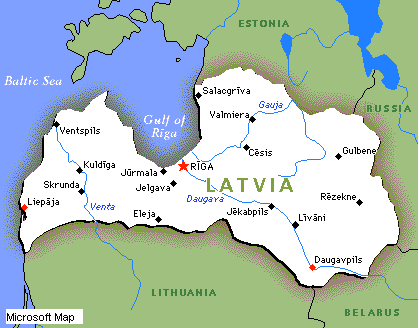 HISTORY:
Independent in 1918, formed from former Russian Empire
gubernias of Courland, southern Livonia, and western
Vitebsk. Republic of U.S.S.R. 1940-1989.
Independent 1989.
RECORD-KEEPING:
See under "RUSSIAN EMPIRE".
ARCHIVES:
Latvijas Valsts Arhîvs
(Central State Historical Archive);
Slokas iela 16; LV-1007 Riga, LATVIA.
BOOKS:
- A Guide to Jewish Genealogy in Latvia and Estonia,
by Arlene Beare. (London: JGS of Great Britain, 2001).
76 pages. ($10). ISBN 0-9537669-2-6. {An introduction to
research in Latvia}.
- See the bibliography
at the Latvia SIG website.
ARTICLES:
- "Jewish Vital Statistic Records in the Latvian Archives"
by Aleksandrs Feigmanis, in Avotaynu X:1 (Spring
1994), pp. 15-16. {Includes inventory}. See additional
supplement in Avotaynu XI:3 (Fall 1995), pp. 67-68.
- "Materials from the 1897 All-Empire Russian Census Held By
the State Historical Archives in Latvia", by Alexandrs
Feigmanis, in Avotaynu XI:1 (Spring 1995), pp. 15-16.
- "Latvian Record Sources", by Kahlile B. Mehr, in
FEEFHS Journal, VIII (2000), pages 63-68.
Aleksandr Feigmanis is a reputable archival researcher,
available for hire. See his many articles in
Avotaynu's "From Our Contributing Editors" column.
His address:
Kahovkas str. 2-12; LV-1021, Riga, Latvia.
aleksgen@mailcity.com.
LDS MICROFILMS:
- The LDS have no microfilming agreement in Latvia.
- Early 19th century revision lists (1797, 1811, 1816, 1834)
microfilmed by the Germans during WWII. See Avotaynu
XIV:1 (Spring 1998), pp. 25-27, and XIV:2 (Summer 1998), p. 24
for inventory.
SPECIAL INTEREST GROUPs (SIGs):
LITHUANIA:
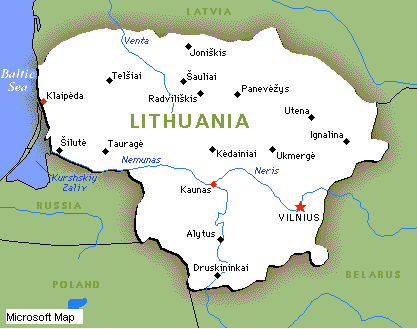 HISTORY:
Most of Lithuania was annexed by Russia in 1795.
Independent Lithuania was re-established in 1918, formed
from Kovno, eastern Vilna, and northern Suwałki gubernias
(and a tiny piece of East Prussia). Vilna area annexed
by Poland, 1919-1939. Capital: Kaunas (Kovno).
Republic of U.S.S.R. 1940-1989. Capital: Vilnius (Vilna).
Independent 1990. Capital: Vilnius.
RECORD-KEEPING:
See under "RUSSIAN EMPIRE"
for Kovno/Vilna gubernia areas.
See under "POLAND" for Suwalk gubernia
areas.
ARCHIVES:
- Lietuvos
Valstybės Istorijos Archyvas
(Lithuanian State Historical Archives);
Gerosios Vilties g. 10; LT 03134 Vilnius; LITHUANIA
Holds vital records for before 1945.
{Requires $100 deposit. Each record costs $18:
$5 for photocopy, $13 for translation.}
{Articles on experiences writing to Lithuanian archives:
Avotaynu IX:1, p. 65; XII:1, pp. 19-20;
Landsmen V:1, pp. 3-11.}
BOOKS:
- Lithuanian Jewish Communities, by Nancy and Stuart
Schoenburg. (New York: Garland, 1991; reprint by Jason
Aronson, 1996). 502 pages. ($30). ISBN 1-56821-993-8.
{A translation of Volume III of Yahadut Lita (1967),
with some additional material. Short sketches of 381 towns}.
- Yidishe Shtete Shtetlech un Dorfishe Yishvim in
Lite... (Jewish Cities, Towns and Villages in Lithuania
up to 1918) by Berl Kagan. (New York, 1991). 796 pages.
($35). Out of Print. {A scholarly survey of 221 Lithuanian
localities. In Yiddish}.
- Jewish Vital Records, Revision Lists and Other Jewish
Holdings in the Lithuanian Archives, compiled by
Harold Rhode and Sallyann Amdur Sack. (Avotaynu, 1996).
160 pages. ($35). ISBN 1-886223-02-5. {Inventory of
holdings of the State Historical Archives in Vilnius}.
- Catalog of the Jewish
Holdings of the Kaunas Regional Archives, by Vitalija
Gircyte. (LitvakSIG & Kaunas Regional Archives, 1998).
{Inventory for Kovno gubernia}.
ARTICLES:
- "Jewish Vital Statistic Records in Lithuanian Archives",
by Alex Friedlander, in Avotaynu VI:4 (Winter 1990),
pp. 4-12. {A thorough overview, with some inventories}.
- "Archival Sources in the Lithuanian State Historical
Archives", by Laima Tautvaisaite, in Avotaynu XI:3
(Fall 1995), pp. 3-7. {Excellent overview, by the
Director of the Archives}.
- "New Archival Finds from Lithuania", by Yakov Shadevich,
in Avotaynu XI:2 (Summer 1995), pp. 10-13.
{Includes listing by town of some non-vital records}.
- "Jewish Revision Lists in Lithuanian Archives", by Harold
Rhode, in Avotaynu XIII:3 (Fall 1997), pp. 23-24.
{Includes inventory for Vilna gubernia}.
- "Kaunas Archives", by Howard Margol and Harold Rhode, in
Avotaynu XIII:3 (Fall 1997), pp. 25-27.
- "Jewish Genealogical Resources at the Kaunas State Archives"
by Vitalija Gircyte, in Avotaynu, XIV:3 (Fall 1998),
pp. 29-31. Available
online.
- "Lithuanian Central Civil Register Archives Revisited",
by Ada Greenblatt, in Avotaynu XIV:1 (Spring 1998),
pp. 22-24. {Includes inventory of 20th century vital
records, by town}.
- "Research and Travel in Suwalki Gubernia Towns",
by Bruce Kahn, in Landsmen IV:4 (Spring 1994),
pp. 10-14.
- "A Genealogical Trip to Lithuania: The Host's Perspective",
by Yakov Shadevich, in Avotaynu VII:1 (Spring 1991),
pp. 3-5.
- "Some Problems in Researching Eastern European Records",
by Boris Feldblyum and Yakov Shadevich, in Avotaynu
IX:3 (Fall 1993), pp. 12-13.
- "Research
and Travel in Lithuania", by Bruce Kahn, Saul Issroff
& Howard Margol, at the JGSR website.
- Also see articles listed under
"RUSSIAN EMPIRE" below.
LDS MICROFILMS:
Microfilming began in May 1994 in the Lithuanian State
Historical Archives in Vilnius. The initial project covered
Protestant and Russian Orthodox church records only.
Microfilming of Jewish vital records began in January 2000,
with the first microfilms available July 2000. See the
Microfilm
Inventory.
Also, some records for southwest areas (former Suwalk gubernia)
available, microfilmed in Poland.
SPECIAL INTEREST GROUPS (SIGs):
- Suwalk/Lomza Interest Group for Jewish Genealogists
(SIGJG)
Covers Suwalk and Lomza gubernias (southwestern Lithuania,
northeastern Poland).
c/o Marlene Silverman, 3701 Connecticut Ave., NW, #228,
Washington, DC 20008.
Formed 1990. Subscription: $24.
Quarterly publication: Landsmen.
See <http://www.jewishgen.org/SuwalkLomza>.
- Litvak SIG:
Covers Vilna and Kovno gubernias.
LitvakSIG, Inc., Dept. 77-9253, Chicago, Illinois 60678-9253
Formed 1994. $36/year, voluntary.
E-mail discussion group.
Website: <http://www.jewishgen.org/Litvak>.
MOLDOVA:
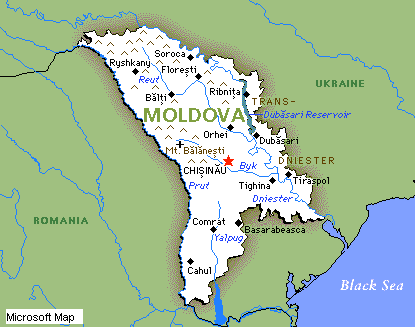 ARCHIVES:
Arhiva Nationala a Republicii Moldovei
(National Archives of the Republic of Moldova)
str. Gheorghe Asachi 67b
277028 Chişinău
MOLDOVA
The archives is unable to undertake research requests by mail.
You may visit, or hire a private researcher.
See Avotaynu XIII:2 (Summer 1997), page 67.
BOOKS:
- Jewish Roots in Ukraine and Moldova: Pages from the
Past and Archival Inventories, by Miriam Weiner,
in cooperation with the Ukrainian State Archives and the
Moldovan National Archives, 1999. 624 pages. ($60).
ISBN 0-9656508-1-2. {Contains comprehensive inventories
of Jewish records in Moldovan archives and civil
registration offices}.
ARTICLES:
- "Jewish Genealogical Research in Moldova", by Vlad Soshnikov,
in Avotaynu, XVI:3 (Fall 2000), page 22.
LDS MICROFILMS:
A microfilming contract was signed in November 1994, and
filming began in January 1995. Jewish records have been
microfilmed for Bendery, Beltsy, Kaushany-Novye, and Kishinev.
SPECIAL INTEREST GROUP (SIG):
See under "ROMANIA" below.
POLAND:
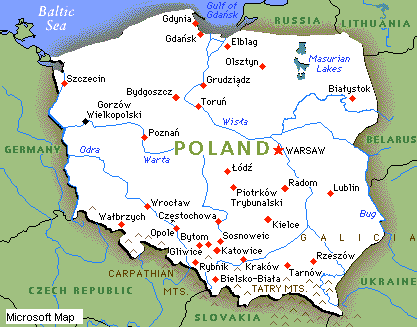 HISTORY:
Between 1772 and 1795, Poland was partitioned between
Russia, Austria, and Prussia, and ceased to be an independent
nation for over 100 years, until it was re-established after
WWI in 1918.
Between the wars, newly independent Poland included parts
of former Russian gubernias of Vilna, Grodno and Volhynia;
former Austrian province of Galicia; and Prussian Poznań
and West Prussia.
After WWII, nearly one half of inter-war Poland (eastern
provinces: Wilno, Nowogródek, Polesie, Wołyń, Tarnopol,
Stanisławów and parts of Lwów and Białystok)
became part of the Soviet Union — these areas are now
part of Ukraine, Belarus and Lithuania. Poland gained
former German areas: most of Pommern (Pommerania), Brandenburg,
Schlesien (Silesia), West Prussia, and half of East Prussia.
RECORD-KEEPING:
Depends upon the occupying power: Russian, Austria, Prussia.
- Russian Poland (Kingdom of Poland):
- 1808: Civil registration established by Napoleon.
Jews and others are included in Catholic registers.
- 1826: Separate registers are kept for each religious
community: Roman Catholic, Jewish, Russian Orthodox,
Protestant, etc.
- 1868: Record-keeping switches from Polish to Russian
language.
For more information on vital records, see the JewishGen
InfoFile "Vital Records
in Poland".
- Austrian Poland (Galicia):
Civil registration began in 1787, but not enforced until
the mid-nineteenth century.
- Prussian Poland:
Civil registration began in 1874.
ARCHIVES:
BOOKS:
- Jewish
Roots in Poland: Pages from the Past and Archival
Inventories, by Miriam Weiner. (The Miriam Weiner
Routes to Roots Foundation and YIVO Institute for Jewish
Research, 1997). 446 + xx pages. ($50).
ISBN 0-9656508-0-4.
{Contains comprehensive inventories of Jewish records in
Polish archives and civil registration offices}.
- Korzenie Polskie: Polish Roots, by Rosemary A.
Chorzempa. (Baltimore: Genealogical Publishing Co., 1993).
240 pp. ($18). ISBN 0-8063-1378-1. {Focuses on the Roman
Catholic majority, but the best book on Polish research}.
- Finding Your Jewish Roots in Galicia: A Resource
Guide, by Suzan F. Wynne. (Teaneck, NJ: Avotaynu, 1998).
220 pp. ($40). ISBN 1-886-223-08-4. {A compilation
of useful material for those researching Galician roots}.
- A Translation Guide to 19th-Century Polish-Language
Civil-Registration Documents, by Judith A. Frazin.
(Chicago: JGS of Illinois, 1989). 311 pp. ($25).
ISBN 0-9613512-1-7. {Helps translate Napoleonic format
vital records microfilmed by the LDS for 1808-1868}.
- Russian-Language Documents from Russian Poland:
A Translation Manual for Genealogists, by Jonathan Shea.
(Orem, UT: Genealogy Unlimited, 1989). 73 pp. ($12).
ISBN 0-921811-05-6. {Helps translate documents such as
vital records from Russian Poland for 1868-1918}.
[Out of Print].
- Additional
bibliography.
ARTICLES:
- "Polish-Jewish Genealogical Research - A Primer", by
Jeffrey K. Cymbler, in Avotaynu IX:2 (Summer 1993),
pp. 4-12. {An excellent overview of available sources}.
- "Jewish Genealogical Research in Polish Archives", by
Prof. Jerzy Skowronek (former State Archivist of Poland),
in Avotaynu X:2 (Summer 1994), pp. 5-8.
- "Location of Western Galician Vital Statistics Records"
by Izabela Pazdziorek, in Avotaynu VII:2
(Summer 1991), pp. 14-15.
- "Demographic Records of Galicia, 1772-1919", by Suzan Wynne.
in Avotaynu VIII:2 (Summer 1992), pp. 7-11. {Includes
inventory of records from eastern Galicia now in Warsaw}.
LDS MICROFILMS:
Extensive collection of over 2,000 microfilms for Russian
Poland, 1808 thru 1880s; and Prussian Poland (Poznań).
Virtually no Jewish records microfilmed for Galicia.
There has been no filming of Jewish records since 1992.
Note: The FHL Catalog is based on Poland's 1945-1975
internal provincial jurisdictions.
SPECIAL INTEREST GROUPS (SIGs):
- Galicia (southern regions formerly in
Austro-Hungarian Empire):
c/o Shelley Kellerman Pollero, 549 Cypress Lane,
Severna Park, MD 21146. (410) 647-9492
$30/year ($37 overseas).
Publication: The Galitzianer. Founded 1993.
E-mail discussion group.
Website: <http://www.jewishgen.org/Galicia>.
- Lomza and Suwalk gubernias (northeastern Poland):
see under LITHUANIA.
- Grodno gubernia (Białystok region):
see under BELARUS.
- Kielce and Radom gubernias (south-centeral Poland
today):
Kielce-Radom SIG.
Published quarterly Kielce-Radom SIG Journal, 1997-2004.
Website: <http://www.jewishgen.org/krsig>.
- Danzig / Gdańsk:
JewishGen Danzig/Gdańsk SIG
Website: <http://www.jewishgen.org/Danzig>.
- JRI-PL, The Jewish Records Indexing - Poland Project:
Creates indexes to Polish-Jewish vital records.
Has indexed over 4 million records to date, on-line.
<http://jri-poland.org>.
ROMANIA:
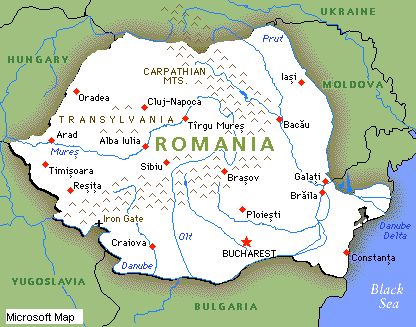 HISTORY:
Moldavia and Wallachia, formerly under Ottoman Turkish rule,
united to form Romania in 1859. Kingdom of Romania formed
in 1881. Transylvania and Bukovina, parts of the former
Austro-Hungarian Empire, became part of Romania after WWI.
RECORD-KEEPING:
- Transylvania & Bukovina (former Austrian regions):
Vital records kept by clergy since late 18th century,
full compliance after 1848. Civil registration in 1895.
- Wallachia & Moldavia (former Ottoman regions):
Civil vital registration, in Romanian, beginning 1865.
ARCHIVES:
Archivelor Statului din Republica Romania;
Bdul Kogalniceanu nr. 29; Bucereşti, Sect. 5; ROMANIA
The archives is reportedly not responsive to mail requests.
However, some on-site visits have been successful.
ARTICLES:
- "Sources for Jewish Genealogical Research in Romania", by
Dr. Ladislau Gyemant, in Avotaynu XII:3 (Fall 1996),
pp. 8-11.
- "Genealogy and History Sources of Jewish Genealogical
Research in Romania (18th-20th Centuries)", by Prof.
Ladislau Gyémánt, in Avotaynu XIII:3
(Fall 1997), pp. 42-48.
- "Sources of Jewish Genealogical Research in the Romanian
Archival System", by Ladislau Gyemant, in Avotaynu
XIV:3 (Fall 1998), pp. 22-28.
- "Researching Jewish Romania On Site", by Paul Pascal, in
Avotaynu XI:1 (Spring 1995), pp. 8-14.
- "Romania: The Sudits and Other Jewish Discoveries", by Paul
Pascal, in Avotaynu XII:1 (Spring 1996), pp. 29-35.
- "Sources of Research for Jewish Genealogy in Transylvania",
by Dr. Ladislau Gyemant, in Avotaynu XI:2 (Summer
1995), pp. 29-30.
- "Selected Sources on Romania at the Central Archives ..."
by Carol Clapsaddle, in Avotaynu VI:1 (Spring 1990),
p. 15. {Sources in Israel for: Bacua, Braila, Bucharest,
Iasi}.
- "Romanian Holdings at the Diaspora Research Institute",
by Carol Clapsaddle, in Avotaynu VI:2 (Summer 1990),
p. 13.
- "Romanian Records at the Holocaust Memorial Museum...",
by Irene Saunders Goldstein, in Avotaynu IX:4
(Winter 1993), pp. 18-19.
Dr. Ladislau Gyemant is a professional researcher.
Str. Tarnita 1; Bloc B5, Scara III, Ap. 28; 3400 Cluj-Napoca;
ROMANIA. Tel. 011-40-64-167256.
E-mail: <
gyemant@mcarmilly.soros.cj.ro>.
LDS MICROFILMS:
The FHL has no Jewish microfilms from Romania
(except a few from former Hungarian region of Banat).
No microfilming contract.
SPECIAL INTEREST GROUP (SIG):
JewishGen ROM-SIG:
Covers Bessarabia, Bukovina, Mįramaros, Moldavia,
Transylvania, and Wallachia.
Formed 1992. $20/year.
Publication: ROM-SIG News (1992-1999).
E-mail discussion group.
Website: <http://www.jewishgen.org/romsig>.
RUSSIAN EMPIRE:
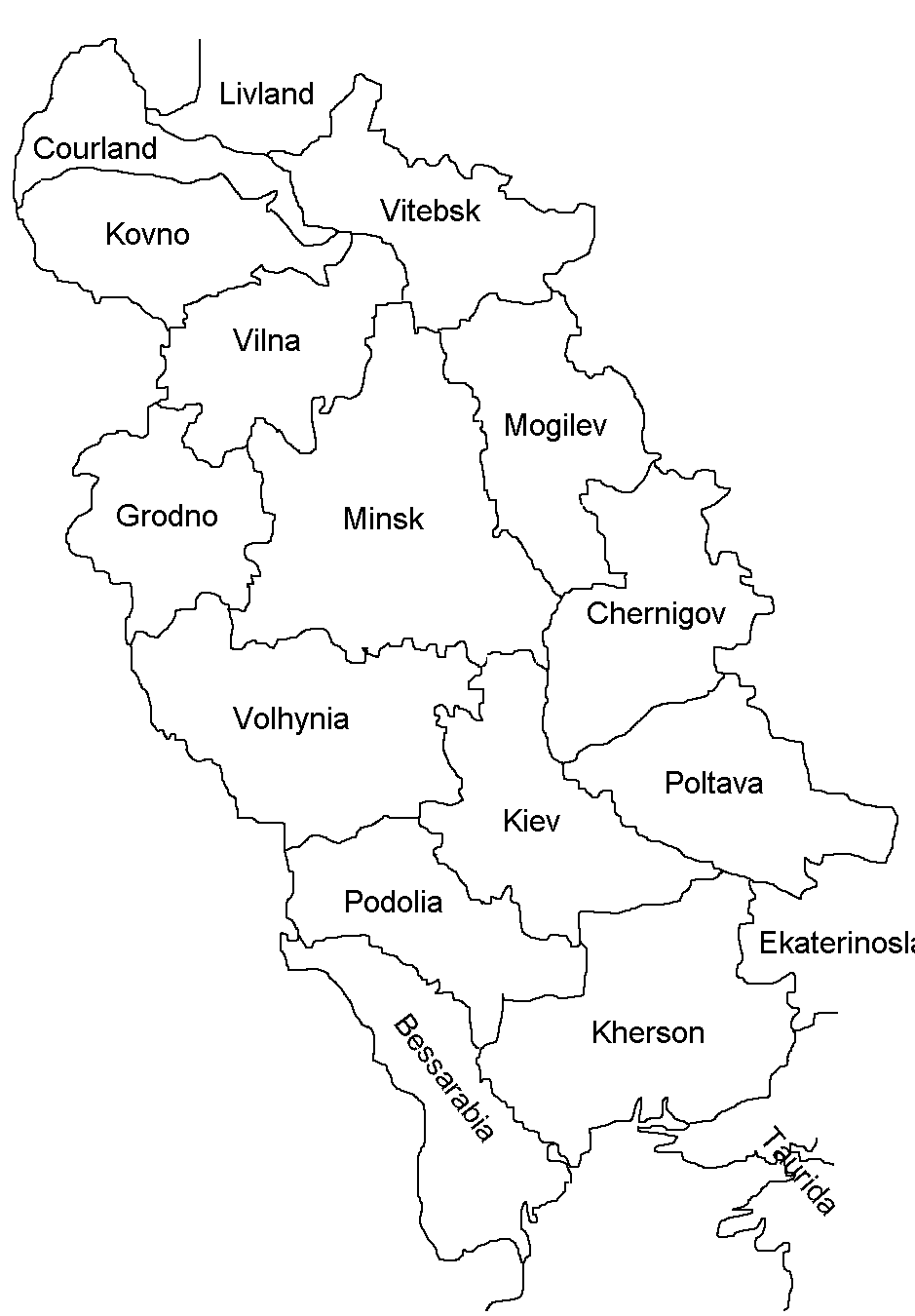
This section is a general heading for the former Czarist
Russian Empire (pre-1917), which included what today are
Estonia,
Latvia,
Lithuania,
Belarus,
Ukraine, the Republic of
Russia,
Moldova, and parts of
Poland and
Romania.
Also see sections on those countries for more specifics.
RECORD-KEEPING:
Vital record keeping became mandatory for Jews in 1835.
Maintained by the Jewish community "crown rabbis".
In columnar format, in both Russian and Hebrew.
Ten censuses ("revizskie skazki" = "Revision Lists")
were taken in the Russian Empire for tax purposes, mid-18th
to mid-19th centuries:
- 5th (1795)
- 6th (1811-12)
- 7th (1816-26)
- 8th (1833-36)
- 9th (1850-53)
- 10th (1857-60).
There was also an all-Empire census in 1897.
The Revision lists and censuses did not survive for all areas.
They are held by various regional archives, and are organized
by community, social class and then by address, unindexed.
ARTICLES:
- "Vital Statistics in Czarist Russia", by Harry Boonin, in
Avotaynu V:3 (Fall 1989), pp. 6-12.
- "Russian Business Directories", by Harry Boonin, in
Avotaynu VI:4 (Winter 1990), pp. 23-32.
- "What May Be Learned from 19th-Century Czarist Jewish Birth
Records and Revision Lists", by Harold Rhode, in
Avotaynu X:3 (Fall 1994), pp. 3-7.
- "Materials from the 1897 All-Empire Russian Census...",
by Alexandrs Feigmanis, in Avotaynu XI:1 (Spring
1995), pp. 15-16. {Focus on Latvia, but has general info}.
- "Russian Archival and Historical Terminology", by Kahille
Mehr, in Avotaynu XII:3 (Fall 1996), pp. 35-37.
- "To Register or Not to Register: The Administrative Dimension
of the Jewish Question in Czarist Russia", by ChaeRan
Freeze, in Avotaynu XIII:1 (Summer 1997), pp. 6-11.
- "Russian Revision Lists: A History", by Boris Feldblyum,
in Avotaynu XIV:3 (Fall 1998), pp. 59-61.
- Jewish Genealogical Research in the Imperial Russian Empire",
by Vladislav Soshnikov, in Avotaynu XVI:2 (Summer 2000),
pp. 32-37.
- "The Russian National Census of 1897", by Thomas K. Edlund,
in Avotaynu XVI:3 (Fall 2000), pp. 29-39.
RUSSIA:
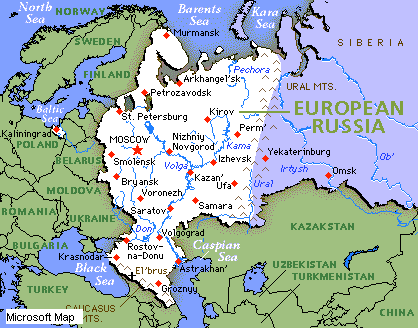
Note: This section refers to the modern
REPUBLIC of Russia, not the Russian Empire, for which
see under "RUSSIAN EMPIRE".
Before WWI, nearly all Jews from "Russia" lived in
the "Pale of Settlement" — outer gubernias of the
Russian Empire — areas that today are in Poland,
Lithuania, Latvia, Belarus, Ukraine and Moldova —
not Russia.
RECORD-KEEPING:
See under "RUSSIAN EMPIRE".
ARCHIVES:
Rossiiskii gosudarstvennyi arkhiv drevnikh aktov (RGADA)
(Russian State Archive of Early Acts);
Bol'shaia Pirogovskaia 17; 119817 Moscow; RUSSIA.
See <http://www.iisg.nl/~abb>
for survey.
LDS MICROFILMS:
Filming started in 1992, but only in interior areas where
there were very few Jews. Some Jewish records from
Tula, Tomsk, Siberia now available.
SLOVAKIA:
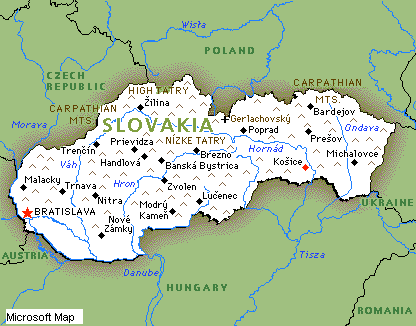 HISTORY:
Formed in 1993 when Czechoslovakia divided. Comprised
of the former Slovak-speaking northern counties of Hungary.
ARCHIVES:
Statny Ustredny Archiv; Cesta 42; Bratislava; SLOVAKIA.
BOOKS:
- Jewish Vital Statistics Holdings in the Archives of
Slovakia.
{A list of 4000 towns, showing the location and scope of
holdings of Jewish birth, marriage and death records}.
On two microfiche, available from Avotaynu. $10.
- Also see under "CZECH REPUBLIC" above.
ARTICLES:
- "Jewish Genealogical Research in Slovakia", by Meyer Dan,
in Avotaynu VII:1 (Spring 1991), pp. 8-9.
- "Slovakian Jewish Research", by Jordan Auslander, in
Avotaynu IX:4 (Winter 1993), pp. 14-16.
- "Slovakian State Archives", by Edward David Luft, in
Avotaynu XII:3 (Fall 1996), pp. 20-22. {Address
list}.
LDS MICROFILMS:
Jewish records in Slovakia are being microfilmed since 1991,
along with Church records. Records from eastern Slovakia,
which had a large Jewish population, were available beginning
in 1995. For inventory as of 1996, see <http://feefhs.org/mf/sk/sk-jew1.html>.
Jewish vital records for 47 localities, generally up through
1895, have been microfilmed in archives in Bytce, Kosice,
Levoca, Presov and Banska Bystrica; now in progress in Nitra
and Bratislava.
SPECIAL INTEREST GROUPS (SIGs):
See under "CZECH REPUBLIC" above.
See under "HUNGARY" above.
WWW SITES:
Slovak and Rusyn Roots: Getting Started, by John Hudick:
<http://slavicroots.com/SlovakRusynRoots.html>.
UKRAINE:
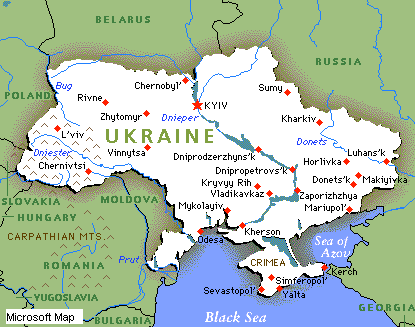 HISTORY:
Formed from Russian Empire gubernias of Podolia, Volhynia,
Kiev, Poltava, Chernigov, Kharkov, Kherson, Taurida and
Ekaterinoslav; and eastern half of the Austrian Empire
province of Galicia.
Parts were in Poland between the wars (Polish inter-war provinces
of Wolyn, Tarnopol, Lwów and Stanisławów).
RECORD-KEEPING:
See under "RUSSIAN EMPIRE".
ARCHIVES:
Tsentral'nyi derzhavnyi istorychnyi arkhiv Ukraïny;
(Central State Historical Archives of Ukraine);
u. Solomenskaya 24; 252601 Kiev; UKRAINE.
Tel. (044) 277-3002.
Finding aids are primitive or non-existent. You can use one
of the private record-searching services, or write to the
archives directly. The archives charges $10 per hour;
typical requests are likely to cost $100 each.
BOOKS:
- Jewish Roots in Ukraine and Moldova: Pages from the
Past and Archival Inventories, by Miriam Weiner,
in cooperation with the Ukrainian State Archives and the
Moldovan National Archives, 1999. 624 pages. ($60).
ISBN 0-9656508-1-2. {Contains comprehensive inventories
of Jewish records in Ukrainian and Moldovan archives
and civil registration offices}.
- Some Archival Sources for Ukrainian-Jewish Genealogy,
by Aleksander Kronick and Sallyann Amdur Sack.
(Teaneck, NJ: Avotaynu, Inc., 1997). 96 pp. ($20).
ISBN 0-886223-05-X. {Inventories of records of 300 towns
in 12 archives, mainly Kiev, Lviv, Warsaw and Zhitomir}.
ARTICLES:
- "Sources for Jewish Genealogy in the Ukrainian Archives",
by Dr. Volodymyr Lozytsky, in Avotaynu X:2 (Summer
1994), pp. 9-14. {Overview of types of records available}.
- "The Practicalities of Genealogical Research in the Ukraine",
by Heorgij V. Papakin, in Avotaynu X:4 (Winter 1994),
pp. 3-4.
- "Ukrainian Research and Ancestral Travels", by Susannah R.
Juni, in Avotaynu XIII:4 (Winter 1997), pp. 33-37.
- "Records of Jews in the Vinnitsa Oblast Archives",
by Vadim Altskan, in Avotaynu VII:3 (Fall 1992),
pp. 10-11. {Podolia gubernia. Includes inventory}.
- "Guide to the Jewish Records in the Rovno Oblast State
Archives", by Dmitriy A. Panov, in Avotaynu X:4
(Winter 1994), pp. 5-9. {Volhynia gubernia. Inventory}.
- "Information for Jewish Genealogists in the State Archive of
Zhitomir Oblast", by Efim Melamed, in Avotaynu XII:1
(Spring 1996), pp. 14-18. {Volhynia gubernia}.
- "Report on Ukrainian and Latvian Archives", by Anton Vadim,
in Avotaynu IX:3 (Fall 1993), pp. 8-9. {Kharkov,
Poltava, Chernigov oblast archives}.
- "Canadian Archivists Visit Ukrainian Archives", and
"Report on a Recent Trip to Ukrainian Archives",
by George Bolotenko and Lawrence Tapper, in Avotaynu
IX:4 (Winter 1993), pp. 9-10; and X:1 (Spring 1994),
pp. 3-9. {L'viv, Chernivtsi, Kamianets-Podilsk archives}.
- "Jewish Genealogical Research in Ukraine", by Vlad Soshnikov,
in Avotaynu, XVI:3 (Fall 2000), pp. 23-26.
LDS MICROFILMS:
Microfilming began in 1994. Projects in progress in Kiyev
and L'viv. Jewish vital records from Crimea filmed in
Simferopol in 1995-96: Bakchisaray, Feodosiya, Karasubazar,
Kerch, Melitopol, Perekop, Simferopol, Yalta, Yevpatoriya.
Filmed in Cherkasy in 1996-97: Mokraya-Kaligorka, Olshana,
Shpola, Zvenigorodka (Zvenigorodka district).
Filmed in Ternopil in 1997: Kremenets (Volhynia).
Filmed in Chernigov in 1997-98: Berezna, Chernigov, Gorodnya,
Kozelets, Nizhyn.
SPECIAL INTEREST GROUPS (SIGs):
PROVINCES AND REGIONS:
Definitions:
-
Gubernia (Russian:
губерния) =
province of the Russian Empire.
There were 60 gubernias in 1914, including 15 in the Pale
of Settlement and 10 in the Kingdom of Poland.
Each gubernia was divided into several districts, called
uyezds (уезды).
-
Pale of Settlement
(Russian: Черта
оседлости
Cherta osedlosti,
Yiddish: דער
תּחום-המושבֿ
der tkhum-ha-moyshv) =
The 15 gubernias on the western edge of the Russian Empire,
to which Jewish residence was restricted, 1794 to 1917.
-
Bessarabia (Rus.
Бессарабия
Bessarabiya, Rom. Basarabia, Yid.
באַסאַראַביע
Basarabye)
—
- Region bordered by the Black Sea, Dniester, Danube
and Prut rivers. In Ottoman Empire until 1812.
Russian gubernia after 1873, in Pale.
In Russian Empire 1812-1856, 1878-1918;
Part of Romania 1856-1878, 1918-1940;
In USSR (Moldavian SSR) 1940-1991.
Today, mostly in Moldova (southernmost and northernmost parts in Ukraine).
Chief city: Kishinev (Rom. Chişinău).
- Bohemia
(Ger. Böhmen, Czech. Čechy) —
- Province of Austrian Empire until WWI.
Province of Czechoslovakia 1918-1992.
Today, in westernmost Czech Republic.
Chief city: Prague (Cz. Praha).
-
Bukovina
(Rom. Bucovina, Ger. Buchenland,
Ukr. Буковина,
Yid. בוקעווינע
Bukevina) —
- Region in foothills of eastern Carpathian mountains.
Ruled by Ottoman Turks until 1769, when occupied by Russia.
Taken by Austria in 1775, it formed part of Galicia until 1849,
when it became a separate province of the Austro-Hungarian Empire,
until the end of WWI.
Province of Romania 1917-1944. After WWII, northern
area became part of USSR, southern area in Romania.
Today, in northeastern Romania and southwestern Ukraine.
Chief city: Chernivtsi (Ger. Czernowitz,
Rus. Chernovtsy, Rom. Cernăuţi).
-
Chernigov (Rus.
Чернигов,
Ukr. Чернігів
Chernihiv, Yid.
טשערניִעוו
Tsherniev) —
- Russian gubernia, 1796-1917, in Pale of Settlement.
Today, mostly in northern Ukraine; its four northernmost
uyezds now in western Bryansk Oblast, Russia.
- Congress Poland = Kingdom of Poland.
- Courland
(Ger. Kurland, Rus.
Курляндия
Kurliandiya,
Latv. Kurzeme) —
- Russian gubernia, 1795-1917.
In the Pale from 1799 until 1829, outside of the Pale 1829-1917.
In Latvia 1918-1940, in USSR until 1989.
Today, southern Latvia.
Capital: Mitava (Ger. Mitau, Latv. Jelgava).
- Crimea (Rus. Крым Krym)
—
- Peninsula and oblast in southeast Ukraine,
southern part of Taurida gubernia.
Capital: Simferopol.
- Czechoslovakia
(Cz. Československo) —
- Nation formed in 1918 from parts of Austro-Hungary
(Czech-speaking Bohemia and Moravia from Austria,
and Slovak-speaking northern counties of Hungary).
Split into Slovakia and Czech Republic in 1991.
- Dobruja
(Rom. Dobrogea,
Bulg. Добруджа
Dobrudzha) —
- Region on the Black Sea, south of the Danube.
Today, SE Romania and NE Bulgaria.
- Ekaterinoslav (Rus.
Екатеринослав,
Yid.
קאַטערינאָסלאַוו
Katerinoslav)
—
- Russian gubernia, 1802-1917, in Pale.
Today, in eastern Ukraine.
(Capital city was renamed to Dnipropetrovsk
Дніпропетровськ
in 1926).
- Estland
(Rus. Эстляндия
Estlandia, Est. Eesti,
Yid. עסטלאַנד
Estland) —
- Russian gubernia, 1795-1917, outside of Pale.
In Estonia 1918-1940, in USSR until 1989.
Today, in northern Estonia.
Capital: Tallinn (Rus. Revel, Ger. Reval).
- Galicia
(Ger. Galizien, Pol. Galicja,
Ukr. Галичина
Halychyna, Yid. גאליציע
Galitsiye) —
- Province of Austro-Hungarian Empire 1772 until 1917.
Belonged to Poland between the two world wars (Polish
interwar provinces of Kraków, Lwów,
Tarnopol and Stanisławów).
The latter three became part of Ukrainian SSR in 1945.
Today, in southeastern Poland and western Ukraine.
- Grodno
(Belr. Гродна Hrodna,
Rus. Гродно Grodno,
Yid. גראָדנע Grodne)
—
- Russian gubernia, 1802-1917, in Pale.
In Poland between the two world wars (parts of Polish
interwar provinces of Wilno, Nowogródek, Polesie
and Białystok). The eastern 2/3rds became part of the
Belorussian SSR in 1939, Białystok area remained in Poland.
Today, western Belarus, some northeastern Poland.
- Kalisz
(Rus. Калиш Kalish,
Yid. קאַליש Kalish)
—
- Gubernia of Russian Poland, 1867-1917.
Today, west-central Poland.
- Kherson
(Rus. and Ukr.
Херсон Kherson,
Yid. כערסאָן
Kherson) —
- Russian gubernia, 1803-1917, in Pale.
Today, south-central Ukraine.
Chief city: Odessa.
- Kielce
(Rus. Кельце Kiel'tse,
Yid. קעלץ Keltz)
—
- Gubernia of Russian Poland, 1867-1917.
Today, south-central Poland.
- Kiev
(Rus. Киев,
Ukr. Киïв Kyyiv,
Yid. קיִעװ Kyiev)
—
- Russian gubernia, in Pale.
Today, central Ukraine.
- Kingdom of Poland
(Pol. Królestwo Polskie,
Rus. Царство
Польское)
—
- Congress Poland = "Russian Poland"
(Pol. Królestwo Kongresowe, Kongresówka)
part of Poland occupied by the Russian Empire, 1815-1918.
The 10 gubernias (1867-1917):
Suwałki, Łomża, Płock, Warszawa, Siedlce, Lublin,
Radom, Kielce, Piotrków and Kalisz.
Today, all in east-central Poland (except northern Suwałki,
which is in SW Lithuania).
- Kovno
(Rus. Ковно,
Yid. קאָװנע Kovne)
—
- Russian gubernia, 1842-1917, in Pale.
Formed from Vilna gubernia in 1842.
Part of independent Lithuania, 1920-1940.
Belonged to Lithuanian SSR 1944-1991.
Today, northern Lithuania.
Chief city: Kaunas.
- Livonia
(Ger. Livland, Latv. Vidzeme,
Rus. Лифляндия
Lifliandia)
—
- Russian gubernia, 1796-1918, outside Pale.
Today, northern Latvia, southern Estonia.
Capital: Rīga.
- Łomża
(Rus. Ломжа Lomzha,
Yid. לאָמזשע Lomzshe)
—
- Gubernia of Russian Poland, 1867-1917.
Today, northeastern Poland.
- Lublin
(Rus. Люблин Liublin,
Yid. לובלין)
—
- Gubernia of Russian Poland, 1844-1917.
Today, southeastern Poland.
- Máramaros
(Rom. Maramureş,
Ukr. Мармарощина
Marmaroshchyna,
Yid. מאַרמעראָש
Marmarosh)
—
- Region in the NE Carpathian Mountains.
A county (megye) of the Austro-Hungarian Empire until 1917
(Capital: Mįramarossziget).
After WWI (via the 1920 Treaty of Trianon), the northern part of
Máramaros became the easternmost province of the newly-formed
Czechoslovakia (Podkarpatskį Rus), and the southern part
became part of Romania (Județul Maramureș).
After WWII, the formerly Czechoslovak part of Máramaros
became part of the Soviet Union.
Today, the region is split (by the Tisza River) between Romania and Ukraine —
the southern half is in Județul Maramureș
(Maramureș County) of NW Romania, and
the northern half is in eastern Zakarpattia oblast
(Закарпатська
область =
Sub-Carpathian Province) of SW Ukraine.
- Memel
(Lith. Klaipėda,
Yid. מעמל Meml)
—
- Northeasternmost area of East Prussia, on Baltic coast,
which became part of Lithuania in 1923.
- Minsk
(Belr. Мінск,
Rus. Минск,
Yid. מינסק)
—
- Russian gubernia, 1795-1917, in Pale.
Today, south-central Belarus.
- Mogilev
(Belr. Магілёў Mahilyow,
Rus. Могилёв,
Yid. מאָליעוו
Moliev)
—
- Russian gubernia, 1802-1917, in Pale.
Today, in eastern Belarus, with small NE portion now in Smolensk Oblast, Russia.
- Moldavia
(Yid. מאָלדעווע)
—
- Former principality under Turkish domination,
which included Bessarabia and Bukovina.
Moldavia and Wallachia merged to form Romania in 1859.
Republic of USSR 1924-1991.
Today, in northeastern Romania and Moldova.
Chief city: Kishinev (Rom. Chişinău).
- Moravia
(Ger. Mähren, Czech. Morava,
Yid. מעהרן Mehrn)
—
- Province of Austrian Empire until WWI.
In central Czechoslovakia 1918-1992.
Today, in eastern Czech Republic.
Chief city: Brno (Ger. Brünn).
- Piotrków
(Rus. Петроковъ
Petrokov, Yid.
פּיעטריקאָוו
Pietrikov)
—
- Gubernia of Russian Poland, 1867-1917.
Today, south-central Poland.
- Płock
(Rus. Плоцк Plotzk,
Yid. פּלאָצק Plotzk)
—
- Gubernia of Russian Poland, 1844-1917.
Today, north-central Poland.
- Podolia
(Rus. Подолье
Podol'ye, Ukr.
Поділля
Podillia, Yid.
פּאָדאָליע
Podolye)
—
- Russian gubernia, 1796-1917, in Pale.
Today, southwestern Ukraine.
Capital: Kamenetz-Podolsk (Ukr. Kamyanets-Podilskyy).
- Polesie —
- a large region of southern Belarus, including parts
of Minsk, Grodno, Mogilev, Kiev and Volhynia gubernias.
A province of Poland between the wars (center: Pińsk).
- Poltava
(Rus. & Ukr. Полтава,
Yid. פּאָלטאַווע)
—
- Russian gubernia, 1802-1917, in Pale.
Today, eastern Ukraine.
- Pomerania
(Ger. Pommern,
Pol. Pomorze)
—
- Province of Prussia since 1815, on Baltic Sea.
Formerly in Germany; since WWII, mostly in northwest Poland.
Principal city: Gdańsk (Ger. Danzig).
- Posen
(Pol. Poznań,
Yid. פויזן Poyzn)
—
- Region now in western Poland.
Ruled by Prussia 1793-1807, and 1815 until WWI.
Grand Duchy of Posen (1815-1850), part of Prussia.
Polish province of Poznań after 1919.
- Prussia
(Ger. Preußen) —
- Former kingdom (1701-1871), largest state in German
Empire (1871-1918).
After WWI, parts of West Prussia ceded to Poland.
After WWII, remainder of West Prussia to Poland;
East Prussia divided: northern half to USSR
(Kaliningrad oblast, now Russia), southern half to Poland.
- Radom
(Rus. Радом,
Yid. ראָדעם)
—
- Gubernia of Russian Poland, 1844-1917.
Today, south-central Poland.
- Russian Poland = Kingdom of Poland
- Ruthenia (Subcarpathian Rus) —
- Region south of the Carpathian mountains.
Part of Hungary before WWI and 1939-1945;
easternmost province of Czechoslovakia 1918-1938
(Podkarpatskį Rus).
To USSR in 1945.
Today, in SW Ukraine (Zakarpatska Oblast =
Закарпатська
область).
Also, Ruthenia is another word for Ukraine.
- Saxony
(Ger. Sachsen,
Yid. סאַקסאניע
Saksonye)
—
- Former kingdom, today a state in the east-central mountain
region of Germany.
Principal cities: Leipzig, Dresden.
- Siedlce
(Rus. Седлец Sedletz,
Yid. שעדליץ Shedlitz)
—
- Gubernia of Russian Poland, 1867-1917.
Today, east-central Poland.
- Silesia
(Ger. Schlesien, Pol. Śląsk,
Czech. Slezsko, Yid.
שלעזיע Shlezye)
—
- Region in valley of the upper Oder bordering on Sudeten mountains.
Ruled by Austrian Empire until 1742, when most of it annexed by Prussia.
After WWII, ceded to Poland.
Today, in southwestern Poland and some in northern Czech
Republic (North Moravia).
Principal city: Wrocław (Ger. Breslau).
- Suwałki
(Rus. Сувалки Suvalki,
Yid. סוּוואַלק
Suvalk, Lith. Suvalkai)
—
- Gubernia of Russian Poland, 1867-1917.
After WWI northern half in Lithuania, southern half in Poland.
Today, northeastern Poland, southwest Lithuania.
- Taurida (Tavrida) —
- Russian gubernia, 1802-1917, in Pale.
Today, southeastern Ukraine. Capital: Simferopol.
- Transnistria
(Rus.
Транснистрия,
Yid.
טראַנסניסטריע)
—
- Region bounded by the Dniester and Southern Bug Rivers –
“land beyond the Dniester River”.
Pre-WWI: Southern Podolia and western Kherson gubernias.
Part of Romania 1941-1944.
Today, southwestern Ukraine and eastern Moldova.
Principal cities: Bershad, Odessa.
- Transylvania
(Rom. Ardeal, Hung. Erdély,
Ger. Siebenbürgen, Yid.
זיבנבערגן
Zibnbergen)
—
- Region bounded by Carpathians and Transylvanian Alps.
Under Austrian rule since 1765, province of
Austro-Hungarian Empire 1867-1918.
Became part of Romania following WWI.
Today, in western Romania.
Chief city: Cluj-Napoca (Ger. Klausenburg,
Hung. Kolozsvár).
- Upper Silesia
(Pol. Górny Śląsk,
Ger. Oberschlesien,
Czech. Hornķ Slezsko)
—
- The southeastern part of Silesia, the highlands between the
upper Oder and upper Vistula Rivers.
In southwestern Poland and northern Czech Republic.
Major cities:
Katowice, Poland (Ger. Kattowitz, Czech. Katovice),
Ostrava, Czech Rep. (Ger. Mährisch-Ostrau, Pol. Morawska Ostrawa),
Bytom, Poland (Ger. Beuthen).
- Vilna
(Rus. Вильна,
Yid. ווילנע Vilne,
Lith. Vilnius, Pol. Wilno)
—
- Russian gubernia, 1802-1917, in Pale.
Polish province of Wilno between the wars
(1919-1939). Today, southeastern Lithuania and
northwest Belarus. Capital: Vilnius.
- Vitebsk
(Belr. Віцебск
Vitsyebsk,
Rus. Витебск
Vitebsk,
Yid. וויטעבסק
Vitebsk, Pol. Witebsk)
—
- Russian gubernia, 1802-1917, in Pale of Settlement.
Today, southeastern Latvia, northeastern Belarus;
some northeastern parts now in Russia.
- Volhynia
(Rus. Волынь Volyn',
Ukr. Волинь Volyn',
Pol. Wołyń,
Yid. װאָהלין
Vohlin)
—
- Russian gubernia, until 1917, in Pale.
Between the wars, the western half became the Polish province of
Wołyń (Województwo Wołyńskie),
and the eastern areas became a part of Zhytomyr Oblast
(Житомирська
область) of the Ukrainian S.S.R.
Today, northwestern Ukraine.
Chief city: Zhytomyr (Rus. Zhitomer);
Inter-war capital: Łuck (Ukr. Luts'k).
- Wallachia
(Rom. Valahia or Țara Românească,
Turk. Eflâk, Yid.
וואָלעכײַ
Vulekhay)
—
- Region between Transylvanian Alps (Southern Carpathians) and the Danube.
Former principality under Ottoman Turkish domination.
Wallachia and Moldavia merged to form Romania in 1859.
Today, in southern Romania, containing the regions of Muntenia
(Greater Wallachia) and Oltenia (Lesser Wallachia).
Chief city: Bucharest (Rom. Bucureşti).
- Warszawa
(Rus. Варшава Varshava,
Yid. ווארשע Varshe,
Eng. Warsaw)
—
- Gubernia of Russian Poland, 1844-1917.
Today, central Poland.
- White Russia
(Belr. Белая Русь
Belaya Rus, Pol. Białoruś,
Ger. Weißrussland) —
- The eastern part of Belarus.
Also called Byelorussia or White Ruthenia.
- Zagłębie
(Zaglembia,
Zagłębie Śląsko-Dąbrowskie,
Zagłębie Górnośląskie) —
- Industrial region centered around Dąbrowa Górnicza,
southern Poland, northeast of Silesia.
Major towns are Będzin, Katowice, Sosnowiec and Zawiercie.
Part of Congress Poland (southern Piotrków gubernia) before WWI;
in Poland (southwestern Kielce województwa) between the wars.
Suggestions, additions and corrections to this document are
encouraged.
Copyright ©1994, 2013 Warren Blatt.
All Rights Reserved.
|